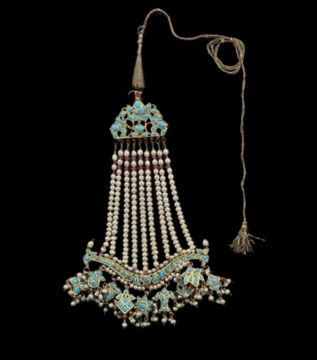
Marjiana, the Pearl of Hormuz

by Shadab Zeest Hashmi

Having never left town, Marjiana is an oyster, a watchful oyster, though her name means “small pearl.” She has read countless books to Ali Baba, books about lands and seas, their fruits and snakes, gems and poisons, and the skies and their mysteries. While Ali Baba dreams, Marjiana watches the world turn, quietly studying the monsters as she balances on the beam between night and day.

Lately, the veils hanging between worlds have thinned, they billow, they flutter. She hears the whispers inside the whispers: schemes, directives, protests, pleadings, prayers, rapid-fire data, lullabies. Her heart is pierced once every 9 minutes when a child is murdered and the cries of the mother pass through her body.  She feels the tonnage of bombs shaking the earth with the same force as the soundless gasps under the rubble.

A savage thirst for oil, a hunger for petrodollars have subsumed the world, and Hormuz, once home to the largest harvest of pearls, is now a slice of fortune where land meets water and ships must pass for oil. Marjiana of coral cheeks and sleepless eyes, Marjiana, woman who stays awake in guard, lays a net where every kind of slaughter is recorded, and every sleeve hiding a weapon becomes transparent. She glides by escalators descending to the pit where the aria of money rises and there are luxe suits turning blood to cash. When she lifts her lamp, the suited ones slink away.

Tonight, Marjiana is walking by forty canisters of oil lined up in the cellar. In the quivering light, she is suddenly realizing the past has come to meet the future. Her foot is on the threshold. The lamp in her hand, a thing of beauty by which the night becomes a boat shimmering in ink– will not last this night. Her house is full of thieves. Gently she will take as much oil needed to refill her lamp and pour the rest on the greed of 39 thieves. The 40th one, the leader of the thieves will meet his end with the sword that belongs to her master who is so full of sleep he cannot see enemies that come as friends.

Tomorrow the lamp will need to be filled, tomorrow a small pearl will have saved the sea and land.

***

Monday, July 23, 2012

Burmese Days

by Maniza Naqvi

“… How does our affair progress? I hope that, as dear Mr. Macgregor would say—U Po Kyin broke into English—eet ees making perceptible progress?”

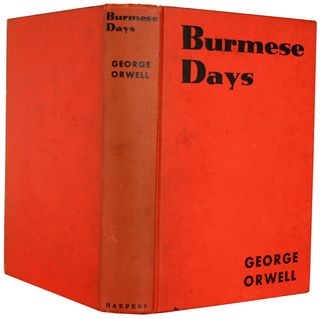
Burmese-Days-3Burmese Days by George Orwell remains relentlessly relevant and a touchstone for cynics eight decades after it was written. The novel opens with U Po Kyin at age 56 thinking of his achievements with satisfaction—and plotting intrigue to further his interests. He thinks back to his first memory of the British troops with their weapons entering victoriously into Mandalay in 1885. “To fight on the side of the British, to become a parasite upon them, had been his ruling ambition even as a child. He does this by playing one side against the other, planting intrigues and solving them, always putting himself in the position of the problem solver, the loyalist to all—taking bribes and ruthlessly controlling everyone.” U Po Kyin's memory of British troops marching into town is set in the moment in which the oil company Burmah Oil is born in 1886 and when Burma became a province of Imperial India. (here, and here and here.)

George Orwell was in Burma in the Indian Imperial Police from 1922-1927 Eric Arthur Blair or George Orwell was born in India, on June 3, 1903 in Motihari Bihar (here). Orwell’s novel follows the trajectories of the ambitions and the psyches of Imperial administrators, their military officers, wives, concubines, their merchants and those who served them. The title of “U” has been bestowed on U Po Kyin for his services enroute his own trajectory from a lowly clerk to a minor official to a Sub divisional magistrate, through planting seditious activities and creating rebellions and quelling them himself so that he can demonstrate his loyalties to the Imperial masters by jailing adversaries while havig his fingers in every pot in his subdivision for personal gain and pleasure.

His good works of building Pagodas will ensure his next life. But in this life his most ardent desire is to be a member of the British Club:

Read more »