
by Mike Bendzela
From preface of Number One last month: Anytime is a good time to take stock of what you think you know, or what you think you have actually learned, but once you have seen two-thirds to three-quarters of your life pass, it would seem rather high time to do so. For all I know, the full measure has actually passed, as I could drop dead tomorrow while digging a grave at my summer job, so I had better hurry with this. [. . .] What would I say if, launched into the firmament and finding myself at Heaven’s Gate, St. Peter said to me, “What have you learned, sinner?” So, a few things I think I actually do know, in descending order of certitude, over the course of three articles: evolution, overshoot, determinism.
The human species likely exists in a state of ecological overshoot. The question is, how much longer can we exist in such a state? Can we prop up our behemoth of an existence for much longer?
That “apparently” in the title has to do a lot of work: I cannot actually say that I know this is true, the way I can say that evolution is true, but it sure looks that way to me (and I must thank sociologist William Catton and human ecologist Bill Rees for their work and insight).
In some ways the two ideas pull in opposite directions. The certainty of evolution is apparent in the abundance of Earth’s archives of evidence, which consists of traces of evolution’s past meanderings over a billion years, sussed out through 200 years or so of hard scientific labor. Overshoot, on the other hand, is about the weight of the present human “ecological footprint” and its bearing on an uncertain future. But they both have in common the idea of the inevitability of mass die-0ffs.
Is it possible for an issue or problem to be so large as to be invisible? I’ve already expressed how evolution by natural selection lay unseen all throughout human history until about 170 years ago, even though it is responsible for all life on the planet. Darwin states succinctly that it is the “laws existing around us” that have brought forth, well, everything. But we were blind to this for two chief reasons:
The mind cannot possibly grasp the full meaning of the term of even a million years; it cannot add up and perceive the full effects of many slight variations, accumulated during an almost infinite number of generations.
We will tend to notice the immediate effects of a condition even while being blind to it as the ultimate cause. A patient experiences chronic numbness in the legs and goes into treatment for neuropathy. Later, the patient experiences loss of vision and seeks treatment for retinopathy. There was a time when the chief cause of these signs, Type 1 diabetes, was unknown. The patient had been treating symptoms all along, not the disease.
Currently, we are obsessed with “solving” a plethora of “problems”: climate change, ocean acidification, soil erosion and loss of arable land, PFAS and microplastics contamination, resource depletion, etcetera. But these are mere symptoms of a larger, untreated disease. “Oh,” you may be thinking, “you’re talking about that old canard, overpopulation.” No, I’ve learned that the number of humans on the planet is secondary to the issue of the means by which we have deployed ourselves across the planet. The whole massive, sprawling, energy-sucking apparatus of our modern civilization simply overwhelms Earth’s native capacity to provide sustenance and space, and to sequester away our waste products. This is the essence of overshoot, and you never hear about it in the news.
Thus, we have a predicament, not a problem (in Bill Rees’s words) that is all but invisible to us. Yet it threatens the very substrate of our modern existence. All the rest — politics, economics, finance, technology — is noise.
*
Given that we are animals, we are surely governed by the same natural laws as other species. All creatures exist within an environment — a niche — and a creature necessarily alters that environment through its processes of living, eating, excreting, reproducing. Over time other creatures may find that altered environment suitable and move in and take over in a process called succession. Every farmer must fight that process. Here on the farm in Maine, if we don’t mow our fields regularly, the grasses, clovers and other low-lying herbs give way weedy perennials, then to woody perennials and brushy shrubs. In as little as five years, we’ll be battling alder thickets, poplar saplings and little pine trees. The hay fields “want” to become a natural woodland.
Modern humans’ very existence means stomping out that process of succession to keep our agricultural system going. We have broken out of our native niche on the plains of East Africa and have introduced our own, novel process of succession: Interrupt natural succession with diesel-powered equipment to keep the land ready for annual crops; then, when population pressures inevitably increase, bring in more equipment to strip off the soil, bring in gravel and fill, build roads, install septic systems, and erect buildings, thus permanently altering the landscape to suit ourselves. Human-caused succession is a sterilizing process. We take over nature and banish its balancing processes, reducing it to a mere landscape and waste dump.
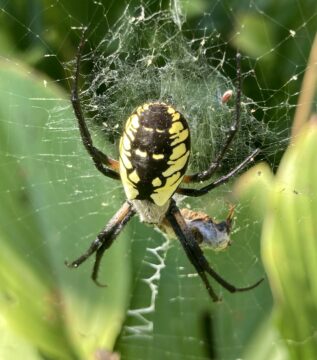
Here’s a disturbing observation, and I wonder if it reveals the hand I have in overshoot: While mowing the fields this year, I did not see a single instance of the gorgeous Argiope spider. Usually, these creatures build their perfect orb webs between tall goldenrod plants, and on dewy mornings the fields look festooned with them. To maintain an easement provided through the Maine Farmland Trust to our landlords and earn the designation “Forever Farm,” we have to keep the land arable. That means I have to mow down the surrounding fields every summer, along with the spiders and everything else that lives there, of course. Often, I will observe the spiders’ black-and-yellow bodies stuck in the radiator grille. But not this year.
I wonder if these spiders’ disappearance means I’ve “mowed them out.” But then, we haven’t seen hardly any arthropod life this year. There were no Colorado potato beetles or cabbage moths in the garden, no mosquitos to speak of, and very few moths and flies (but plenty of ticks in the spring). This is in keeping with reports I’ve heard indicating insect life has decreased by double-digit percentages over the decades worldwide. This may be overshoot in action, and I could be witnessing my part in it. But if I don’t mow, we will end up with woodlots here and lose the agricultural easement. There are no innocent bystanders at this stage.
*
In step with our tendency to think We’re Special, we believe we can keep outwitting nature, as we have been doing for some time now. From the onset of the Holocene (that is, from the end of the last glacial period) human endeavor has involved freeing ourselves from the shackles of the “natural checks” Darwin discussed: famine, disease, predation, early death, etc. We’ve managed to postpone and even eliminate many of these checks.
To study how the system works, humans have invented a “dismal science” (one of several) called economics; and damned if I can figure out how it works, but from where I sit it looks like the Art of Kicking Cans Down the Road, and we’ve been doing it in fits and starts, but in spades, for millennia now. It works like this: Human curiosity and “innovation” lead whole populations into terrible binds, which usually involve some scarcity; so, we humans have learned to take from elsewhere. This has allowed our species to grow itself out of these binds by either moving somewhere else, taking over other continents, or by finding new ways of exploiting “resources”, which ultimately means cracking open the earth’s crust like some vast oyster.
Enter sheer speculation: I suspect the path toward overshoot actually began about 2 million years ago, when our species’ ancestors, Homo erectus, acquired a trifecta of super-adaptive traits: Language, control of fire, and stone hand axes. Mainstream science tells us that language didn’t arise until about 350,000 years ago. I’m telling you that language must have at least begun with the hand axe and fire control, for how the hell did erectus hand down knowledge of these innovations without the use of the first tool, language? You need tools to make tools, and for the Acheulean hand axe you need not just other, specific kinds of stones and antlers to use as hammers, you need to communicate this know-how sufficiently enough for it to be handed down for almost 2 million years! This involved exapting lips, tongue, and larynx — and even hands for gestures — for the purposes of some sort of linguistic communication. It may not have been epic poetry, but it was enough to bootstrap our genus through the first 90% of its existence.
I watched a lecture (see Notes) in which a distinguished paleoanthropologist dismisses the erectus tool kit as “unremarkable,” “merely functional,” not possibly indicative of “symbolic thought” (i. e. language). And yet in another lecture an experimental anthropologist, someone who actually reconstructs past methods, shows how these tools were made, and he emphasizes that it takes graduate students two years to learn the techniques to fabricate a proper Acheulean hand axe. And this happens within an environment saturated with language, the university. This shows the utter implausibility of the idea that Homo erectus could thrive for 1.5 million years, passing on knowledge of toolmaking and control of fire all the while, without some form of symbolic communication.
An Acheulean hand axe is not a mere stone. It is a tool, and a tool is someone’s idea, an idea that needs to be conveyed to others.
This is a roundabout way of saying the road to overshoot was paved by our wicked clever ancestors, who began using tools, language, and fire to wrench the environment to do their bidding. With advanced group hunting and cooking skills, made possible by hand axes, verbal direction, and cooking fires, Homo followed the migrating herds of favored feed animals right out of Africa, in several successive waves, all the way to Asia, Southeast Asia, Siberia. As the genus diversified into more modern forms — heidelbergensis, neanderthalensis, and sapiens — Homo made it eventually to the Indonesian islands and even the rest of the world.
Give them a few hundred thousand years, and humans extinguish megafauna, interrupt the natural succession of habitats to establish cereal farms, continue growing in numbers and spreading to new continents, each new scarcity leading to a newer place or innovation.
Thus advances the archetypal invasive species.
*
One of the more intractable cul-de-sacs we found ourselves in as a species began to be felt in the late 19th century, as new, arable farmland began to run out along with viable sources of fertilizer, such as guano and animal manures. This was noticed by Sir William Crookes, whose warnings given during a speech he delivered in 1898 (described beautifully in Thomas Hager’s book, The Alchemy of Air) function as a near-parable of the human propensity to kick cans far down the road. Crookes warned of mass starvation unless some way was found to chemically synthesize fixed nitrogen, a chief input for staple crops such as wheat and rice. Our agricultural system had finally overwhelmed the natural nitrogen cycle — we were taking up more from the soil than nature could replenish — and the results could be catastrophic. Thus began a mad-dash to solve the difficult project of breaking apart atmospheric nitrogen (N2) and combining one of the atoms with three hydrogen atoms to form a molecule of ammonia — the basis of fertilizer.
Undaunted by repeated failed attempts, a German-Jewish chemist, Fritz Haber, finally “solved” the problem, using temperature, pressure, and a catalyst to fix atmospheric nitrogen in 1908. Once Haber was teamed with industrial chemist Carl Bosch, the Haber-Bosch process was born, and soon synthetic fertilizers would become a staple of modern agriculture. I have put “solved” in quotation marks because not only did excess nitrogen begin polluting waterways, but synthetizing fertilizer also binds humanity, like the maiden on the railroad tracks, to an even greater predicament, the finite nature of the fossil fuels. To make the ammonia, Haber harvested all the hydrogen he needed from methane molecules — “abundant” in the form of natural gas — fairly punting the can down the road a mile. But this dependence on depleting natural gas reserves means the Haber-Bosch solution to agricultural sustainability cannot go on forever. The whole episode is a fable that deserves as a moral the famous quip from American journalist Eric Severeid: “The real cause of problems is solutions”! Catton memorably calls it “the tragic story of human success.”
Thus begins the chapter on humanity’s utter dependence on a depleting supply of fossilized solar energy. It’s a dependency that will increase by orders of magnitude throughout the twentieth century, typifying what Catton has termed “drawdown,” the depletion of a fundamental resource to maintain and grow a population. Humanity grows successfully at the expense of everything else.
If we’re generous, we can say the fossil fuel era has lasted two hundred years so far. If we squint hard enough, we can make out that Homo erectus handed down their Acheulean technology for two million years. That means we’ve lived off the bounty of coal, oil and gas for only .0001% of the time erectus was able to survive using hand axes, a vanishingly small time, relatively speaking, a geological eyeblink.
It brings to mind one of Catton’s more haunting quotations:
This fact [dependence on finite resources] puts mankind out on a limb which the activities of modern life are busily sawing off.
A halting, meandering, but direct line leads from our ancestors — who with their fashioned stones and brands of fire foraged continents and hunted down giant herbivores — to us modern humans foraging coal, oil and natural gas in Earth’s crust with the assistance of more advanced “stones” — metals and minerals. We’ve now literally taken over the planet and are well on the way to remaking it in our own image. Somehow, amidst all this success and perhaps because of it, we’ve come to see ourselves as being exempted from the principles of ecology. Such a mistaken impression can only end in catastrophe.
*
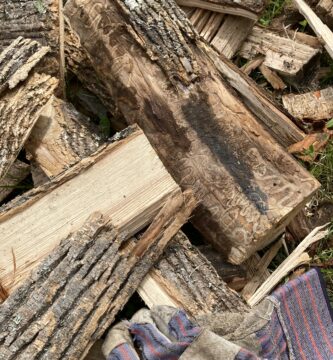
Like the emerald ash borer, we are currently running exuberantly through our resource-rich environment. These insects were transported from Asia to North America, probably in wooden shipping pallets, sometime in the 1990s. It took a while for them to get established, but for over twenty years now they have successfully “invaded” ash trees all throughout the United States and Canada, permanently altering the northern forests, just as Dutch elm disease and chestnut blight did in the previous century. But they cannot help themselves: They didn’t “invade” anything, they were introduced, and they are merely doing what evolution selected them to do — eat, reproduce, and move on to the next tree. Similarly, early species of African Homo didn’t know they were invading “the rest of the world.” They were merely following the food.
Once the ash trees in North America have been “drawn down,” the current abundant emerald ash borer population will decline in numbers. Perhaps new variants will readapt to their new conditions. Perhaps not. Their future is as up in the air as ours is.
I do know, however, that if this beetle could be endowed with the cognitive abilities of an advanced African ape, you can be sure it would find a way to wrench another species of tree to its will to fulfill its appetites. Then it would move on, eating, excreting, and reproducing. Or it would invent a way to artificially grow ash vascular cambium (the delectable inner bark), the feedstock for its larvae, and continue on its campaign for world dominion.
And who could blame them?
***
Notes
Primary source for subject of overshoot, sociologist Dr. William Catton, Jr., Overshoot: The Ecological Basis of Revolutionary Change.
Video of human ecologist Dr. William Rees, originator of the “ecological footprint,” The Fundamental Issue — Overshoot.
Lecture by paleoanthropologist Dr. Ian Tattersall, The Origins of Human Cognition.
Video featuring experimental anthropologist Dr. Dietrich Stout, Stone Age Hand Axe Shaped by Complex Brain.
Book The Alchemy of Air, by Thomas Hager.
Enjoying the content on 3QD? Help keep us going by donating now.