
by Mike Bendzela

Anytime is a good time to take stock of what you think you know, or what you think you have actually learned, but once you have seen two-thirds to three-quarters of your life pass, it would seem rather high time to do so. For all I know, the full measure has actually passed, as I could drop dead tomorrow while digging a grave at my summer job, so I had better hurry with this. The short answer to “What do you actually know now” is “Diddly squat,” but that is relative to all one could possibly know. I do know that saying “I know just about nothing” is a rather worn-out sentiment. In fact, it has been done to death.
Yet it is a sentiment that occurs to me with astonishing frequency and urgency as I dig those holes for cremation urns at the cemetery. There’s little I can do at this late stage to remedy the situation enough to be able to pretend that I actually know something well. What would I say if, launched into the firmament and finding myself at Heaven’s Gate, St. Peter said to me, “What have you learned, sinner?” So, a few things I at least think I actually do know, in descending order of certitude, over the course of three articles about evolution, ecological overshoot, and determinism.
1. We human beings are not just descended from animals, we are animals, full stop; but most of us don’t believe this or don’t think it matters all that much.
If I were to place an estimation of certainty on this one, it would come close to one hundred percent, and I would say this right to St. Peter’s traditional Catholic face. It is even the foundation of the other two lessons I’ve learned. Darwin and Wallace’s idea is the one obsession of mine that I’ve made the effort to sleuth out as much as a lay person can.
As an adjunct instructor of writing, I can take one course per semester at my university, free of charge, which is one of the perks of the job, and over the years I’ve taken seven courses on evolution, four in biology and three in anthropology, some audited, others for a grade. I did pretty well in all (and I was delighted that these professors all required long form, hand-written answers on exams!). I never get sick of learning about the subject the way I’ve gotten sick, for example, of reading novels and contemporary short stories. These are trivial compared to the evolutionary history of our kind, which is why over the years I’ve read more books about evolution than novels. That we are one with the animals is perhaps the bitterest pill our species has had to swallow, and I suspect its implications will never be embraced entirely by a majority of people. Most people, like cats, just spit the pill out.
The lesson can be stated this way: We are fully animal and fully human simultaneously, the way a woodchuck is fully animal and fully rodent simultaneously. This is the result of our being essentially one extended family with the other animals. But this is considered absurd, heresy, even. We are instead created by God, in his Own Image. Our most ancient, fragmentary, hand-copied manuscripts tell us so.
Perhaps the most elegant depiction of our animal heritage comes by way of Richard Dawkins, who asks us to imagine a chain of our direct female ancestors going back in time. You take your mother by the hand (in my case, Barbara), and she takes her mother’s hand (Florence), and she takes her mother’s hand (Eva), and you go back centuries, (to Germany in my case), back millennia (to Africa in everyone’s case) to a reputed “Mitochondrial Eve,” that female whose mitochondrial DNA just happened to have been passed down uninterrupted, ovum by ovum, for a few hundreds of thousands of years, to reside now in every human being on Earth.
Imagine continuing back, say, five million years and beyond, and walking along this line of female progenitors (which would stretch miles). You would begin to notice the distinctly human features fading away to expose the essentially ape features underneath — hairy, tailless, long-legged, long-armed bodies; protruding thumbs for grasping things; relatively large but smaller-than-human skulls for their brains. You would see these hairy female ancestors walking upright along the limbs of trees, carrying children in their arms.
Follow this line of ancestors a few times around the planet (by this time hands have disappeared and you find yourself holding onto a claw) and you would come to small, furry, mammalian ancestors scurrying in the shadows of dinosaurs; and much further back to tetrapod fish that could turn their heads and stump on four limbs in shallow waters. You could head back hundreds of millions of years further, if you had the stamina, to find fluke-like, grandmotherly chordates, and back even further to multicellular progenitors, eventually tracing back to a unicellular replicator in Darwin’s fabled “warm little pond.” It seems absurd to most people, but it’s analogous to tracing back the development of a single human being to the cellular egg in its mother’s ovary.
Isn’t it strange? People have no problem believing that a football player develops from a single cell over a period of nine months, but they can’t handle the idea that all species developed from a single cellular life form alive billions of years ago.
The process that animates this whole earthly panoply of creatures is appalling in its simplicity and therefore embarrassing to our vaunted sense of self-importance. It’s a simple algorithm: Entities make copies of themselves in abundance, no one copy exactly identical to the other, and the conditions of life at the time select the most reproductively successful copies to go on copying themselves while the less successful dwindle out. This guarantees change, locks it into the flow of time, in fact. The great potter’s field of paleontology tells us so.
This process, then, must be the foundation of everything — even the breathtaking paradoxes we find in many species, including our own. There are snakes and whales with pelvic bones, scaled fish that can fly, and feathered birds that cannot fly but can run like hell. But is there any paradox as wondrous as that of the thinking human brain that refuses to accept, even when confronted directly with the evidence, the process of natural selection that created it? Most people find the idea preposterous, even though it’s as obvious as the tooth pattern in our jaws and the configuration of bones in our limbs. Natural selection has brought forth a creature that is not only completely blind to this process but actively denies acknowledging it when it is eventually revealed through centuries of discoveries. Somehow, evolution must account for this brain that resists evolutionary explanations. Of the approximately 80% of Americans who “accept” evolution, over half of those believe it was “guided by God or a higher power.” This means they don’t accept Darwin’s central tenet, natural selection, which means they do not really accept evolution at all. It’s like saying you believe in the laws of physics, but God guides every falling sparrow.
I’ve imagined the impediment in fable form this way:
The Atlantic herring lived shrewdly in schools and indeed never left them. They wavered above their flatfish neighbor, the flounder, and informed him of their newest lesson: “It seems hard to believe, but we are one and the same. Your kind once swam upright like us and had eyes on the right as well as the left side of the head.” Gazing up at these herring, the flounder quipped, “Right and left are myths. The world has two directions—fore and aft—as anyone with eyes can see.”
This impediment is not just evident in religious creationists. It’s apparent in higher intellectual circles as well. In fact, a sophisticated resistance to a complete evolutionary worldview was apparent right from the start. Alfred Russel Wallace, the co-discoverer of natural selection, would only take his and Darwin’s view so far. Wallace thought evolution accounted for everything except the size and complexity of the human brain. Surely some higher power must be involved. He made the common of error of thinking, “I can’t explain how mere natural selection could account for something as wondrous as a brain housing language and human cognition; therefore, it couldn’t have happened that way.” He later converted to spiritualism and embraced the practice of phrenology. Darwin’s shocked response is legendary: “I hope you have not murdered too completely your own & my child.”
Some people find the all-encompassing view of evolution — that the shuffling and sorting of reproducing entities accounts for everything — repulsive. I’ll never forget an anecdote the professor of the biology course I took told our class. A member of his dissertation committee, a very prominent geneticist, apparently, told him that reading Dawkins’ book, The Selfish Gene, made him “a little sick.”
I learned that a prominent paleontologist and a prominent linguist, no fans of slow, bumbling natural selection, both believe that a sudden mutation, a “saltation,” must have occurred about 350,000 years ago, and, poof, there was language. But whom did this mutant person have intercourse with, as it were?
But look: Once upon a time, there were apes around that had no human cognition and no language, OK? Then, somehow, sometime in the past, no one actually knows when, thinking, speaking apes arrived on the scene, and how but by increments, through the natural selection of genetic elements? One doesn’t get to invoke special creation when one becomes incredulous about the cumulative powers of a stupid little directionless insensate algorithm.
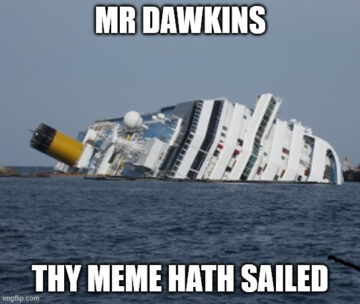
Daniel Dennett evoked the analogy of a “universal acid” to describe the effect of Darwin’s idea: Once the idea is introduced, it dissolves every discipline in its path. Even notions of human exceptionalism and pride. The processes of replication, variation, and selection can operate on different substrates, too, not just on genes, opening the doors of perception to the universal view. Dawkins first proposed we call these replicators “memes.” His meme itself has continued to live on, albeit in mutated form, but many thinkers take a very jaundiced view of his perspective:
Leave it to Darwin to glance ahead to see how this acid dissolves all disciplines. There’s a fabulous passage in The Descent of Man, and Selection in Relation to Sex where Darwin points out all the parallels between the evolution of species and the evolution of languages themselves:
The formation of different languages and of distinct species, and the proofs that both have been developed through a gradual process, are curiously parallel. [. . .] We find in distinct languages striking homologies due to community of descent, and analogies due to a similar process of formation. The manner in which certain letters or sounds change when others change is very like correlated growth. We have in both cases the reduplication of parts, the effects of long-continued use, and so forth. The frequent presence of rudiments, both in languages and in species, is still more remarkable. The letter m in the word am, means I; so that in the expression I am, a superfluous and useless rudiment has been retained. In the spelling also of words, letters often remain as the rudiments of ancient forms of pronunciation. Languages, like organic beings, can be classed in groups under groups; and they can be classed either naturally according to descent, or artificially by other characters. Dominant languages and dialects spread widely, and lead to the gradual extinction of other tongues. A language, like a species, when once extinct, never, as Sir C. Lyell remarks, reappears. [. . .]
Emily Dickinson said she knew she was reading poetry when “I feel physically as if the top of my head were taken off.” That was the feeling I had upon first reading this passage.
From this life-long study I’ve developed a little “heuristic,” which is a fancy way of saying “rule of thumb,” and it’s not even an original one: When confronted with multiple explanations for a phenomenon, the one explanation that is the most humiliating, the most embarrassingly material, the most destructive to “common sense,” is the explanation you should seriously look at because it’s probably true. This idea will rear its homely little head in subsequent essays here.
A final human paradox to consider: Upon meeting another human, we are far less inclined to notice those evolutionary commonalities that bind us as a species and far more inclined to see those flyspecks –“beams in the eye,” if you will — that seem to differentiate us. We don’t immediately see the bilateral symmetry; the tailless, tetrapodal bauplan; the vestigial fur. We are not apt to say, “My, what forward-facing eyes and big brain case you have! What limber arms and opposable thumbs! What slender legs tapered for long-distance running!” No, we are more apt to say, “Why is your skin that color, why do you talk so funny, and what the hell is that you’re eating?!” Leave it to a blind, unthinking algorithm to “design” a creature that is, well, blind and unthinking about basic facts of life.
To this day, people who should know better refer to others whose actions they disapprove of as “animals,” and the other animals standing around listening are not even cognizant enough to shout back, “And what is your point, exactly?”
*
Notes
I’ve grown to dislike the look of hyperlinks in the main text; therefore, I leave questions about sources in your and Google’s hands.
The fable is from the book Metazoan Variations: Evolutionary Fables and Other Emblematic Tales.
Images
Photograph of sky by the author.
Dawkins meme by author, using Meme Generator and the image “Grounded and partially capsized Cruise ship Costa Concordia and the Ocean Crane Barge Meloria – 12 Feb. 2012 – (1)” by Horacio Arevalo is licensed under CC BY-SA 3.0.
Enjoying the content on 3QD? Help keep us going by donating now.