Islands of Safety and Ironic Points of Light

by Mark R. DeLong

1.

A screenshot from My Dinner with André (1981). Two men sit conversing at a table in a fancy restaurant. We see the balding head of Wally (Wallace Shawn) from the back and the face of Andr´(André Gregory). André is holding his hand up to emphasize a point of discussion.
Screenshot from My Dinner with André (1981).

Roger Ebert labeled it the one movie “entirely devoid of clichés.” “It should be unwatchable,” he said, “and yet those who love it return time and again, enchanted.” It was My Dinner with André, which I watched with my wife and a couple of friends at the Carolina Theatre in Durham, North Carolina, back in 1981 when the movie was released. Years later, I picked up a used VHS of the film and baffled my children with it.

One scene struck me from the first viewing, and my memory has returned to it especially in recent months. Toward the end of their dinner, Wally (Wallace Shawn) and André (André Gregory) discuss matters of preserving culture—or perhaps, more accurately, André steers the conversation through his wild and impossible adventures in new age-y communities, recounting events that would defy the laws of physics or at least stretch our imaginations.1For instance, a community, “Findhorn,” that built “a hall of meditation” seating hundreds of people with a “roof that would stay on the building and yet at the same time be able to fly up at night to meet the flying saucers.” Findhorn actually exists, though the architecture that André describes was fanciful, to say the least. The fascination with flying saucers was real, though, in the 1960s, when a leader of the Findhorn community felt that extraterrestrials could be contacted via telepathy and the community built a landing strip for the saucers.

One of the leaders of such a group, André says, was “Gustav Björnstrand”—a fictional character, not a real “Swedish physicist” as André claims—who is trying to create

a new kind of school or a new kind of monastery … islands of safety where history can be remembered and the human being can continue to function, in order to maintain the species through a Dark Age. In other words, we’re talking about an underground, which did exist during the Dark Ages in a different way, among the mystical orders of the church. And the purpose of this underground is to find out how to preserve the light, life, the culture. How to keep things living.

Wally listens, entranced but not convinced that André’s unhinged stories make sense. He’s “just trying to survive,” he says, and takes pleasure in small comforts: dinner with his girlfriend, reading Charlton Heston’s autobiography, sleeping under a warm electric blanket on cold New York nights. “Even if I did feel the way you do—you know, that there’s no possibility for happiness now,” an exasperated Wally replies to André, “then, frankly, I still couldn’t accept the idea that the way to make life wonderful would be to totally reject Western civilization and to fall back to a kind of belief in some kind of weird something.” Read more »

Footnotes

  • 1
    For instance, a community, “Findhorn,” that built “a hall of meditation” seating hundreds of people with a “roof that would stay on the building and yet at the same time be able to fly up at night to meet the flying saucers.” Findhorn actually exists, though the architecture that André describes was fanciful, to say the least. The fascination with flying saucers was real, though, in the 1960s, when a leader of the Findhorn community felt that extraterrestrials could be contacted via telepathy and the community built a landing strip for the saucers.

Wednesday, March 26, 2025

Things May Appear Bleak, And Yet…

by Marie Snyder

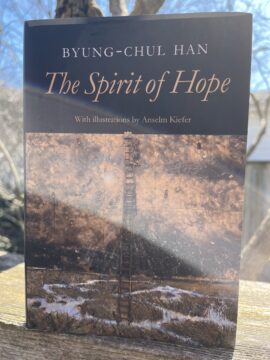
Byung-Chul Han’s The Spirit of Hope is a beautiful book, the kind you want to treat with care and won’t dare dog-ear a page. Anselm Kiefer’s illustrations throughout provide a place for contemplative moments between ideas. It’s more immediately accessible than The Burnout Society, which took me weeks to wrap my head around, yet no less profound. 

A REVOLUTIONARY POLITICS OF HOPE

Book cover of Byung-Chul Hans' The Spirit of Hope

We like a secure illusion of control over the world, yet that hasn’t gotten us much further along. We recognize something’s missing. Han writes, “Amid problem-solving and crisis management, life withers. It becomes survival. … It is hope that opens up a meaningful horizon” (2).

Han explains how a lack of hope furthers the current neoliberal capitalist trajectory: 

“Fear and resentment drive people into the arms of the right-wing populists. They breed hate. Solidarity, friendliness and empathy are eroded. … Democracy flourishes only in an atmosphere of reconciliation and dialogue. … Hope provides meaning and orientation. Fear, by contrast, stops us in our tracks. … Hope is eloquent. It narrates. Fear, by contrast, is incapable of speech, incapable of narration” (2-3).

Climate activist Roger Hallam recently wrote that the human race is likely going extinct this century, yet he demonstrates his hope in the very action of continuing to write our way through and by suggesting public alternatives to political capture. When we’re no longer open to seeing possibilities, we get held fast by fear, but it appears to be a feature of the system, not a bug. 

“The current omnipresent fear is not really the effect of an ongoing catastrophe. … The neoliberal regime is a regime of fear. It isolates people by making them entrepreneurs of themselves. … Our relation to ourselves is also increasingly dominated by fear: fear of failing; fear of not living up to one’s own expectations; fear of not keeping up with the rest, or fear of being left behind. The ubiquity of fear is good for productivity. … To be free means to be free of compulsion. In the neo-liberal regime, however, freedom produces compulsion. These forms of compulsion are not external; they come from within. The compulsion to perform and the compulsion to optimize oneself are compulsions of freedom. Freedom and compulsion become one. … We optimize ourselves, exploit ourselves, to the bitter end, while harbouring the illusion that we are realizing ourselves. These inner compulsions intensify fear, and ultimately make us depressive. Self-creation is a form of self-exploitation that serves the purpose of increasing productivity” (9-10).

This brings to mind the many life hacks promoted to help self-automate our lives by creating habits to try to help us blow through chores and work without noticing it, as if to better sleepwalk through it all in a psychological version of Severance. As long as we’re optimizing ourselves, we’re not being; we’re merely objects that can work more efficiently, which further prevents our connection with others. Social media also paradoxically erodes social coherence, but Hope is a counter-figure, even a counter-mood, to fear: rather than isolating us, it unites and forms communities” (10-11). Read more »