
Digital Cryptids and Consensus Reality

by David Kordahl

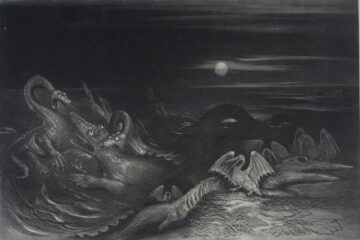
John Martin, frontispiece to Thomas Hawkins’s The Book of the Great Sea Dragon (1840). Image courtesy of Simon Cooke, Victorian Web.

Like most Americans, I spent the summer of 2020 indoors. I had just graduated from Arizona State and moved my wife and our two daughters to Shreveport, Louisiana, but my new job as an assistant professor would not start for a few months. We settled into an Airbnb and only left to shop for groceries or to survey the city, driving from neighborhood to neighborhood to scout for real estate. With no campus office, I worked on a scientific manuscript in the garage attached to the Airbnb under the pulse of an oscillating fan. And as I refined that manuscript—the last unpublished section of my physics dissertation—I would periodically flip over to Twitter to see the latest viral news clips, which, in the summer of 2020, amounted to the most extreme daily fallout from the death of George Floyd.

By now, it’s hard to avoid political clichés about these events. The protests, it was true, were mostly peaceful, but by mid-June dozens of cities had imposed mandatory curfews. People’s private reactions differed, but in those months I noticed my opinions drifting rightward in real time, as I heard NPR discussions of police defunding by day and watched Twitter videos of looting by night.

This column is not about those events in themselves, at least not intentionally, since my reactionary opinions aren’t all that interesting. What I think is probably more fruitful to discuss is how such pieces of evidence (or “evidence”—the scare quotes are appropriate) shape personal opinion. Such videos may act like sightings of digital cryptids, like glimpses of Bigfoot disappearing into the forest. They do not function as common evidence, but they are transformative for the witnesses who had never before believed. These sightings bypass the usual stages of dispassionate parsing and give the viewer the impression of a ground truth. Their power is that they are assimilated not as news, but as personal experience.

Admittedly, in my own case, I’m thinking of one specific video. Read more »
Tuesday, June 17, 2025

Speak Our Truth

by Jerry Cayford

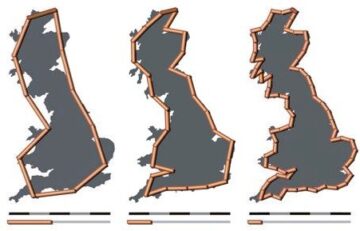
The coastline of the United Kingdom as measured with measuring rods of 200 km, 100 km and 50 km in length. Creative Commons Attribution-Share Alike 3.0 Unported

I was always attracted to that old dichotomy: people must be either stupid or lying when they claim to believe some obvious falsehood. This dichotomy is a staple of Democratic theorizing about our political culture. (Sometimes the choice is between stupid and evil, which amounts to the same.) For example, Adam-Troy Castro’s social media classic “Why Do Liberals Think Trump Supporters Are Stupid?” has been circulating since halfway through Trump’s first term. But this simple dichotomy is losing its appeal. It is just not plausible that tens of millions of ordinary Republicans—our neighbors, friends, and families—are stupid or evil. There have been many proposed explanations of this puzzle: information siloes hide the obvious from otherwise intelligent people; tribalism exerts a powerful evolutionary draw. I believe, though, that there is a different and hidden complexity here.

I use the word “complexity” deliberately, because my argument draws on one of the icons of chaos theory (aka complexity theory) known as the “Coastline Paradox.” That name refers to a 1967 paper, “How Long Is the Coast of Britain?” by one of the pioneers of chaos theory, Benoit Mandelbrot. James Gleick provides a quick introduction to the topic in “The Man Who Reshaped Geometry” (1985), and a thorough treatment in his book Chaos: Making a New Science (1987). But the Coastline Paradox itself is easy to understand.

Imagine you measure the coast of Britain by putting markers every ten miles and summing the distances between them. You get a certain result. If you put markers every mile, you get a larger result. Measure the coast with a yardstick: longer still. With an inch ruler: longer. The coast will continue to get longer as you trace it around ever-smaller irregularities, around every grain of sand. So, how long is the coast? As Gleick says in his article, “In fact, it depends on the length of your ruler. As the scale becomes finer and finer, bays and peninsulas reveal new subbays and subpeninsulas, and the length—truly—increases without limit, at least down to atomic scales.” In a sense, physical length does not exist. Or, physical lengths are all infinite. Or, better, length depends on your method of measuring.

Examining length gives us a glimpse into a new picture of how the things we say and believe relate to reality. Read more »