
by David Kordahl
Like most Americans, I spent the summer of 2020 indoors. I had just graduated from Arizona State and moved my wife and our two daughters to Shreveport, Louisiana, but my new job as an assistant professor would not start for a few months. We settled into an Airbnb and only left to shop for groceries or to survey the city, driving from neighborhood to neighborhood to scout for real estate. With no campus office, I worked on a scientific manuscript in the garage attached to the Airbnb under the pulse of an oscillating fan. And as I refined that manuscript—the last unpublished section of my physics dissertation—I would periodically flip over to Twitter to see the latest viral news clips, which, in the summer of 2020, amounted to the most extreme daily fallout from the death of George Floyd.
By now, it’s hard to avoid political clichés about these events. The protests, it was true, were mostly peaceful, but by mid-June dozens of cities had imposed mandatory curfews. People’s private reactions differed, but in those months I noticed my opinions drifting rightward in real time, as I heard NPR discussions of police defunding by day and watched Twitter videos of looting by night.
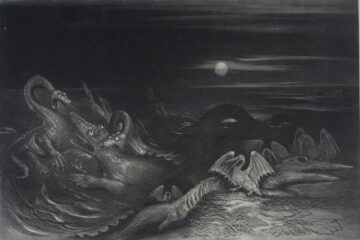
This column is not about those events in themselves, at least not intentionally, since my reactionary opinions aren’t all that interesting. What I think is probably more fruitful to discuss is how such pieces of evidence (or “evidence”—the scare quotes are appropriate) shape personal opinion. Such videos may act like sightings of digital cryptids, like glimpses of Bigfoot disappearing into the forest. They do not function as common evidence, but they are transformative for the witnesses who had never before believed. These sightings bypass the usual stages of dispassionate parsing and give the viewer the impression of a ground truth. Their power is that they are assimilated not as news, but as personal experience.
Admittedly, in my own case, I’m thinking of one specific video.
The video was taken on May 30, 2020, only five days after Floyd’s death. It was posted by Elijah Schaffer, who at the time was a journalist for Blaze Media. I experienced it as a free-floating clip on Twitter, where Schaffer wrote, “BREAKING: man critically injured at Dallas riots // It appears he attempted to defend a shop with a large sword // Looters ran at him, then he charged rioters // They then beat him with a skateboard and stoned him with medium sized rocks // I called an Ambulance and it’s on the way”—before posting the gruesome clip.
The chaotic footage wasn’t easy to parse, but the ending, with a man being stomped by a crowd until his twisted body lay on a blood-spattered sidewalk, seemed clear enough. Or was it? In the days after the video was posted, Donald Trump referred to it several times, spurring corrections. “Trump cites Dallas beating to governors, leaves out details,” went one typical headline. “Fact check: Dallas man attacked during protests did not die from his injuries,” noted Reuters.
These articles were technically correct, and the public importance of the incident dissipated once it emerged that the stomped man, the writer C. A. Shoultz, wasn’t dead after all. But I continued to think about that video, because I thought it represented something important. It represented a type of media existing only on the outskirts of the mainstream discourse, never to be shown on reputable sites as a source of raw data, and peeking in only as an item to be debunked.
This differed sharply from the models of mass media put forward by older critics. Daniel J. Boorstin’s The Image: A Guide to Pseudo-Events in America (1961) was obsessed with the idea that real experiences were being replaced by manufactured ones—news replaced by reporting about the news, heroes replaced by celebrities, adventure replaced by tourism, art replaced by synopses, all events replaced by pseudo-events. Similarly, these older critics frequently cautioned readers to pay attention to how media could colonize their imaginations. In Four Arguments for the Elimination of Television (1978), Jerry Mander stated this memorably. “Once television places an image inside your head,” he wrote, “it is yours forever.”
In the summer of 2020, the old script had flipped. The past conventions for amateur footage—think of Rodney King, or even George Floyd—had trained us to expect that attention-grabbing clips would be shared widely by mainstream sources. But for those of us who were on Twitter, the mainstream news now seemed not like a digest of all newsworthy clips, but instead like a lossy summary of what our corner of the internet had already seen yesterday. And no matter how it was spun, there was something real about the stomping and the blood. Twitter placed images inside our heads, that was fair, but these images seemed sharper, more definite and true, than the diffuse narratives that formed without them.
For the mainstream narrative, it was significant that Shoultz had not died, and it was significant that he had not been defending his own business. For viewers of the digital cryptid, however, these corrections changed nothing. The clip’s message remained intact. Shoultz may have been reckless, but the blood was real.
The arguments I had that summer seem like a preview of everything that came after them. Some members of my extended family—the ones who still got their news mainly from newspapers and network TV—experienced the summer as a photo negative of my own. Where I had seen a slide toward chaos, they saw a country waking up to its sins. Did I really think, they would ask, that businesses, which were no doubt insured, had a greater claim to value than human lives?
Since then, it has occurred to me that we were not disagreeing about shared events. We all spent those months indoors, but whatever I pictured when I thought of “the protests” was not what they pictured. Our images would never converge over something as weak as an argument. We were stalking different beasts.
Digital cryptid sightings may eventually be cataloged under a legible species. By the end of the summer, newspapers were reporting on the CHAZ in Seattle and Kyle Rittenhouse in Kenosha, each of which gave a public hook for conversations that in May had existed only on the fringes. Once a species has been publicly named, forgotten sightings can be retrospectively integrated into a broader trend.
But as the summer ended, I did my best to ignore broader trends. I was starting a new job, finishing a manuscript, waiting for ordinary life to resume. What I didn’t yet recognize was that the disagreements of 2020 were hardening into a new form of ordinary life. That summer I had watched a video because someone I followed thought it was worth sharing. Today, I see its successors because digital algorithms know that I will stop to watch. Others are shown other things. We can argue about it all when we still come together, and who can say whether we refer to any consensus reality. We have all become hunters of digital cryptids in different parts of the online forest, and now find that they are also stalking us.
***
Enjoying the content on 3QD? Help keep us going by donating now.