
by Akim Reinhardt
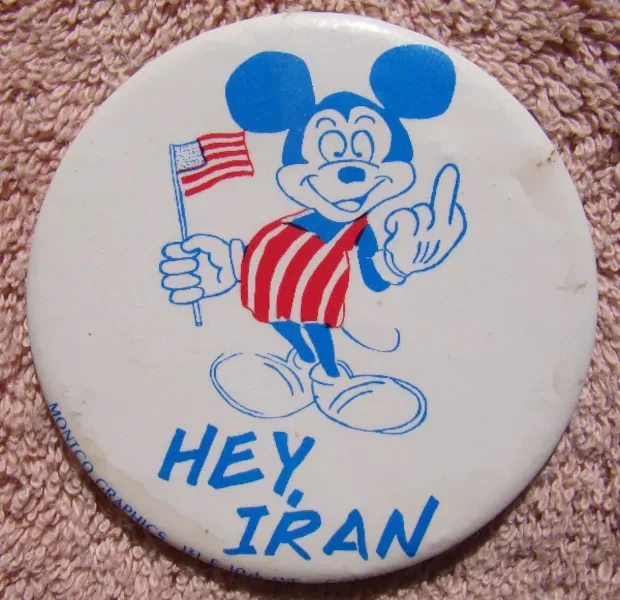 I was 12 years old when I walked down a street in my Bronx neighborhood and saw the poster in the window of Cappie’s. Cappie’s was a certain kind of corner store common in 20th century New York. It sold newspapers and magazines, candy and soda, lotto tickets, cigarettes, and various tchotchkes aimed at kids and teens. Cheap toys, baseball cards, posters, etc. Most of their posters were pinups of the era’s sex pots such as this or that Charlie’s Angels in various states of near nudity. But this poster featured a cartoon mouse, a clear copyright infringement on Walt Disney’s famed vermin. The caption read: Hey, Iran! The mouse held an American flag in one hand. The other flipped the bird.
This was the year 1980, and the Iran hostage crisis was chugging along. Soon, America’s most watched and trusted newsman, Walter Cronkite of CBS, was signing off his nightly broadcast with an addition. Instead of just “And that’s the way it was,” followed by the day’s date, he was now adding: “And that’s the way it was [that day’s date], the [X] day of captivity for American hostages in Iran.” The last time he signed off this way, on January 20, 1981. It was the 444th day.
That running tally, the images of blindfolded hostages, and other near-constant media discussions were a relentless source of U.S. shame and impotence. The saga dragged on and on. The American citizenry, much more homogeneous then than it is now (ca. 80% white, 12% black, and >90% native-born), was united in its outrage and frustration. Nearly everyone in the United States hated Iran, or at least specifically, the Iranian revolutionaries holding American hostages. And that mass hatred was made easy by mass ignorance.
We all heard, over and over, that the fundamentalist Muslim revolutionaries who’d captured the U.S. embassy and kidnapped some of its staff had overthrown the Shah of Iran. Politicians and the media kept telling us that the Shah had been a friend of the United States. But what hardly any Americans knew was that the Shah had been in power only because back in 1953, President Dwight Eisenhower and British Prime Minister Winston Churchill had directed the CIA and its British counterpart, MI6, to foment a coup against Iran’s democratically elected prime minister, Mohammad Mosaddegh. Read more »
 Most people associate the Cold War with several decades of intense political and economic competition between the United States and Soviet Union. A constant back and forth punctuated by dramatic moments such as the Berlin Airlift, the Berlin Wall, the arms race, the space race, the Bay of Pigs, the Cuban Missile Crisis, Nixon’s visit to China, the Olympic boycotts, “Mr. Gorbachev, tear down this wall!” and eventually the collapse of the Soviet system.