
by Akim Reinhardt
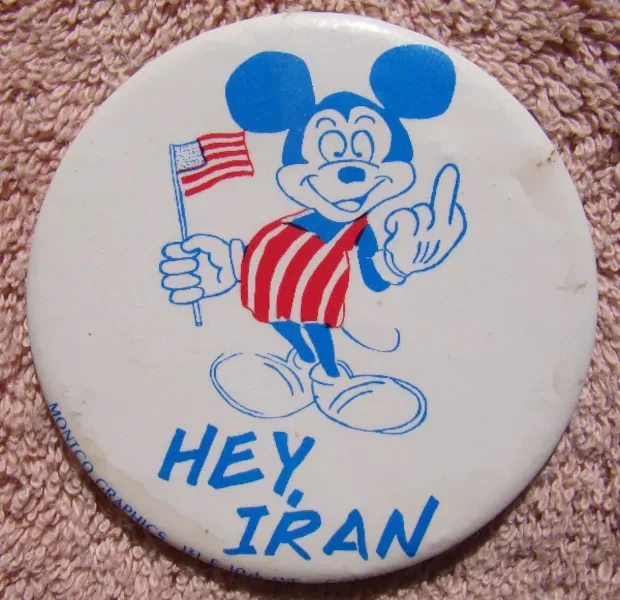 I was 12 years old when I walked down a street in my Bronx neighborhood and saw the poster in the window of Cappie’s. Cappie’s was a certain kind of corner store common in 20th century New York. It sold newspapers and magazines, candy and soda, lotto tickets, cigarettes, and various tchotchkes aimed at kids and teens. Cheap toys, baseball cards, posters, etc. Most of their posters were pinups of the era’s sex pots such as this or that Charlie’s Angels in various states of near nudity. But this poster featured a cartoon mouse, a clear copyright infringement on Walt Disney’s famed vermin. The caption read: Hey, Iran! The mouse held an American flag in one hand. The other flipped the bird.
This was the year 1980, and the Iran hostage crisis was chugging along. Soon, America’s most watched and trusted newsman, Walter Cronkite of CBS, was signing off his nightly broadcast with an addition. Instead of just “And that’s the way it was,” followed by the day’s date, he was now adding: “And that’s the way it was [that day’s date], the [X] day of captivity for American hostages in Iran.” The last time he signed off this way, on January 20, 1981. It was the 444th day.
That running tally, the images of blindfolded hostages, and other near-constant media discussions were a relentless source of U.S. shame and impotence. The saga dragged on and on. The American citizenry, much more homogeneous then than it is now (ca. 80% white, 12% black, and >90% native-born), was united in its outrage and frustration. Nearly everyone in the United States hated Iran, or at least specifically, the Iranian revolutionaries holding American hostages. And that mass hatred was made easy by mass ignorance.
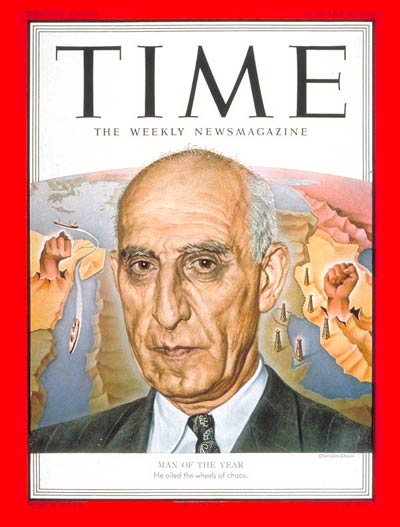
We all heard, over and over, that the fundamentalist Muslim revolutionaries who’d captured the U.S. embassy and kidnapped some of its staff had overthrown the Shah of Iran. Politicians and the media kept telling us that the Shah had been a friend of the United States. But what hardly any Americans knew was that the Shah had been in power only because back in 1953, President Dwight Eisenhower and British Prime Minister Winston Churchill had directed the CIA and its British counterpart, MI6, to foment a coup against Iran’s democratically elected prime minister, Mohammad Mosaddegh.
Was it because Mossaddegh was a communist during the Cold War? No, Mosaddegh was actually anti-communist. Rather, it was because he had committed the unforgivable crime of pushing back against British colonialism by not letting the British own, control, and profiteer off of Iran’s oil anymore. The West’s Cold War propaganda focused on decrying Communist totalitarianism and championing democratic freedoms, but the United States and its closest allies were mostly concerned with preserving their largest businesses’ access to capitalistic markets and resources. So U.S. and British power brokers replaced Iran’s democratically elected prime minister with a monarch; Shah is Persian for King. And the Shah of Iran quickly began amassing one of the world’s worst human rights records, torturing and murdering any dissidents his security forces could get their hands on. This went on for over 35 years.
No wonder the Iranian revolutionaries hated Americans (and Brits) so much.
But few Americans knew anything about this when Iranian revolutionaries captured the U.S. embassy in 1979. Indeed, most Americans weren’t old enough to even really remember the CIA/MI6 overthrow of Irania democracy in 1953; the median age in the United States in 1980 was about 30. But even if you had been old enough to remember the 1953 coup 26 years later, and you had paid attention to it in the news back then, you were likely to have been ingesting pro-American, anti-Mossaddegh propaganda that the CIA spoon-fed the U.S. press during the 1950s, before the 1961 Bay of Pigs fiasco blew its pristine reputation for justified and successful clandestine operations. No wonder Americans quickly united against the Iranian Revolution with virtually no self-reflection on how U.S. foreign policies and actions had contributed to it.
And here we are again, in a tizzy about Iran. And once again, most Americans aren’t old enough to remember the preceding eruption. The Iranian hostage crisis ended over 45 years ago; the U.S. median age is now about 40. It would seem then that conditions are ripe for a whole lot of Fuck Iran! buttons and posters, especially given the many reprehensible aspects of the revolutionary Iranian theocracy. Yet it turns out that Americans are not united in their attitudes about Iran like they were during the 20th century. There are lots of reasons for this.
For starters, Americans are not united on much of anything these days. Fierce partisanship is the name of the game, this side/that side, and those who don’t want to play squeamishly retreat into apolitical stances. Partisanship is, of course, nothing new in U.S. politics. But now there is no longer centralized media to galvanize public opinion. The concept of such a thing in today’s United States is almost unfathomable.
Where have you gone, Walter Cronkite?
Beyond that, it used to be that nothing would unite a nation’s populace more tightly than a common enemy. During the Cold War, Americans’ common enemy was the Soviet Union. The Cold War lasted nearly half a century, too long a period to produce uninterrupted unity. American Cold War unanimity first began fracturing over the unjustifiable and murderous war in Vietnam, which ended ignominiously in 1975. But then it reformed around a new common enemy during the 1979–81 Iran hostage crisis, which contributed to the caustic and jingoistic Reagan backlash. Reagan called the USSR the “evil empire,” and many Americans rallied around his Cold War hawkishness. But that didn’t last either.
After Cold War ended, the ruptures began to widen. Even the tragedy of September 11th could provide only a temporary salve on America’s self-inflicted partisan wound, which has largely been spreading and festering for more about three and a half decades since the USSR’s collapse. The 9-11 band aid was soon ripped off by the second Gulf War, which immediately divided Americans. From the jump, savvy observers doubted whether there were any weapons of mass destruction in Iraq, and of course there weren’t. What’s more, Iraq had had nothing to do with 9-11. By the time the last soldiers came home, after nearly a decade, Americans had never so thoroughly turned their backs on an overseas U.S. war. In the waning years, it seemed like even the Americans who supported the war couldn’t be bothered to pay attention beyond clapping for vets receiving ribbons and plaques before ball games.
Now here we are again: another war in the Middle East, and a violent redux with Iran. But this is not like the earlier imbroglios with Iran, whether the propagandized coup, or the revolution that eventually sprang from it, both of which found Americans united. No, this is more like the more recent second Gulf War. From the beginning, people are questioning it. Many have immediately pointed out that: the United Nations, led by the United States, already had a deal in place to keep Iran from getting nuclear weapons, at least until Donald Trump ripped it up; that Iran does not currently have nuclear weapons; that most of Donald Trump’s supporters loved his earlier promises to not start anymore regime-change forever wars; and that his opponents will oppose just about anything this dictatorial psychopath does, especially the über violent stuff.
Even the propagandists at Fox News can’t find a poll showing a majority of U.S. voters support the war on Iran, or even think that Trump’s handling of Iran has made us safer.
And as to our NATO allies, whom Trump has spent a decade in and out of office besmirching, belittling, and extorting? Surprise, surprise, they want nothing to do with this war, which: Trump started without consulting them; has nothing to do with NATO’s primary mission of defending member nations from outside attack; and has no clear objective. This is a war of aggression, not a defensive war. Iran most certainly has not invaded the Untied States. It hadn’t even attacked Israel in over two years.
Perhaps this war will end soon. Either because the Untied States and Israel manage a swift victory, or because Iran somehow finds a way to punch back hard enough to make Trump back down, the way rich kid bullies usually do when you bloody their nose. Or maybe this war will drag on and on, because a quick victory is often not so quick after all, and because destroying one government is a lot easier than building a new, successful one. Maybe it will be 444 days. Maybe it will be however many years the second Gulf War lasted.
Or maybe it will last however long it takes for us to learn the lesson of the 1953 Iranian coup and the horrors that have followed.
Akim Reinhardt’s website is ThePublicProfessor.com