by Jochen Szangolies
In 1960, the physicist and cyberneticist Heinz von Foerster, together with two co-authors, predicted that on Friday, November 13, 2026, doom would come. On this date, if the human population were to continue growing as it had for the previous 2,000 years, its hyperbolic growth would tend to infinity, and we would all be ‘squeezed to death’. Of course, this estimate for doomsday was not an altogether serious one, and ended up being off by about a month (Marvel really dropped the ball on the tie-in here).
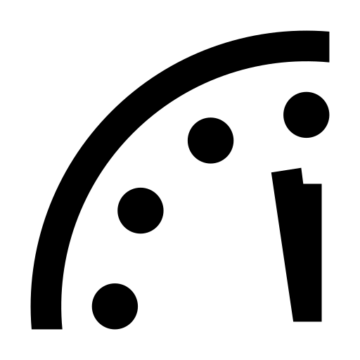
But apocalypticism is certainly experiencing a boom. Climate change, AI, war, a new pandemic: all these and more stoke renewed millenarian fears. And rightly so, at least to some extent: the past half-century or so is the first in the history of humanity that we could feasibly broker our own demise. Our technologies have grown so powerful, our weapons so destructive, and our exploitation so disruptive that we today stand before the very real possibility of bringing about our end through hubris, malice, or simply negligence. In AI, we have created a technology that we can barely control in its current state, yet for which some have argued that ‘if anyone builds it, everyone dies’. In January, the Doomsday Clock, a measure brought into being in 1947 by the Bulletin of Atomic Scientists to quantify the likelihood of global catastrophe, was set to a record 85 seconds to midnight, with the main driver of risk being the increasingly aggressive, adversarial, and nationalistic demeanor of the ‘Great Powers’ USA, Russia, and China. The recent UN Emissions Gap Report now sees exceeding the Paris goal of limiting warming to below 1.5°C as unavoidable, occurring within the next decade, and urges drastic measures to limit the extent and duration of overshoot.
Moreover, these risks are not independent. As the climate changes, resource wars, population displacement, and weather catastrophes further destabilize global security, while maintaining and deploying a large military apparatus both actively harms the climate further and drains resources from necessary mitigating projects, such as energy transition or renaturalization efforts. Taking the lead in the ‘AI race’ is seen to be of critical importance, to the detriment of safety, alignment, and control. Entire forests are illegally felled to make room for data centers, while illegal gas turbines pump cancerogenous nitrous oxide into the air and leak highly climate damaging methane.
In short, even though the doomsayer is (thankfully) historically the profession with the worst track record, it is true that we’re living in times of unprecedented uncertainty about the future. Read more »
 How terrified should we be of Artificial Intelligence right now? I’m fascinated by the variety of perceptions on offer after a few Anthropic employees affirmed that “we really do believe AI can kill all humans.” Comedian Josh Johnson says what many of us are thinking: “Just