
Crawford Kilian in The Tyee:
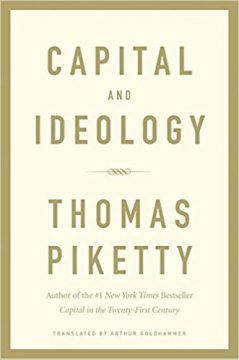 Thomas Piketty’s new book Capital and Ideology won’t be available in English until next March. At 1,150 pages, it will likely be more bought than read. But some of its ideas are already causing a stir, and one insight in particular could explain how the Canadian election will go.
In a 180-page report published in March 2018, Piketty documented a remarkable shift in the political “cleavages” of Britain, France, and the U.S. Those cleavages certainly apply to Canada and other nations as well.
“In the 1950s-1960s,” Piketty writes, “the vote for ‘left-wing’ (socialist-labour-democratic) parties was associated with lower education and lower income voters. This corresponds to what one might label a ‘class-based’ party system: lower class voters from the different dimensions (lower education voters, lower income voters, etc.) tend to vote for the same party or coalition, while upper and middle class voters from the different dimensions tend to vote for the other party or coalition.”
Having won the Second World War, the U.S. and its allies designed an economic system that would reward workers with job stability and relatively high income. This was not out of the goodness of their hearts; the late British historian Tony Judt argued that Western governments had seen workers turn communist after the First World War, while the middle classes turned fascist. They forestalled a repeat by imposing various forms of social democracy on themselves: health care, respect for unions, greater access to education, high tax rates on the wealthy.
More here.
 Some sporting moments achieve mythical status because of their sheer audacity. Muhammad Ali’s
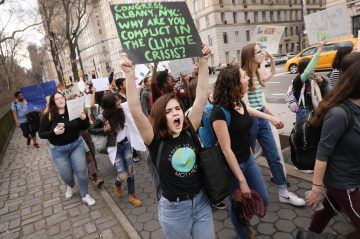 As it is becoming obvious that political responses to global warming such as the Paris treaty are not working, environmentalists are urging us to consider the climate impact of our personal actions. Don’t eat meat, don’t drive a gasoline-powered car and don’t fly, they say. But these individual actions won’t make a substantial difference to our planet, and such demands divert attention away from the solutions that are needed.
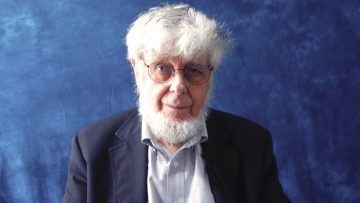 How do we understand that our 100,000-fold excess of numbers on this planet, plus what we do to feed ourselves, makes us a tumor on the body of the planet? I don’t want the future that involves some end to us, which is a kind of surgery of the planet. That’s not anybody’s wish. How do we revert ourselves to normal while we can? How do we re-enter the world of natural selection, not by punishing each other, but by volunteering to take success as meaning success and survival of the future, not success in stuff now? How do we do that? We don’t have a language for that.
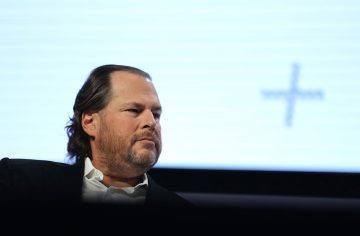 Tech mogul Marc Benioff has been winning media accolades for his declaration that “capitalism, as we know it, is dead.” The billionaire founder and CEO of Salesforce, a cloud-based customer-relations company, has launched an advertising blitz promoting his new book, Trailblazer, which calls for a “more fair, equal and sustainable capitalism,” as Benioff put it in a New York Times op-ed on Monday. This “new capitalism” would not “just take from society but truly give back and have a positive impact,” Benioff maintains.
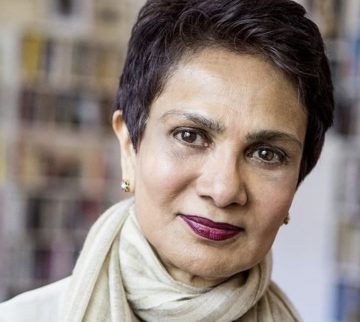 Throughout my career as a neurosurgeon, I have worked closely with oncologists. Many of my patients have cancer of the brain — one of the deadliest of the near-infinite number of cancers. I have always viewed my oncological colleagues with complicated, contradictory feelings. On the one hand, I’m in awe of their work, which can be so emotionally demanding. On the other, I suspect they don’t always know when to stop.
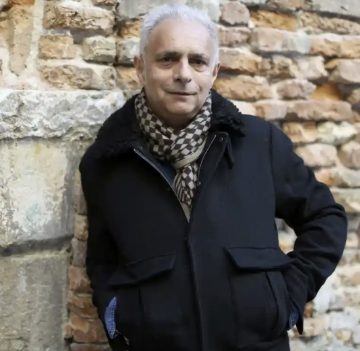 Unlike Hillary Clinton, who used the same title for her memoir,
  In New York, where I live, whenever there’s a big holiday weekend, the traffic on Friday as folks leave town turns much of Manhattan into a hot, fume-filled parking lot. On those days, one can often walk faster than the traffic is moving. That may be the exception, but congestion in many cities has reached the point where getting around by car at certain times of day is almost not an option.
 FOR THE AUTUMNAL EQUINOX OF 1967
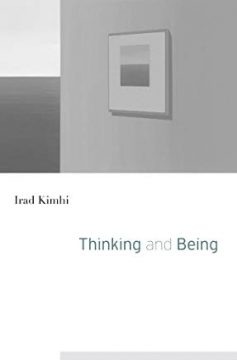 Of all the ways that human beings differ from the rest of what is found in nature, being able to think is most fundamental. Being able to think is, it seems, uniquely characteristic of us. But what is so special about the ability to think? In other words, what is so special about us? Analytic philosophy finds its foundations in an answer: not very much. An elusive new book, Thinking and Being, by Irad Kimhi, a heretofore little-known Israeli philosopher, argues that this is the wrong answer. And so, he argues, a whole tradition of philosophical thought is wrong, not just in the details, but in the fundamentals. What Kimhi wants to show is that the logical features of thought, and so also the features of those who think them, stand at a far remove from anything we might now call “natural.”
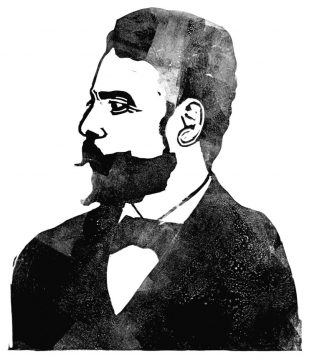 This shattering, sometimes unbearably powerful novel, completed in 1904, was written by Henrik Pontoppidan, who won the Nobel Prize in 1917. It is considered one of the greatest Danish novels; the filmmaker Bille August turned the story into a nearly three-hour movie called, in English, “A Fortunate Man” (2019). The novel was praised by Thomas Mann and Ernst Bloch, and is effectively at the center of Georg Lukács’s classic study “
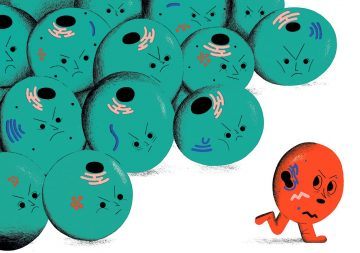 Yasuyaki Fujita has seen first-hand what happens when cells stop being polite and start getting real. He caught a glimpse of this harsh microscopic world when he switched on a cancer-causing gene called Ras in a few kidney cells in a dish. He expected to see the cancerous cells expanding and forming the beginnings of tumours among their neighbours. Instead, the neat, orderly neighbours armed themselves with filament proteins and started “poking, poking, poking”, says Fujita, a cancer biologist at Hokkaido University in Sapporo, Japan. “The transformed cells were eliminated from the society of normal cells,” he says, literally pushed out by the cells next door.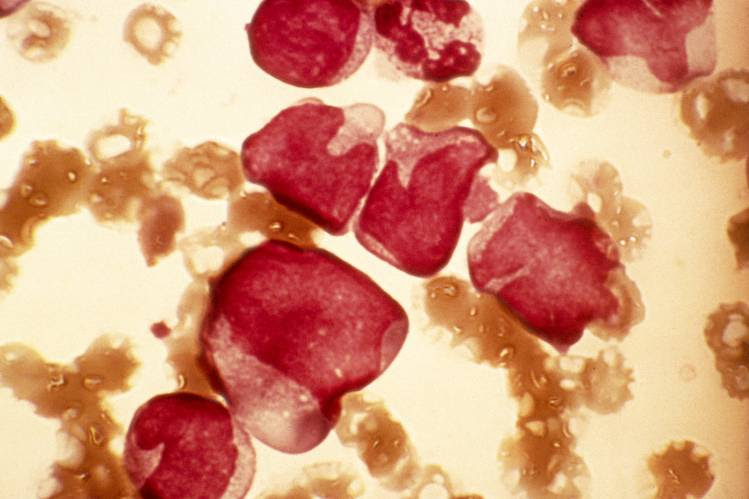
 Artificial intelligence is better than humans at playing chess or go, but still has trouble holding a conversation or driving a car. A simple way to think about the discrepancy is through the lens of “common sense” — there are features of the world, from the fact that tables are solid to the prediction that a tree won’t walk across the street, that humans take for granted but that machines have difficulty learning. Melanie Mitchell is a computer scientist and complexity researcher who has written a new book about the prospects of modern AI. We talk about deep learning and other AI strategies, why they currently fall short at equipping computers with a functional “folk physics” understanding of the world, and how we might move forward.