
Enjoying the content on 3QD? Help keep us going by donating now.
Category: Recommended Reading
The Art of Mungo Thomson
Jan Tumlir at Artforum:
Clever is a term that is sometimes used to describe Thomson by his detractors. In art, it carries a decidedly unflattering tone. Yet the cleverness on offer here opens every “one liner” interpretation to a radiating constellation of lines that is pretty much inexhaustible. One of these has to do with the fact that, as Rosalind Krauss notes in her 1981 essay “The Originality of the Avant-Garde,” Rodin was among the first in his field to work perfectly in sync with the regime of technical reproducibility. “Now, nothing in the myth of Rodin as the prodigious form giver,” she writes there, “prepares us for the reality of these arrangements of multiple clones.”5 Nevertheless, it is evident that Rodin multiplied his sculptures in edition copies circulated throughout the globe, much like photographs. This analogy is central to Krauss’s argument.6 The connection between the dispositifs of these two media—one involving casts and molds, the other negative film and positive prints—deserves much more attention than I am prepared to give it here, but let’s keep it in mind. Another tangential line worth pursuing: Rodin made ample use of photography proper in his figural renderings. In other words, the emphatically hands-on aesthetic for which he is known took shape in the shadows of the hands-off. By the end of his life, this artist had amassed an archive of some seven thousand photographs, many of them featuring nude models, which he employed in his studio process. In addition, Rodin regularly commissioned photographs of his sculptures, thus twisting this intermedial exchange into a feedback loop.7
more here.
Enjoying the content on 3QD? Help keep us going by donating now.
Review of “A Splintering” by Dur e Aziz Amna – a woman’s ambitions in Pakistan
Mirza Waheed in The Guardian:
 I admired Dur e Aziz Amna’s precise and lyrical first novel, American Fever; the protagonist – an exchange student from Pakistan to rural Oregon – staying with me long after I encountered her. She has now delivered a superb second novel that features another fascinating central character, though in a much darker, more disturbing context.
A Splintering is the story of Tara, one of five siblings from a poor farming family in the hinterlands of Pakistani Punjab. This is the kind of landscape where age-old codes of manhood, with brother or son as provider and adjudicator of women’s lives, still rule. Tara, gazing at the stars from their courtyard at night, wants to get away from the squalor of Mazinagar (literally, past city), where most people live and die unnoticed, and build a life full of money and possessions in the city. She has no romantic notions about the soporific countryside. “I have no nobility. I come from darkness and filth.”
Tara marries an unambitious accountant from the city and quickly absorbs the mores of urban life, but wants more and more every day, for her children and for herself, and finds she is willing to do anything for it.
More here.
Enjoying the content on 3QD? Help keep us going by donating now.
Horses: A 4,000-Year Genetic Journey Across the World
David Chaffetz at the Asian Review of Books:
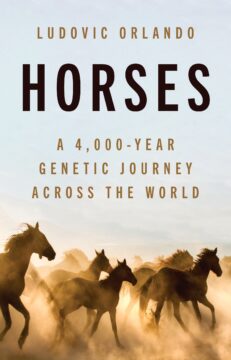 Some myths take longer to die than others. For students of equine history, the passion that these animals inspire in their owners and breeders often act as a veil, impenetrable for scientists and historians trying to get to the facts. In Horses, Ludovic Orlando, who has been gathering the facts jaw bone by jaw bone for two decades, deploying the latest technology, appears to have pierced the veil, finally, though with many a surprising turn to keep the readers on edge, as though enjoying a detective novel.
Many of the stories told here have appeared in scientific magazines since the publication of “The origins and spread of domestic horses from the Western Eurasian steppes” in Nature magazine, in 2021. Orlando enlivens these stories, however, by describing his travels to and from England, to the steppes of Kazakhstan and on to the Siberian tundra, where he has his fruitful encounters with colleagues, including William Taylor, Pablo Librado, Alan Outram and Pavel Kuznetzov.
More here.
Enjoying the content on 3QD? Help keep us going by donating now.
Google DeepMind CEO Demis Hassabis on AI
Enjoying the content on 3QD? Help keep us going by donating now.
Friedrich Engels Predicted Modern Gentrification 150 Years Ago
P.E. Moskowitz at Literary Hub:
 In Urban Fortunes, their foundational work on the economies of cities, urban theorists John Logan and Harvey Molotch argue that the people running American cities no longer care about affordability, a city’s ability to educate children, or the happiness and health of its residents; rather, they are only interested the amount of money a city is able to generate. This focus is not the result of a philosophical bug that’s somehow spread to the brains of city managers everywhere. People such as Richard Florida make the city-as-business philosophy seem appealing, but there’s something bigger going on. Logan and Molotch argue that the city-as-growth-machine is an inherent feature of late capitalism in the United States. Cities, more than being places for people to live, have become ways to produce, manage, attract, and extract capital.
Under capitalism, there’s an inherent tension between what Marxist academics call “use value” and “exchange value.”
More here.
Enjoying the content on 3QD? Help keep us going by donating now.
Arvo Pärt: The Holy Minimalist Who Defied The Soviets
Ian Thomson at The New Statesman:
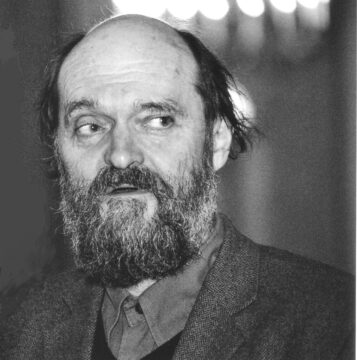 Arvo Pärt, the pre-eminent religious composer of our time, was born in 1935 in Estonia, before its Soviet occupation. His music suggests the contemplative devotion and purity of Gregorian plainchant and Renaissance church chorale, though it could only have been written today, being at once archaic and abstract-modern. With its sense of stasis and light, the music reflects the immensity of the Baltic landscape and Estonia’s own forested plains. Under communism, Pärt fell foul of the Soviet censors as his music defied official atheism. His work is shaped by his Eastern Orthodox faith; it is a form of prayer.
Pärt, who turned 90 on 11 September, has retired from public life and ceased to compose. He can still occasionally be glimpsed at the Arvo Pärt Centre, a beautiful glass-encased building that opened in 2018 on the edge of a pine forest close to Tallinn, Estonia’s capital.
more here.
Enjoying the content on 3QD? Help keep us going by donating now.
From Soundwaves to Brainwaves: The Transformative Power of Music
Iris Kulbatski in The Scientist:
 Life begins with music. The human body provides the basic musical elements for the soundtrack to fetal development. The rhythmic pulsing of mom’s heartbeat, the rise and fall of her footsteps, the steady rush of her breathing and circulation, the pitch and melody of her voice, and the rumbling staccatos of her digestion all prime the developing fetus to recognize and respond to music postnatally.1,2 Womb sounds shape brain development, form the basis of future language and communication, and program musical dialects into the fleshy enclaves of the body.
More here.
Enjoying the content on 3QD? Help keep us going by donating now.
In the loop: odd rings of DNA in tumors
Elie Dolgin in Science:
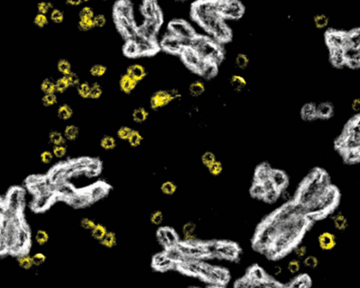
Mischel’s first curious observation had to do with how quickly glioblastomas adapted to treatment. Within a week or two, tumors that had once bristled with extra copies of the receptor gene, EGFR, shed most of them. That kind of genomic shift should have unfolded gradually, over successive rounds of cell division. Instead, it happened with unsettling speed. Stranger still, cells that had seemingly rid themselves of EGFR retained the uncanny ability to bring it roaring back, spawning new tumors with high gene expression as soon as the drug pressure lifted. It was like watching a doused fire suddenly reignite from cold ash.
“The tumors were changing their genomes way too quickly,” says Mischel, a neuropathologist and cancer biologist now at Stanford Medicine. “It was a colossal scratching of heads.” The mystery deepened when David Nathanson, a trainee in Mischel’s lab, began to examine glioblastoma cells under the microscope. He stained chromosomes blue; EGFR was tagged in red. He expected the red signals—the extra copies of EGFR—to align neatly along the blue chromosomes. What appeared instead was chaos: scattered red dots drifting across the nucleus, unmoored from any chromosomal structure. “It was really crazy to see,” says Nathanson, now a brain cancer biologist at the University of California (UC), Los Angeles.
More here.
Enjoying the content on 3QD? Help keep us going by donating now.
Sunday, September 14, 2025
Giorgio Armani (1934 – 2025) Fashion Designer
Enjoying the content on 3QD? Help keep us going by donating now.
Robert Davies (1944 – 2025) Founder of Supertramp
Enjoying the content on 3QD? Help keep us going by donating now.
Robert Grosvenor (1937 – 2025) Sculptor
Enjoying the content on 3QD? Help keep us going by donating now.
The Smoker
Ottessa Moshfegh in The Paris Review:
 This one time, my dad bought me a house in Providence, Rhode Island. It was a two-story fake Colonial with yellow aluminum siding on Hawkins Street. We bought it from the bank for $55,000; it was one of many properties under foreclosure in the city in 2009. Dad and I had spent a few days driving around and looking at these houses. In one driveway, I found a dirty playing card depicting the biggest penis I could ever imagine—I still have it. In one basement, the realtor had to disclose, the former owner had tied his girlfriend’s lover to a chair, tortured him, and then shot him in the head.
More here.
Enjoying the content on 3QD? Help keep us going by donating now.
Trump Is Shutting Down the War On Cancer
Jonathan Mahler in The New York Times:

When America declared war on cancer more than 50 years ago, there was a misguided assumption outside the scientific community that it would be only a matter of years before the disease was eradicated — that defeating cancer would be no different than building an atomic bomb or putting a man on the moon. But there would be no miracle cure: As of this writing, some 40 percent of Americans will be diagnosed with cancer at some point in their life.
What there would be, however, was decades of minor breakthroughs that would accrue over time, transforming both our understanding of the disease and our ability to treat it. One way to measure the cumulative effect of those breakthroughs is with statistics: In the mid-1970s, America’s five-year cancer-survival rate sat at 49 percent; today, it is 68 percent. You can also correlate America’s sustained investment in cancer research directly with these returns: According to a recent study in The Journal of Clinical Oncology, every $326 that our government spends researching cancer extends a human life by one year. Now an extraordinarily successful scientific research system — one that took decades to build, has saved millions of lives and generated billions of dollars in profits for American companies and investors — is being dismantled before our eyes.
More here.
Enjoying the content on 3QD? Help keep us going by donating now.
Sunday Poem
White Corn Boy*
I am the White Corn Boy.
I walk in sight of my home.
I walk in plain sight of my home.
I walk in the straight path which is towards my home.
I walk to the entrance of my home.
I arrive at the beautiful goods curtain which hangs at the doorway.
I arrive at the entrance of my home.
I am in the middle of my home.
I am at the back of my home.
I am on top of the pollen footprint.
I am on top of the pollen seed print.
I am like the Most High Power Whose Ways Are Beautiful.
Before me it is beautiful,
Behind me it is beautiful,
Under me it is beautiful,
Above me it is beautiful,
All around me it is beautiful,
* From Aileen O’Brian, The Diné:
Origin Myths of the Navaho Indians.
Enjoying the content on 3QD? Help keep us going by donating now.
Friday, September 12, 2025
Mark Blyth on Writing, Thinking, and Why AI Can’t Save You
Catherine E. De Vries at Etched in Marble:

Mark Blyth is not the kind of academic who waits to be summoned. His sharp insights, delivered in a no-nonsense Scottish accent, are difficult to ignore. He writes to provoke, to clarify, and, perhaps above all, to care. A professor of International Political Economy at Brown University, Blyth has built a career dismantling bad economic ideas.
In Austerity: The History of a Dangerous Idea, Angrynomics, and most recently Inflation: A Guide for Users and Losers (with Nicolò Fraccaroli), he has taken apart technocratic orthodoxies and asked the more difficult questions, about power, inequality, and the terms by which society is organized.
In my conversation with Blyth for Etched in Marble, his writing reveals itself not merely as a craft, but as a mode of resistance, a way of thinking aloud and, more crucially, against the grain. For Blyth, the page isn’t a place to polish conclusions, it’s where the real argument begins.
More here.
Enjoying the content on 3QD? Help keep us going by donating now.
Scott Alexander reviews “If Anyone Builds It, Everyone Dies”
Scott Alexander at Astral Codex Ten:
 Most people in AI safety (including me) are uncertain and confused and looking for least-bad incremental solutions. We think AI will probably be an exciting and transformative technology, but there’s some chance, 5 or 15 or 30 percent, that it might turn against humanity in a catastrophic way. Or, if it doesn’t, that there will be something less catastrophic but still bad – maybe humanity gradually fading into the background, the same way kings and nobles faded into the background during the modern era. This is scary, but AI is coming whether we like it or not, and probably there are also potential risks from delaying too hard. We’re not sure exactly what to do, but for now we want to build a firm foundation for reacting to any future threat. That means keeping AI companies honest and transparent, helping responsible companies like Anthropic stay in the race, and investing in understanding AI goal structures and the ways that AIs interpret our commands. Then at some point in the future, we’ll be close enough to the actually-scary AI that we can understand the threat model more clearly, get more popular buy-in, and decide what to do next.
MIRI thinks this is pathetic – like trying to protect against an asteroid impact by wearing a hard hat.
More here.
Enjoying the content on 3QD? Help keep us going by donating now.
Do you know how escalators really work?
Enjoying the content on 3QD? Help keep us going by donating now.
America, where everything gets dialed up to 11
Corey Robin at his own website:
 We can’t just have a country where people, being people, get mad and rowdy every once in a while and shout at or beat each other up. No, we have to live a country where people are constantly murdering other people.
We can’t have a country where a few hunters in the countryside own rifles to hunt deer. No, we must allow every manchild, as a matter of constitutional right, to shlep or shoulder an Uzi onto or into every public space and square.
We can’t have leaders and spokespersons who quietly and consistently denounce all violence. No, we have to mount elaborate martyrologies that turn every grifter into a saint, every thug into a prince, every huckster into an intellectual.
More here.
Enjoying the content on 3QD? Help keep us going by donating now.
Is Mathematics Invented or Discovered?
Enjoying the content on 3QD? Help keep us going by donating now.