
Leon Vlieger at The Inquisitive Biologist:
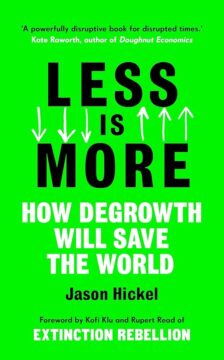 I have been promising/threatening for a while to cover degrowth, and thanks to a United States Society for Ecological Economics book club, now I will. In Less is More, economic anthropologist Jason Hickel identifies capitalism as the cause of our problems—the sort of criticism that makes many people really uncomfortable. Fortunately, he is an eloquent and charismatic spokesman who patiently but firmly walks you through the history of capitalism, exposes flaws of proposed fixes, and then lays out a litany of sensible solutions. It quickly confirms that sinking feeling most of us will have: that the economy is not working for us. What is perhaps eye-opening is that this is not by accident, but by design.
It helps, as Hickel quickly does, to clarify two things. First, he does not object to economic growth per se. Indeed, many of the world’s poorest countries need to grow further to meet basic human needs. The problem is growth for growth’s sake. In nature, growth is ubiquitous but normally follows a sigmoidal curve of some kind, eventually coming to a halt. Capitalism is different, which brings us to point two. People often confuse capitalism with markets and trade, but they pre-date capitalism by millennia. This is all textbook Marx, but, Hickel explains, markets and trade are organised around use-value: we trade for what is useful to us. Capitalism, on the other hand, is organised around exchange-value: goods are sold to make a profit, which is then reinvested to generate more profit. Growth is a structural imperative of capitalism: “It is a system that pulls ever-expanding quantities of nature and human labour into circuits of accumulation” (p. 40). The results are plain for all to see: environmental destruction and human immiseration benefitting a small minority.
More here.
Enjoying the content on 3QD? Help keep us going by donating now.