
Christopher Sandford in The Hedgehog Review:
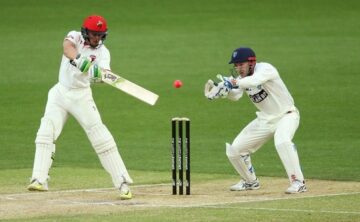 At its heart, cricket stands as a wonderfully pastoral exercise in deferred gratification. Today, there are various forms of the sport around the world, but to most purists its true and highest expression lies in the international, or “test,” match, involving, say, England playing Australia or India facing Pakistan. Such encounters typically last five full days, with roughly eight hours of actual sport each day and the contestants communally decamping to a hotel each evening and returning to pick up where they left off the following morning. Twice a day, the same players leave the field and stroll back to the pavilion, or clubhouse, for a good meal, and on the warmer afternoons—rarely an issue during matches in England—a uniformed attendant will periodically appear on the field bearing a tray of assorted refreshments. Just to give you a sense of the essentially unhurried nature of the enterprise, a single batter can remain at his post for several hours, if not entire days, on end, and, if sufficiently skillful, accrue upwards of one hundred individual runs before being dismissed. In another of cricket’s cherished rituals, he can expect to be warmly applauded by his opponents on reaching such a milestone.
For decades, cricket’s ruling powers have dreamed of making it big in America, with some success. Today, there are some six thousand teams of varying skill in operation from coast to coast, with a list of names that combine, in somehow quintessentially American style, the patriotic (Washington Freedom), the ecological (Seattle Orcas), and the gung ho (Texas Super Kings). In June 2024, the US national team defied expectations by beating their heavily favored opponents, Pakistan, in a round of the T20 (or shorter-form) World Cup tournament held at the 7,200-seat Grand Prairie Stadium, near Dallas.
More here.
Enjoying the content on 3QD? Help keep us going by donating now.