
Isabel Huacuja Alonso in The Caravan (from 2017):
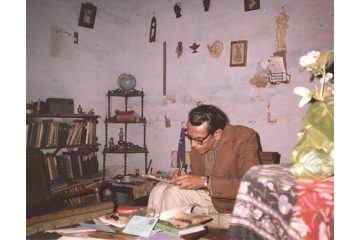 “Destitutes Compound,” a story by Naiyer Masud, is about a young man who leaves his home after an argument with his father. After his only friend dies, the man concludes that it is time for him to return to his family. As he makes preparations for his homecoming, he realises that the children he met when he first arrived at the compound now have greying hair. When he returns, he learns that both his parents have passed away, but an old, blind grandmother still sits in the house’s entrance cracking betel nuts, just as she had when he left. The image of the grandmother rhythmically cracking betel nuts has stayed with me for years. To me, she symbolises time itself, resting still, awaiting our return.
Masud is the author of four acclaimed collections of short stories in Urdu. Most of his stories meticulously detail everyday feelings and sensations, but in ways that render them unfamiliar, uncomfortable and new. The narrator of “Ba’i’s Mourners” is consumed by a fear of brides when he learns of one who died from a scorpion bite before reaching her groom’s house. In “Obscure Domains of Fear and Desire,” the narrator describes the complex sensations that old houses evoke in him—some sections of them make him feel afraid, while others evoke an eerie expectation that a distant desire will soon be fulfilled.
More here.
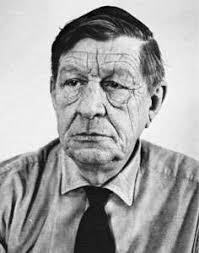 A second spur for Auden was his experience during the Spanish Civil War, where he witnessed the destruction of churches and the persecution and murder of the clergy. As Carpenter writes, “In all, several thousand clergy members of religious orders fell victim to Republican persecutors, and this was only a fraction of the total number of people murdered on the Republican side.” Auden was deeply disillusioned by what he found in Spain. He later said that he “could not escape acknowledging that, however I had consciously ignored and rejected the Church for sixteen years, the existence of churches and what went on in them had all the time been very important to me.”
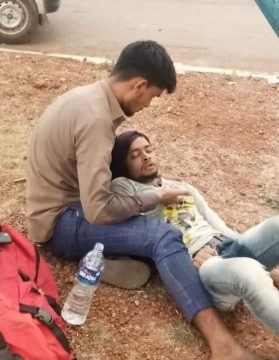 DEVARI, India — Somebody took a photograph on the side of a highway in India. On a clearing of baked earth, a lithe, athletic man holds his friend in his lap. A red bag and a half empty bottle of water are at his side. The first man is leaning over his friend like a canopy, his face is anxious and his eyes searching his friend’s face for signs of life. The man is small and wiry, in a light green T-shirt and a faded pair of jeans. He is sick, and seems barely conscious. His hair is soaked and sticking to his scalp, a sparse stubble lines the deathlike pallor of his face, his eyes are closed, and his darkened lips are half parted. The lid of the water bottle is open. His friend’s cupped hand is about to pour some water on his feverish, dehydrated lips.
 Our blood and cells are complex mixtures of DNA, RNA, proteins, metabolites, lipids, sugars, metal ions, and more. All of these are deeply important in informing our health and wellness. Today, we can measure a few of these molecules routinely, but what are we missing might be in the rest of the data. Dalton Bioanalytics is creating a comprehensive and inexpensive method to look at all these molecules to bring about truly multiomics data. I sat with Austin Quach, CSO of Dalton Bioanalytics, to talk about his platform from inventing it in his lab to starting a company.
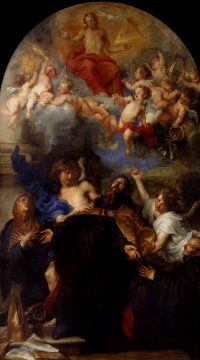 According to medieval Jewish commentaries on the Torah, heaven will be dazzling and dramatic. It will contain chambers “built of silver and gold, ornamented with pearls.” New arrivals will pass through gates guarded by 600,000 angels and bathed in “248 rivulets of balsam and attar.” The righteous will attend elaborate feasts and lounge in lavish gardens. As a rule, paintings of heaven are more vague and more amorphous than paintings of hell, but avuncular artists still stuff them with cherry-cheeked cherubs. In the New Testament, John promises his followers that God’s “house has many rooms.”
 In coming weeks, the Northeast of the United States will experience the peak of its annual migration of monarch butterflies. The butterflies’ life cycle takes place over an astonishingly broad geographic range. Each year, the monarchs overwinter by the millions in the high-altitude forests of Mexico. Then, in the spring and summer, they head north to the United States and southern Canada, the northern limit of where milkweed, the only plants that the fastidious monarchs breed on, will grow.
 A philosopher and cultural critic, Santiago Zabala is well known for articulating the ongoing relevance of a strand of philosophy oriented around interpretation: philosophical hermeneutics. In his latest book, he brings his hermeneutic perspective to an interrogation of the mounting challenges posed by the conditions of today’s intellectual and political landscape. As the subtitle indicates, this book addresses the misinformation and misunderstandings that are so prevalent today. Alternative facts, fake news and post-truth are all symptoms of a lack of any mutual understanding about what is real. Similarly, the return of realism has become a trend in the intellectual world, reflected in the realist rationality proffered by a psychologist like Jordan Peterson or by the philosophical movement of speculative realism. Questions about what is real have never been so pressing on a global scale. Indeed, responses to those questions have impacts not only on humanity but on the diversity of species on Earth, which are currently threatened with a mass extinction event.
 Imagine reading a story titled “The Relentless Pursuit of Booze.” You would likely expect a depressing story about a person in a downward alcoholic spiral. Now imagine instead reading a story titled “The Relentless Pursuit of Success.” That would be an inspiring story, wouldn’t it? Maybe—but maybe not. It might well be the story of someone whose never-ending quest for more and more success leaves them perpetually unsatisfied and incapable of happiness. Physical dependency keeps alcoholics committed to their vice, even as it wrecks their happiness. But arguably more powerful than the physical addiction is the sense that drinking is a relationship, not an activity. As the author Caroline Knapp described alcoholism in her memoir
  D
D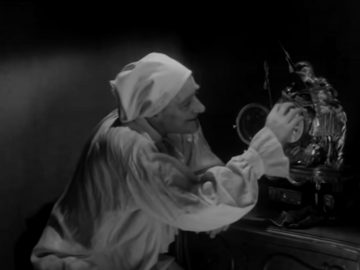 For that matter, Kant’s rigorous discipline turns out to be contagious. Though he was unmarried, he didn’t live alone—he had a household and spent much time interacting with his friend and unofficial majordomo Wasianski (played by André Wilms) and the manservant Lampe (Roland Amstutz)—and much of the movie’s action is centered on Kant’s obsessional domestic routine and the petty agonies of its perturbations. (The script, by Collin and André Scala, is loosely based on the memoirs of the real-life Wasianski,
 Chris Dillow writes perhaps the most interesting
  The world’s largest nuclear fusion project began its five-year assembly phase on Tuesday in southern