
Category: Recommended Reading
America Could Control the Pandemic by October
The Editorial Board of the New York Times:
 Six to eight weeks. That’s how long some of the nation’s leading public health experts say it would take to finally get the United States’ coronavirus epidemic under control. If the country were to take the right steps, many thousands of people could be spared from the ravages of Covid-19. The economy could finally begin to repair itself, and Americans could start to enjoy something more like normal life.
Six to eight weeks. For proof, look at Germany. Or Thailand. Or France. Or nearly any other country in the world.
In the United States, after a brief period of multistate curve-flattening, case counts and death tolls are rising in so many places that Dr. Deborah Birx, the Trump administration’s coronavirus response coordinator, described the collective uptick as a sprawling “new phase” of the pandemic. Rural communities are as troubled as urban ones, and even clear victories over the virus, in places like New York and Massachusetts, feel imperiled.
More here.
The Far Unknown
Eileen: The Making of George Orwell
Martin Tyrrell at the Dublin Review of Books:
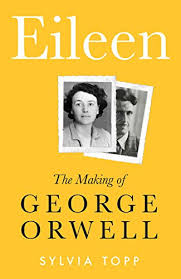 Eileen Blair, George Orwell’s first wife, is the subject of this welcome and assiduously researched biography by Sylvia Topp. Eileen married Orwell in 1936 when he was a virtual unknown and, until her death in 1945 at the age of just thirty-nine, shared with him a life that was lived primarily on the unreliable income from his writing. She did not live to see even the beginnings of the worldwide fame that would come her husband’s way with Animal Farm, which was published in the year of her death.
“She was a good old stick,” Orwell famously remarked when Stephen Spender offered his condolences. To Spender this was an affected stoicism: deep down, he reckoned, Orwell was hurting. Others thought the same. Still, it is that throwaway “good old stick”, ever so faintly on the wrong side of cold-heartedness, that has, well, stuck.
more here.
1 February 1974: The evolution of Lucian Freud
Robert Melville at The New Statesman:
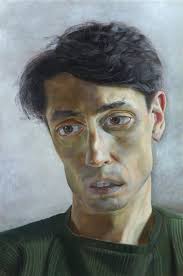 Immediately afterwards, the paintings take a turn towards our grosser world, and the realism begins to hurt. The portrait of John Minton has a piercing sadness. The portrait of Francis Bacon with lowered eyes has a Germanic intensity; it’s as if Grunewald had started a noli me tangere. The wide-eyed girl appears once more, in a green dressing gown, with a dog resting its head in her lap, but she has come back to our edgy, nerve-ridden world. Another girl appears. She has yellow hair and a charming face, and the images of her are still controlled by line.
By the end of the Fifties Freud is drawing with a loaded brush, and the faces ate marred by broad, highly visible paint strokes. In the frightening Woman Smiling he takes no account of human pride. He finds or invents a fearsome tattoo of blood clots under the skin.
more here.
Why Bertrand Russell’s argument for idleness is more relevant than ever
Max Hayward in New Statesman:
 We are used to thinking of idleness as a vice, something to be ashamed of. But when the British philosopher Bertrand Russell wrote “In Praise of Idleness” in 1932, at the height of the Great Depression, idleness was an unavoidable reality for the millions who had lost their jobs. Russell realised that his society didn’t just need to confront the crisis of mass unemployment. He called for nothing less than a total re-evaluation of work – and of leisure. Russell believed that we don’t only need to reform the economic system in which some are worked to the bone while others suffer jobless destitution, we also need to challenge the cultural ethic that teaches us to value ourselves in proportion to our capacity for “economically productive” labour. Human beings are more than just workers. We need to learn how to value idleness.
Russell’s call could hardly be more relevant today, as we face the prospect of another great recession. Millions may lose their jobs in the coming months and, as automation and technology continue to advance, the jobs lost during the pandemic may never return. Today, reformers point to the possibility of a universal basic income as a way to prevent widespread poverty. But, as many have learned while locked down at home on government-sponsored furloughs, a life without work can feel desolate even when supported by a steady income. Does a jobless future condemn us to live less meaningful lives?
In 1930 the economist John Maynard Keynes predicted that, within a century, advances in productivity would allow inhabitants of developed countries to maintain a decent standard of living while working 15 hours a week. If that prediction now looks laughable, it failed for reasons that Russell foresaw. Recalling the famous example of the pin factory that Adam Smith used to explain the division of labour, Russell imagined a new technology that will halve the amount of time it takes to make a pin. If the market for pins is already saturated, what will happen? In a sane world, Russell thought, the factory would simply halve working hours, maintaining the same wages but greatly increasing the time that the workers could devote to the joys of leisure. But, as Russell observed, this rarely happens. Instead, the factory owner will opt to keep half the workers on the same hours and lay off the rest. The gains from the advances of technology will be realised not as an expansion of leisure but rather as drudgery for some and jobless destitution for others, with the savings enjoyed only by the winner, the factory owner.
Looking back over the past century, we can see Russell’s predictions borne out.
More here.
In this dystopian world, Kamala Harris sails above the presidential bar
Richard Wolffe in The Guardian:
 What is Mike Pence? When the painted smile fades and the glazed eyes begin to focus on reality, is there an honest penny in him? For the next three months, the core question of whether Pence has any core is the only real target for America’s history-making vice-presidential candidate, Kamala Harris. As much as the Trump campaign wants to scare the bejesus out of its old, white base with terrifying tales about Krazy Kamala, her own policy positions don’t really matter. Like every other veep candidate, Harris doesn’t deliver a voter bloc or state. She doesn’t displace the top of the ticket because veeps never do.
All that matters is one debate night, in Salt Lake City, in early October. And even that night will be quickly overshadowed by the second presidential debate a week later. How can the summer’s biggest political story – except for the pandemic, recession and racial justice protests – be so easily dismissed? To understand that dynamic, you need look no further than Joe Biden and Pence. Back in 2008, Barack Obama’s pick of Biden as his running mate was everything Harris is today: a counterweight to everything he wasn’t. Biden offered some older, whiter balance to the first African American nominee for president. He also undercut Obama’s main claim to that nomination: opposing the war in Iraq. Biden had voted for the invasion, even as he turned into a sharp critic of the war like every other Democrat. How did Obama overcome his policy differences with Biden on the campaign trail? He didn’t need to.
More here.
Wednesday Poem
Mike Brown is Eighteen
[And legal] now.
[Taking full advantage of the enough he is.
Might go sign up for the war.
Might as well.
Still can’t get drunk,
or perhaps get a real loan
without offering his death,
as if it were even legal
to be young, black, living
and really living.
He is no exception.
Just “legal” now:
Legal to sex and war
and sign permission slips
for his own intents
and purposes.
What is a young black life?
But, thick hair,
good organs for the taking,
and crying mothers,
Anyhow. If that. Then,
what makes him feel that
he had the right to be
rendered enough?
To be black and worthy
of the space we take up
feels paradoxical
now and then;
It is his only constant,
his forgotten privilege,
to have inherited
a surplus of self-doubt.
But, he’s legal now,
old enough to be
declared “enough of that”
and withstand it all.]
Might as well…
by Trace Howard DePass
from Split This Rock
Tuesday, August 11, 2020
Philosophical Intuitions Are Surprisingly Stable
Joshua Knobe in Daily Nous:
 When it comes to many philosophical issues, people feel conflicted or confused. There is something drawing them toward one intuition but also something drawing them toward the exact opposite intuition. This tension seems to be an important aspect of what makes us regard these issues as important philosophical problems in the first place.
In a new draft paper, I argue that experimental philosophy research over the past decade or so has shown us something very surprising about these issues. It has shown that the tensions in people’s intuitions are themselves stable. In particular, these tensions seem to be surprisingly stable both across different demographic groups and across different situations.
To illustrate, consider the problem of free will. Existing studies on people from Western cultures indicate that there is a tension in their intuitions. There is something is drawing them toward compatibilism but also something drawing them toward incompatibilism. More recent studies have shown something very surprising about that tension. The tension seems to itself be stable across cultures. In other words, it’s not as though there are other cultures in which just about everyone thinks that compatibilism or incompatibilism is obviously right. Rather, people across numerous different cultures seem to find this issue confusing, and in much the same way.
More here.
Sean Carroll’s Mindscape Podcast: Jason Torchinsky on Our Self-Driving Future
Sean Carroll in Preposterous Universe:
 It’s easy to foresee that technological progress will change how we live; it’s much harder to anticipate exactly how. Self-driving cars represent an enormous technological challenge, but one that is plausibly on the way to being solved. What will be the unanticipated consequences when autonomous vehicles become commonplace? Jason Torchinsky is a fan of technology, but also a fan of driving, and his recent book Robot, Take the Wheel examines how our relationship with cars is likely to change in the near future.
More here.
Leo Szilard: The Genius Behind the Atomic Bomb
A blow-by-blow account of how Trump killed thousands of Americans
William Saletan in Slate:
 On July 17, President Donald Trump sat for a Fox News interview at the White House. At the time, nearly 140,000 Americans were dead from the novel coronavirus. The interviewer, Chris Wallace, showed Trump a video clip in which Robert Redfield, the director of the Centers for Disease Control and Prevention, warned of a difficult fall and winter ahead. Trump dismissed the warning. He scoffed that experts had misjudged the virus all along. “Everybody thought this summer it would go away,” said Trump. “They used to say the heat, the heat was good for it and it really knocks it out, remember? So they got that one wrong.”
Trump’s account was completely backward. Redfield and other U.S. public health officials had never promised that heat would knock out the virus. In fact, they had cautioned against that assumption. The person who had held out the false promise of a warm-weather reprieve, again and again, was Trump. And he hadn’t gotten the idea from any of his medical advisers. He had gotten it from Xi Jinping, the president of China, in a phone call in February.
More here.
We’re All Mad Here: A Conversation With Tom Waits
Quantifying Vitality: The Progressive Paradox
Jackson Lears at the Hedgehog Review:
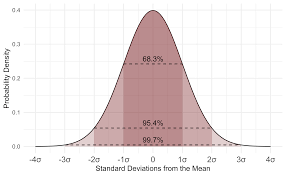 Statistics in the Progressive Era were more than mere signs of a managerial government’s early efforts to sort and categorize its citizens. The emergence of statistical selves was not simply a rationalization of everyday life, a search for order (as Robert Wiebe taught a half century of historians to say). The reliance on statistical governance coincided with and complemented a pervasive revaluation of primal spontaneity and vitality, an effort to unleash hidden strength from an elusive inner self. The collectivization epitomized in the quantitative turn was historically compatible with radically individualist agendas for personal regeneration—what later generations would learn to call positive thinking.
Then as now, positive thinking underwrote entrepreneurial ambition. Consider the career of Helen Wilmans, who abandoned her life as a rancher’s wife to become a prolific author of inspirational books celebrating the creative powers of mind.
more here.
Reading Comics
Ivan Brunetti at the Paris Review:
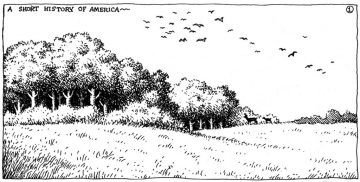 The comic is bookended by two pieces of nondiegetic text. We start with the title hovering above a pastoral scene, nature as yet unspoiled: trees, deer, birds, and a gently sloping hill. We can safely assume this is America, but when? It could be yesterday, or thousands of years ago. We deduce that the second panel shows this same setting not long after, because of a key continuity: the trees, placed in the same position inside the two panels, haven’t grown much. Our eyes adjust quickly to repetition and become acutely sensitive to any deviation, however small. Instantly, we take in the hill and felled trees, along with the introduction of the railroad track, upon which chugs a small train, billowing steam as it disappears into the distance. The wild animals are gone, a visual shorthand for the encroachment of humans. Because of the train’s presence, we infer that these first two panels take place in the early-to-mid-nineteenth century. In the third panel, a few birds glide in the sky, recalling the first panel. The hill remains in the scene (though altered), as well as the train track, but years must have passed, because we also see a house, shed, and cart (signifying “farm”), as well as a dirt road (signifying “town”), telegraph wires, and a man with horse and buggy. Will this fellow be our main character?
more here.
Tuesday Poem
Seduction
Poetry catches me with her toothed wheel
and forces me to listen stock-still
to her extravagant discourse.
Poetry embraces me behind the garden wall, she picks up
her skirt and lets me see, loving and loony.
Bad things happen, I tell her,
I, too, am a child of God,
allow me my despair.
Her answer is to draw her hot tongue
across my neck;
she says rod to calm me,
she says stone, geometry,
she gets careless and turns tender,
I take advantage and sneak off.
I run and she runs faster,
I yell and she yells louder,
seven demons stronger.
She catches me, making deep grooves
from tip to toe.
Poetry’s toothed wheel is made of steel.
by Adélia Prado
from The Alphabet in the Park
Wesleyan University Press, 1990
Translation from Brazilian Portuguese by Ellen Doré
Original Portuguese at “read more”
A bold and wise princess who doesn’t need a prince
Gail Russell Chadock in The Christian Science Monitor:
 We never knew why my father took over storytelling for his three little girls, but we always suspected it was to save us from “Sleeping Beauty.” Walt Disney’s masterwork hit the big suburban screens in 1959 with a message for girls as vivid as its widescreen Technirama: If you’re pretty enough, a prince will rescue you. In a masterstroke of counterprogramming, my father invented a series of bedtime stories featuring three princesses who happened to be just our ages and even looked like us. For some reason, the grownups were never around when peril struck. So, night after night, it was up to the three sisters to save the village, which they always managed to do just about the time that one of us fell asleep. It did occur to us that this village was either highly unfortunate or its adults incredibly inept that so much fell to these little girls. We also saw that our parents wanted us to be strong. These girls didn’t need to be rescued. They were alert, wise, and bold. That was enough. But how to carry this storyline into life was not obvious. The fifth-grade teacher might like you if you raised your hand in class, but what about the boy you hoped would ask you to dance? Experience showed that boldness could have a downside.
By the 1970s, there was a cottage industry explaining to women what was holding them back. We needed mentors, networks, and constant vigilance to manage our careers and break through the invisible “glass ceiling” limiting our progress. But in my early experience, glass ceilings were not often invisible. Women were just beginning to be admitted to what had been men-only colleges, and teaching jobs followed. Some who were not pleased showed it. I loved to tell my network about the welcome dinner for new graduate students in a vast, candlelit Gothic hall. I sat next to the dean of the graduate school, whose first words to me were: “I don’t know why the graduate school is now admitting women. You’ll all just get married, have babies, and your education will be wasted.”
After a few days to recover, I began telling friends this story and found their laughter and support encouraging. Soon, I had accumulated many such stories, all hilarious when told from my point of view. There was the department chair who told me at our first meeting that he used math requirements “to keep little girls out of the program.” Or the job interview that opened with the question: “Isn’t it amazing how so many unqualified women are now getting job interviews?” All good for laughs. Then, one of them hit hard. A colleague I trusted urged me, soberly, to quit teaching, because “If you don’t leave political science, you will lose everything feminine about you.” In today’s culture, that remark goes straight to laugh line. But on that day, in that place, something went crash. I walked back to my rented apartment over a garage convinced that my career was over. That’s usually a time to call a mentor, but he was the mentor. Nor was it a moment to enlist the network. Pity or encouragement both seemed intolerable.
In the quiet that followed, I opened a Bible, looking for any thought more inspiring than my own. Here’s the first thing I read: “How long will thou go about, O thou backsliding daughter? for the Lord hath created a new thing in the earth, A woman shall compass a man.” (Jeremiah 31:22).
More here.
Inside the mind of an animal
Alison Abbott in Nature:
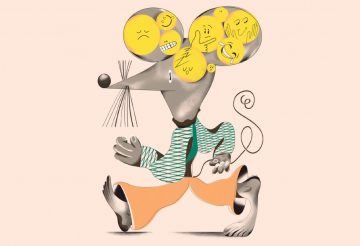 Two years ago, Jennifer Li and Drew Robson were trawling through terabytes of data from a zebrafish-brain experiment when they came across a handful of cells that seemed to be psychic. The two neuroscientists had planned to map brain activity while zebrafish larvae were hunting for food, and to see how the neural chatter changed. It was their first major test of a technological platform they had built at Harvard University in Cambridge, Massachusetts. The platform allowed them to view every cell in the larvae’s brains while the creatures — barely the size of an eyelash — swam freely in a 35-millimetre-diameter dish of water, snacking on their microscopic prey.
Out of the scientists’ mountain of data emerged a handful of neurons that predicted when a larva was next going to catch and swallow a morsel. Some of these neurons even became activated many seconds before the larva fixed its eyes on the prey1. Something else was strange. Looking in more detail at the data, the researchers realized that the ‘psychic’ cells were active for an unusually long time — not seconds, as is typical for most neurons, but many minutes. In fact, more or less the duration of the larvae’s hunting bouts.
“It was spooky,” says Li. “None of it made sense.”
Li and Robson turned to the literature and slowly realized that the cells must be setting an overall ‘brain state’ — a pattern of prolonged brain activity that primed the larvae to engage with the food in front of them. The pair learnt that, in the past few years, other scientists using various approaches and different species had also found internal brain states that alter how an animal behaves, even when nothing has changed in its external environment.
More here.
Sunday, August 9, 2020
Bill Gates on Covid: Most US Tests Are ‘Completely Garbage’
Steven Levy in Wired:
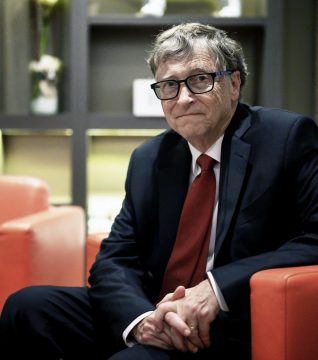 FOR 20 YEARS, Bill Gates has been easing out of the roles that made him rich and famous—CEO, chief software architect, and chair of Microsoft—and devoting his brainpower and passion to the Bill and Melinda Gates Foundation, abandoning earnings calls and antitrust hearings for the metrics of disease eradication and carbon reduction. This year, after he left the Microsoft board, one would have thought he would have relished shedding the spotlight directed at the four CEOs of big tech companies called before Congress.
But as with many of us, 2020 had different plans for Gates. An early Cassandra who warned of our lack of preparedness for a global pandemic, he became one of the most credible figures as his foundation made huge investments in vaccines, treatments, and testing. He also became a target of the plague of misinformation afoot in the land, as logorrheic critics accused him of planning to inject microchips in vaccine recipients. (Fact check: false. In case you were wondering.)
WIRED: You have been warning us about a global pandemic for years. Now that it has happened just as you predicted, are you disappointed with the performance of the United States?
Bill Gates: Yeah. There’s three time periods, all of which have disappointments. There is 2015 until this particular pandemic hit. If we had built up the diagnostic, therapeutic, and vaccine platforms, and if we’d done the simulations to understand what the key steps were, we’d be dramatically better off. Then there’s the time period of the first few months of the pandemic, when the US actually made it harder for the commercial testing companies to get their tests approved, the CDC had this very low volume test that didn’t work at first, and they weren’t letting people test. The travel ban came too late, and it was too narrow to do anything. Then, after the first few months, eventually we figured out about masks, and that leadership is important.
More here.
Immunology Is Where Intuition Goes to Die
Ed Yong in The Atlantic:
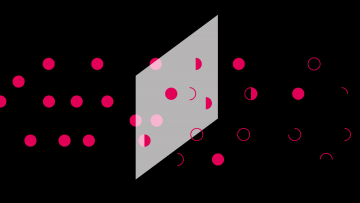 There’s a joke about immunology, which Jessica Metcalf of Princeton recently told me. An immunologist and a cardiologist are kidnapped. The kidnappers threaten to shoot one of them, but promise to spare whoever has made the greater contribution to humanity. The cardiologist says, “Well, I’ve identified drugs that have saved the lives of millions of people.” Impressed, the kidnappers turn to the immunologist. “What have you done?” they ask. The immunologist says, “The thing is, the immune system is very complicated …” And the cardiologist says, “Just shoot me now.”
The thing is, the immune system is very complicated. Arguably the most complex part of the human body outside the brain, it’s an absurdly intricate network of cells and molecules that protect us from dangerous viruses and other microbes. These components summon, amplify, rile, calm, and transform one another: Picture a thousand Rube Goldberg machines, some of which are aggressively smashing things to pieces. Now imagine that their components are labeled with what looks like a string of highly secure passwords: CD8+, IL-1β, IFN-γ. Immunology confuses even biology professors who aren’t immunologists—hence Metcalf’s joke.
More here.