
Katie Hafner at the website of the Glenn Gould Foundation:
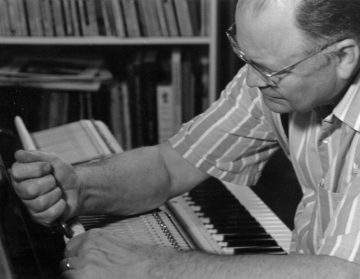 Verne Edquist, a master piano tuner who spent most of his professional life working for one client – Glenn Gould – died peacefully on August 27 after a long illness. He was 89.
I first met Verne in the summer of 2004, when I traveled to Toronto to start research for a book about Gould’s beloved CD-318. Verne and his wife, Lillian, welcomed me into their house on the outskirts of town and we sat for several hours in their living room, my recording device whirring away, while Verne recounted his life, and his work with the very eccentric Glenn Gould.
It was the start of an acquaintanceship that endured well past the publication of my book, A Romance on Three Legs: Glenn Gould’s Obsessive Quest for the Perfect Piano.
During that first meeting, I heard about the late-night recording sessions. Verne always arrived early to start tuning. Even after he finished tuning, he was required to stay throughout the session, in the event that a note should slip out of tune. I also heard about Gould’s endearingly bizarre coffee orders, his despair over the damaged CD-318, and his desperate calls to Verne late in his life, while re-recording The Goldberg Variations on a Yamaha.
More here.
 Stephen Hawking made a number of memorable contributions to physics, but
 A new compilation,
  Because Gornick is foremost a memoirist, any tour of her work must contend with her autobiography as she tells it, in fragments. There is no single book in which she narrates her life story straight through; “truth in memoir,” she writes in The Situation and the Story (2001), “is achieved not through a recital of actual events.” Instead, each of her books marshals different pieces of her life in service of a central insight, whether she’s writing memoir, criticism, reportage, or a biography of someone else. She is dedicated to nonfiction as a genre, but has a novelist’s instinct for selection. To recount her biography chronologically thus requires some reconstruction.
 The immediate aftermath of the
 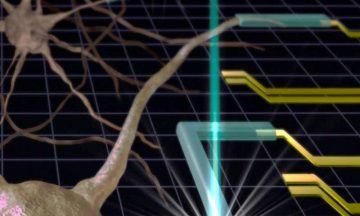 Researchers at the National Institute of Standards and Technology (NIST) have developed a new method of 3-D-printing gels and other soft materials. Published in a new paper, it has the potential to create complex structures with nanometer-scale precision. Because many gels are compatible with living cells, the new method could jump-start the production of soft tiny medical devices such as drug delivery systems or flexible electrodes that can be inserted into the human body.
 What does coffee do to you? Dinah Lenney’s Coffee is a free-form exploration of such surprisingly complicated questions: Why do we drink coffee? What gives it its power? Humans have been considering these and other coffee-related queries (like “Is it good for my health?” and “Is it good for my society?”) for centuries, ever since they first encountered the substance. Lenney is most interested in coffee’s direct effects on our lived experience, and what they mean.
 It
It  I recall an illuminating moment a decade or so ago. Cathy Guisewite had just announced she would step back from creating new instalments of her long-running
  ON MY DOORMAT,
 When I was a teenager I was, like most teenagers, preoccupied with the idea that somewhere on the horizon there was a Now. The present moment came to a peak out there; it achieved a continuous apotheosis of nowness, a wave endlessly breaking on an invisible shore. I wasn’t quite sure what specific form this climax took, but it had to involve some concatenation of records, poems, pictures, parties, and behavior. Out there all of those items would be somehow made manifest: the pictures walking along in the middle of the street, the right song broadcast in the air every minute, the parties behaving like the poems and vice versa. Since it was 1967 when I became a teenager, I suspected that the Now would stir together rock ’n’ roll bands and mod girls and cigarettes and bearded poets and sunglasses and Italian movie stars and pointy shoes and spies. But there had to be much more than that, things I could barely guess. The present would be occurring in New York and Paris and London and California while I lay in my narrow bed in New Jersey, which was a swamplike clot of the dead recent past.
 The smart play for Trump is to postpone the nomination to reduce the risk of Democratic mobilization, and to warn Republicans of the risks should he lose. Trump’s people do not usually execute the smart play. They are often the victims of the hyper-ideological media they consume, which deceive them about what actually is the smart play. This time, though, they may just be desperate enough to break long-standing pattern and try something different.
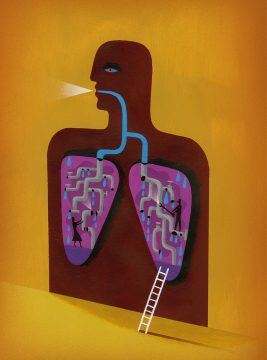 Over the course of two decades spent developing treatments for the genetic lung disease cystic fibrosis, biologist Fredrick Van Goor has had hundreds of conversations with patients. But he remembers one in particular. The discussion was about the genetics of cystic fibrosis, a disease that develops when a person inherits two faulty copies of the cystic fibrosis transmembrane conductance regulator (CFTR) gene. This gene encodes the CFTR protein, which resides in the cell membrane and transports chloride and bicarbonate ions out of the cell. More than 2,000 variants of CFTR have been identified, and more than 350 of them are known to produce enough disruption in the protein’s function to trigger the debilitating and life-shortening condition. The focus of the conversation was the inevitable inequities of personalized medicine, which can be highly effective for people who meet certain criteria, but will leave others behind — as was the case for this patient. “He described it as being on a sinking ship, when all of the other lifeboats have left,” Van Goor recalls. “That image has stuck with me.”