Isaac Chotiner in The New Yorker:
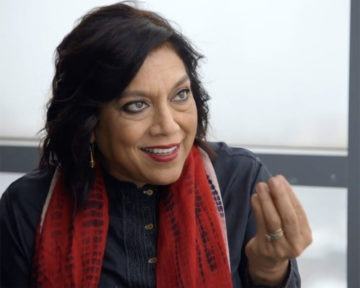 This month marks the American release of the director Mira Nair’s six-part television adaptation of “A Suitable Boy,” Vikram Seth’s beloved, kaleidoscopic novel of early post-Partition India, from 1993. (It began streaming on Acorn TV on December 7th.) The book, which, at more than thirteen hundred pages, is longer than “War and Peace,” tells the story of a young woman, Lata, and her search for a husband, while also featuring a remarkable cast of characters, largely from four interwoven families. The novel also touches on land reform, cricket, and religious tension, in playful, inventive language and sometimes with laugh-out-loud humor. Seth reportedly has been working on a sequel for more than a decade, the rumors of which have thrilled his fans.
Nair, who was born in 1957 in the Indian state of Odisha (then called Orissa), and has been based in New York for about four decades, was an obvious choice for the adaptation. In 1988, she directed “Salaam Bombay!,” a critically acclaimed account of life in the slums of Mumbai. She followed it up with an early Denzel Washington drama, “Mississippi Masala,” about an Indian from Uganda in the American South. Since then, Nair has made ten feature films, including “Monsoon Wedding,” from 2001, and has become known as one of the preëminent interpreters of the Indian-immigrant experience. Nair has also adapted classic novels, including “Vanity Fair,” and several pieces of modern literature, such as Jhumpa Lahiri’s “The Namesake” and Mohsin Hamid’s “The Reluctant Fundamentalist.” In a Profile of Nair, in 2002, John Lahr wrote, “Nair’s films negotiate disparate ethnic geographies with the same kind of sly civility she practices in life. Her approach is sometimes oblique: she doesn’t make political films, but she does make her films politically. Her gift, to which ‘Monsoon Wedding’ attests, is to make diversity irresistible.”
Nair and I recently spoke over Zoom, while she was completing work on the last episode of the series. During our conversation, which has been edited for length and clarity, we discussed her career as a filmmaker, the challenges of adapting an epic novel, and how rising intolerance in India, led by the Hindu-nationalist Bharatiya Janata Party, affected her work on “A Suitable Boy.” After our interview, it was reported that members of the B.J.P. called for an investigation of Netflix, the series’ Indian distributor, claiming that the depiction of a kiss between a Muslim man and Hindu woman intentionally affronts religious sentiments, which in India is a criminal offense. Netflix has made no public comment, and Nair declined to address the complaint.
More here.


 This much is all true: I believe that “quality television” is in fact of extremely low quality, that “YA literature” is not literature, that “OA literature” as it were looks more and more like YA with each passing year, that superhero movies are of course not cinema and that no self-respecting adult should ever watch them, except perhaps as an expression of love to some li’l tyke in their lives. If we were living in a culture dominated by grown-ups, Martin Scorsese would be considered the purveyor of middle-brow forgettable fare rather than the gold standard of sophistication, and at least the childless among us would not even have to be aware of Spider-Man’s existence.
 Those of us living in democracies tend to take the idea for granted. We forget what an audacious, radical idea it is to put government power into the hands of literally all of the citizens of a country. Where did such an idea come from, and where is it going? Political scientist David Stasavage has written an ambitious history of democracy worldwide, in which he makes a number of unconventional points. The roots of democracy go much further back than we often think; the idea wasn’t invented in Athens, but can be found in a large number of ancient societies. And the resurgence of democracy in Europe wasn’t because that continent was especially advanced, but precisely the opposite. These insights have implications for what the future of democracy has in store.
 At twenty-seven weeks, my baby was a sweet potato—and also a croissant, a slingshot, and a sugar glider. At thirty-one weeks, she was a head of romaine lettuce, a croquembouche, a foam finger, and a small-clawed otter. There were inconsistencies. At twenty-four weeks, she was the size of an Atlantic puffin but also a GI Joe, which I’d thought was very small. The bakery item that week was a demi-baguette, which further complicated things, as a baguette is long and skinny, unlike a rotund Arctic bird. Later, I realized I had confused the GI Joe with a toy soldier. (I myself had been a Teenage Mutant Ninja Turtles girl in childhood.) Some weeks I tried to average out the animal, vegetable, toy, and bread and come up with my own Jabberwocky: a puffin with baguette legs and a GI Joe head.
 BRUEGEL SEEMS LIKE A BETTER FIT for a certain type of film than for poetry. His indiscriminate eye; his contempt for obvious “takeaways”; his wide, lucid images withholding judgment—in all these ways, he anticipates the “slow
 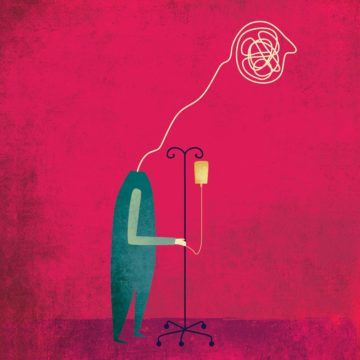 In her job as a physician at the Boston Medical Center in Massachusetts, Sondra Crosby treated some of the first people in her region to get COVID-19. So when she began feeling sick in April, Crosby wasn’t surprised to learn that she, too, had been infected. At first, her symptoms felt like those of a bad cold, but by the next day, she was too sick to get out of bed. She struggled to eat and depended on her husband to bring her sports drinks and fever-reducing medicine. Then she lost track of time completely.
 Beth, the protagonist of the TV show The Queen’s Gambit, is not someone you’d want as a friend. She takes money from her childhood mentor—the old janitor who taught her chess—and never pays him back, visits him or thanks him for launching her career. She treats the young men who help her improve—a group that eventually coalesces into a supportive entourage—in a similarly instrumental way. She is so focused on winning tournaments that she can barely spare a word of caution when her adoptive mother is falling into a fatal alcoholic spiral. When she loses, she is petulant and childish, unlike her opponents, who are graceful and kind. She is cruel and manipulative when—as an adult—she plays against a talented Russian child, softening to him only after she has beaten him.
 The idea that the Earth itself is like a single evolving ‘organism’ was developed in the mid-1970s by the independent English scientist and inventor James Lovelock and the American biologist Lynn Margulis. They dubbed it the ‘Gaia hypothesis’, asserting that the biosphere is an ‘active adaptive control system able to maintain the Earth in homeostasis’. Sometimes they went pretty far with this line of reasoning: Lovelock even ventured that algal mats have evolved so as to control global temperature, while Australia’s Great Barrier Reef might be a ‘partly finished project for an evaporation lagoon’, whose purpose was to control oceanic salinity.
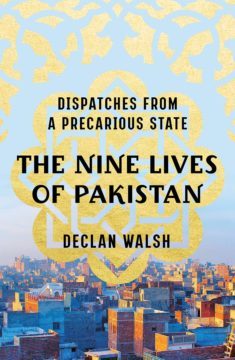 A decade before the arrival of New York Times correspondent Declan Walsh’s The Nine Lives of Pakistan: Dispatches from a Precarious State—which was released in the United States on Nov. 23—another major book of long-form reportage about the country’s chaotic post-9/11 years was published: Nicholas Schmidle’s To Live or to Perish Forever. The two books open with anecdotes of the authors being suddenly ordered to pack their bags and expelled from the country after reporting stories that crossed a red line for Pakistan’s security services—Schmidle for reporting on the Pakistani mutation of the Taliban and Walsh for his coverage of the insurgency in the vast, rural Balochistan province. Walsh’s book comes more than seven years after he was kicked out of Pakistan in May 2013.
 On December 4, Netflix subscribers will start streaming Mank, David Fincher’s biopic about Herman Mankiewicz, the Hollywood screenwriter who wrote the original script for Orson Welles’s Citizen Kane. Mank is a cinematic feast that requires neither familiarity with Herman Mankiewicz nor prior exposure to Citizen Kane to enjoy it. But as with most works of complexity, the more one brings to it, the richer the experience. As it happens, I bring a great deal. I call it knowledge. The less charitable might call it obsession.
 The best thing about David Fincher’s new film, “Mank,” is that it isn’t about what one expects it to be about. More specifically, the movie (which is streaming on Netflix) is not about the assertion, made most strenuously by Pauline Kael in her controversial New Yorker piece “