
 Kathleen Tyson over at the Official Monetary and Financial Institutions Forum:
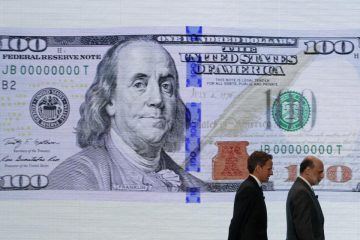
Speculation about the dollar’s hegemonic decline is premature. The global financial plumbing is relatively inflexible in the short term. It will not change quickly or inexpensively.
It took a century of New York banks’ financial activism and extensive global interbank innovation and collaboration to make the dollar a global hegemonic currency.
Dollarisation of the global economy was driven by mercantile ambitions from New York, not geo-strategic ambitions from Washington. New York banks expanded abroad with gold as the hegemonic asset for settlements, offering dollar finance only for trade. The dollar only became a hegemonic currency after the US revoked Bretton Woods dollar-for-gold convertibility in 1971.
It was New York banks that insisted on the need for a central bank and the plumbing for international settlements. The Federal Reserve was founded in 1913 against a backdrop of wider national suspicion and American isolationism, hence the 12 regional reserve banks and a strict domestic mandate. The McFadden Act in 1927 banned inter-state branching and mergers by American banks, forcing New York banks to look abroad for investment and expansion opportunities. Like the Fed, the Bank for International Settlements was conceived in New York to make settlements of gold and German war reparations more convenient. The first two presidents of the BIS were New York mercantile bankers. The Fed only joined the BIS as a member in 1994.
More here.
 Gilad Edelman in Wired:
 Salomé Viljoen in Phenomenal World:
 Raphaële Chappe and Mark Blyth debate Sebastian Mallaby in Foreign Affairs (registration required):
 “I have a crazy new way of writing poems,” John Berryman wrote to illustrator Ben Shahn in January 1956. He had indeed hit on something crazy and new: an 18-line structure he ended up calling his “
 W
W No writer understood loneliness better than
 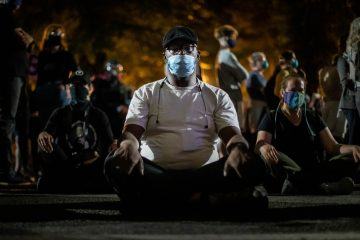 Ah, election season. There’s a patriotic buzz in the air. Bumper stickers and lawn signs all over the neighborhood. Now comes the time when we check the location of our polling places, make a plan to vote—and pack a “go bag” in case we need to take to the streets in sustained mass protest to protect the integrity of the vote count. That last one is not something you’d expect to be doing in the United States, but things are different in the
 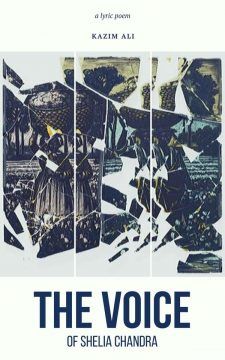 Kazim Ali’s latest book of poems is born out of our collective existential crisis. How do we continue to survive “in a world governed by storm and noise”? Creating an ingenious form on the page, Ali uses sound to give us a sort of research project that grapples with this crisis of survival over time. But the project’s beauty manifests from the impossibility of its findings. After all, how is one supposed to answer the colossal question of existence?
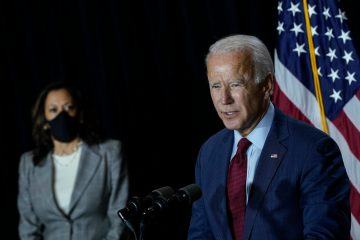 Hydraulic fracturing — the controversial oil and gas extraction method usually called “fracking” — has divided Democrats and the political left for a decade now. Many in the environmental community claim that allowing fracking is incompatible with climate action. Others, including Joe Biden and Kamala Harris, take a more nuanced position: During their respective debates, both Biden and Harris emphasized that a Biden-Harris administration would not ban fracking.
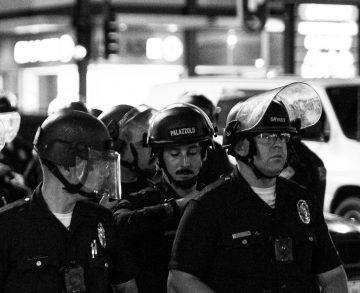 From Jacob Blake, to George Floyd, to Breonna Taylor, 2020 has seen immense pressure to re-examine how the police interact with society. The oft-cited statistic that Black individuals are
 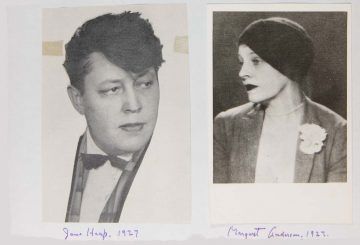 In the early thirties, for a certain clique of Left Bank–dwelling American lesbians, the place to be was not an expat haunt like the Café de Flore or Le Deux Magots. Nor was it Le Monocle, the wildly popular nightclub owned by tuxedoed butch Lulu du Montparnasse and named for the accessory worn to signal one’s orientation. According to the writer Solita Solano, the “only important thing in Paris” was a study group on the philosophies of the Greek-Armenian mystic George Ivanovich Gurdjieff, held at Jane Heap’s apartment. Heap, a Kansas-born artist, writer, and gallerist, was Gurdjieff’s official emissary, a rare honor. Under her supervision, the group engaged in intense self-revelation, narrating the stories of their lives without censoring or embellishing. As the author Kathryn Hulme explained in her memoir, Undiscovered Country: A Spiritual Adventure, the goal was to uncover the real I and thus escape being “a helpless slave to circumstances, to whatever chameleon personality took the initiative.”
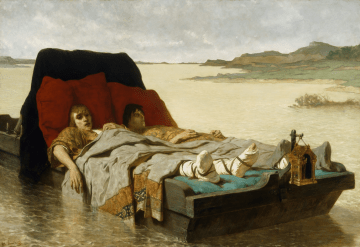 When one thinks about the Merovingians—and, really, who doesn’t?—one seldom thinks of the Mediterranean. There is good reason for that. Whatever else the Merovingians may have been, they were a hodgepodge of northern clans, tribes, and kingdoms who came from one end of the northern tier of Europe and settled eventually in the other. They drank beer rather than wine; cooked in lard rather than olive oil; avoided cities as centers of evil spirits; had little literature that we know of and less science; had no ships other than rivercraft; and lived, fought, and died on scattered parcels of farmland cleared from the immense, dense forest of the continent. That is not to say they fitted the prejudiced Dark Age caricature of them as mere “barbarians”—a kind of gruesome but temporary way station between the glories of Rome and Aachen. As shown by a generation of scholars from Walter Goffart and Ian Wood to Chris Wickham, Andreas Fischer, and Peter Heather, the period from Rome’s fall to Aachen’s ascent deserves to be studied for its own self and not merely as another of history’s dreary “periods of transition”; after all, every age is one of transition, and the transitions involved—political, cultural, intellectual, technological, and every other type—are usually themselves the chief points of interest.
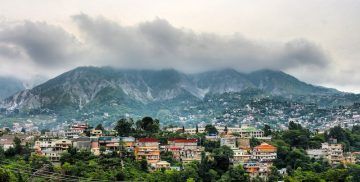 Today, Kashmiri writers are of all forms. They write folklore, journalism, novels, blogs, poems, ghazals, nazms: literature can be found scribbled on trees, on social media, in notebooks kept in attics. They write across languages: in Kashmiri, Urdu and English, and within Kashmir lie distinctions, of class, caste and language.