
Avi Asher-Schapiro in Harper’s Magazine:
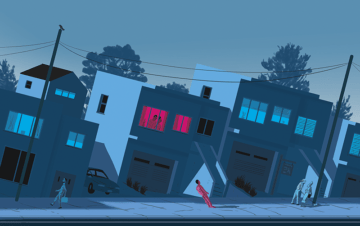 Susan Simien was born and raised in San Francisco, but he had begun to feel like a stranger in his hometown. In the Nineties, when Simien was growing up, the Ingleside neighborhood where he lived was diverse—nearly half of its households were, like Simien’s, middle-class and African-American. But in recent years, friends and neighbors had left for more affordable towns and suburbs—so many that Simien had lost track. Over the course of his lifetime, the African-American population in San Francisco had been cut in half. “You can’t throw a rock and hit someone who actually grew up around here,” Simien liked to say.
As a teenager, Simien knew he wanted to work in the tech industry. While other kids in his neighborhood were playing outside, he was shooting aliens on his Xbox; when anyone in his family needed help with a broken printer or new cell phone, they called Simien. In 2017, at age twenty-five, he joined the International Brotherhood of Electrical Workers union, and he was soon making $30 to $40 an hour as an AV installer—as much as $75,000 a year if he could get steady work. Over the long term, though, the pay wasn’t going to cut it in the Bay Area. “Low six figures was beginning to feel like low-income,” he told me. Simien and his family were just the sort of people getting priced out. He lived with his grandparents near the top of a sloping block in a boxy, two-story, suburban-style tract house—the kind of building that developers erected after World War II to accommodate the upwardly mobile families filling out the city’s edges. Simien’s grandmother worked for decades as a manager at a department store; by the mid-Nineties, she had saved enough money to buy the house for $150,000. The family is still paying off the mortgage. “I didn’t want to ever have to leave that house,” Simien told me. “I knew I had to do something.”
One day in 2017, Simien was riding the BART train when he saw an ad for the Holberton School, a for-profit technology training program. Holberton had plastered the stations with posters that said things like ivy league salaries and no up-front tuition and become a software engineer in 2 years or less. The ads featured flattering photos of people who looked like Simien’s friends from Ingleside: twentysomething African Americans, Asian Americans, and Latinos. They were all grinning.
More here.
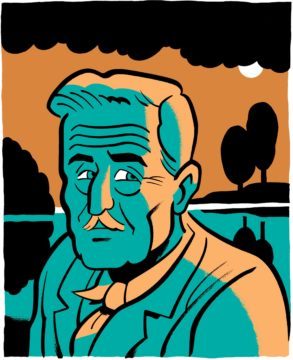 What if the North had won the Civil War? That technically factual counterfactual animated almost all of William Faulkner’s writing. The Mississippi novelist was born thirty-two years after Robert E. Lee surrendered to Ulysses S. Grant at Appomattox, but he came of age believing in the superiority of the Confederacy: the South might have lost, but the North did not deserve to win. This Lost Cause revisionism appeared everywhere, from the textbooks that Faulkner was assigned growing up to editorials in local newspapers, praising the paternalism and the prosperity of the slavery economy, jury-rigging an alternative justification for secession, canonizing as saints and martyrs those who fought for the C.S.A., and proclaiming the virtues of antebellum society. In contrast with those delusions, Faulkner’s fiction revealed the truth: the Confederacy was both a military and a moral failure.
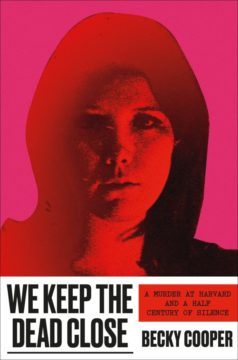 I asked Iva and James to tell me everything they knew. They looked uncomfortable, whispering despite the fact that there wasn’t really anyone there but the barista.
 It seems an innocent enough question: why are males more frequently left-handed than females? But the answer is far from simple, and it reveals fundamental principles of how our psychological and behavioural traits are encoded in our genomes, how variability in those traits arise, and how development is channelled towards specific outcomes. It turns out that the explanation rests on an underlying difference between males and females that has far-reaching consequences for all kinds of traits, including neurodevelopmental disorders.
 For those awash in anxiety and alienation, who feel that everything is spinning out of control, conspiracy theories are extremely effective emotional tools. For those in low status groups, they provide a sense of superiority: I possess important information most people do not have. For those who feel powerless, they provide agency: I have the power to reject “experts” and expose hidden cabals. As Cass Sunstein of Harvard Law School points out, they provide liberation: If I imagine my foes are completely malevolent, then I can use any tactic I want.
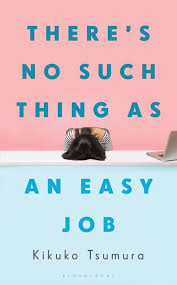 “God,” a friend of mine recently confided to me, “needs to make a comeback.”
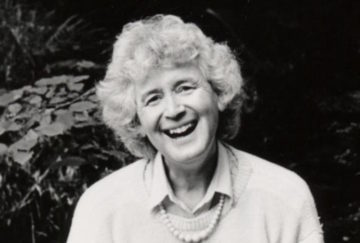 Wales mattered to Jan. In midlife, and at more or less the same time as her gender reassignment, she embraced what she called Welsh Republicanism. Her home, Trefan Morys, is in a remote area near the town of Criccieth. You leave the main road, take a long, rutted drive, negotiate the narrow entrance in a high stone wall, and you are suddenly in an enchanted space. Elizabeth was the architect of the garden and Jan the interior designer. You enter the house through a two-part stable door (Jan always greeting you with the words, “Not today, thank you”), into a cozy kitchen, and then the main downstairs room. The walls are lined with eight thousand books, including specially leather-bound editions of Jan’s own. Up the stairs there is another long room, with an old-fashioned stove in the middle. Here are more books, but this space is given over mainly to memorabilia and paintings. Pride of place is given to a six-foot-long painting of Venice, done by Jan, in which every detail of the miraculous city is rendered (including tiny portraits of the two eldest sons, who were very young at the time Jan painted it). Model ships hang from the ceiling, and paintings of ships adorn the walls. Jan loved ships from the time she spied them, as a child, through a telescope as they passed through the Bristol Channel near her family’s home.
 The UK National Health Service (NHS) is set to initiate the trial of Galleri blood test that can potentially detect over 50 types of cancers. Developed by GRAIL, the test is capable of detecting early-stage cancers through a simple blood test. In research on patients with cancer signs, the test identified many types like head and neck, ovarian, pancreatic, oesophageal and some blood cancers, which are difficult to diagnose early. The blood test checks for molecular changes. NHS Chief Executive Simon Stevens said: “Early detection – particularly for hard-to-treat conditions like ovarian and pancreatic cancer – has the potential to save many lives. “This promising blood test could therefore be a game-changer in cancer care, helping thousands of more people to get successful treatment.” Anticipated to start in the middle of next year, the GRAIL pilot will involve 165,000 people. This participant population will include 140,000 people aged 50 to 79 years who have no symptoms but will have annual blood tests for three years.
 For centuries people have pondered the
  You might recall the strange case of Matthew J. Mayhew, professor of educational administration at The Ohio State University. In late September he published
 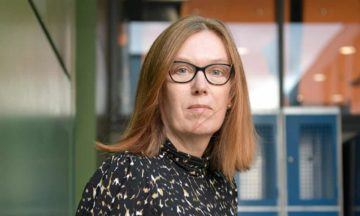 At the heart of Oxford’s effort to produce a Covid vaccine are half a dozen scientists who between them brought decades of experience to the challenge of designing, developing, manufacturing and trialling a
 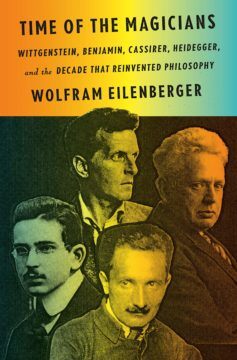 “AND WHAT ABOUT unbiased research? What about pure knowledge?” bursts out the more idealistic of the two debaters. Before the other, the more cynical one, even has a chance to answer, the idealist ambushes him with even grander questions: “What about the truth, my dear sir, which is so intimately bound up with freedom, and its martyrs?” We can picture the caustic smile on the cynic’s face. “My good friend,” the cynic answers, “there is no such thing as pure knowledge.” His words come out calmly, fully formed, in sharp contrast to the idealist’s passionate, if sometimes logically disjointed pronouncements. The cynic’s rebuttal is merciless:
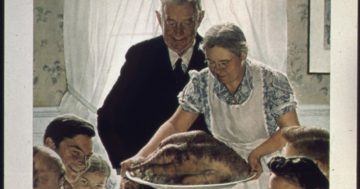 Our quest centres on this simple question: why do so many languages and cultures identify these North American natives as “the birds from India” (oiseaux d’Inde, or simply dinde in French).
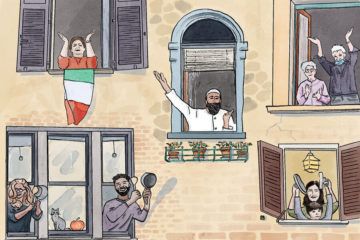 Truth is, this year has seen plenty of gratitude, instinctively and generously expressed. The people applauding out their windows for emergency responders, the heart signs, the food deliveries to essential workers, the neighborhood trash teams, the looking-in on elders. Online platforms as purpose-built as gratefulness.org and as customarily combative as Twitter have been flooded with counted blessings: for our loved ones, for the Amazon carrier, for our dogs. People gave thanks for simple things, mostly – their families, video chats, the “tall green trees that are older than me,” a hummingbird, the ocean, soup. (“Yep, soup,” says a West Sacramento, California, man.) But many, many other expressions of gratitude took the form of generosity, of trying to give back or pay it forward. The news was filled with stories of people in grocery lines paying for the customer coming next, donations to farmworkers, businesses furnishing free meals to front-line responders.
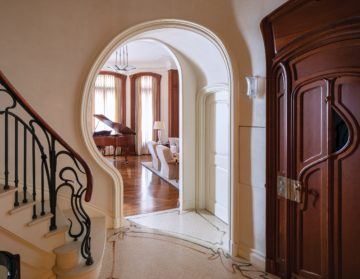 Mark Ellison stood on the raw plywood floor, staring up into the gutted nineteenth-century town house. Above him, joists, beams, and electrical conduits crisscrossed in the half-light like a demented spider’s web. He still wasn’t sure how to build this thing. According to the architect’s plans, this room was to be the master bath—a cocoon of curving plaster shimmering with pinprick lights. But the ceiling made no sense. One half of it was a barrel vault, like the inside of a Roman basilica; the other half was a groin vault, like the nave of a cathedral. On paper, the rounded curves of one vault flowed smoothly into the elliptical curves of the other. But getting them to do so in three dimensions was a nightmare. “I showed the drawings to the bass player in my band,” Ellison said. “He’s a physicist, so I asked him, ‘Could you do the calculus for this?’ He said, ‘No.’ ”