
Category: Recommended Reading
Letter from Karachi
Alia Ahmed at The Hudson Review:
 Today I am in Saddar, the former colonial center, clamorous and poetically falling to bits. Pakistan is a particularly loud country (“Well, yes,” a famous doctor once countered, rolling his eyes, “there are people here,” yet I stand by it), and Saddar is no different. Once a pedestrian zone crisscrossed by tram lines, it is now clogged by technicolor buses and auto-rickshaws, dusty vans, beat-up cars, or the tinted 4 x 4 of a Very Important Person, complete with armed bodyguards limply hanging off the side like party streamers. Traffic cops, elegant in starched white uniforms, stand bravely amidst the chaos to direct it with waving arms and screeching whistles. Saddar is home to the Karachi Press Club, the Cotton Exchange, the City Railway Station and, of course, the experiment in human ingenuity that is the parking lot outside the National Bank. Cars are parked in tight rows, squeezed into whatever available space, no sensible way to vacate. A smattering of biryani restaurants lines the far end of the lot. Dilawar (a young Pushtun with green eyes, a migrant from the cold north) hollers for the other “valets” and, consolidating their manpower, lift stationary cars out of the way, hooting encouragement, so I can reverse.
more here.
The Thinkers Who Tried To Strip Metaphysics From Philosophy
Gary Saul Morson at The American Scholar:
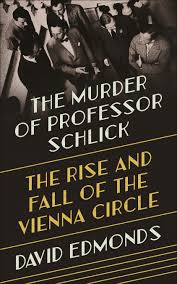 Austria between the world wars fostered an extraordinary number of talents in diverse fields: Sigmund Freud in psychology, Arnold Schoenberg in music, Karl Kraus in journalism, Robert Musil in literature, Gustav Klimt in art, the Bauhaus in architecture, and the “Austrian school” in economics. In some of these areas, the overriding ethos was hostility to what the Bauhaus called “ornament.” The Vienna Circle of philosophers, led by Moritz Schlick, hoped to cleanse philosophy of anything vague or, to use their favorite term of abuse, “metaphysical.” Some members also aspired to provide firm foundations for knowledge, an ambition that can be traced back to Descartes and the 17th-century rationalists.
They hoped to realize this ambition by rethinking the bases of mathematics and science. As British philosopher David Edmonds points out in this informative and well-written account, by “science” the Circle philosophers meant physics because, surprisingly enough, they were ignorant of recent major innovations in biology.
more here.
Are Poly-aneuploid Cancer Cells the Keystone Cure for Cancer?
From Scientia:
 Cancer is a global health concern. There are over 100 types of cancer, which taken together, kill more than 10 million people across the world each year. Although localised cancers can be treated successfully through excision or localised radiotherapy, metastatic cancers spread throughout the body and are incurable, eventually leading to death. Once cancer cells have metastasised, they grow aggressively and are resistant to virtually all treatments. Despite enormous funds and dedicated efforts put into cancer research over the last half-century, half of all people diagnosed with cancer still die from their disease.
Traditional thinking in cancer therapy accepts that cancer is incurable once it spreads. There are billions of cells in a tumour and it only takes one cell to randomly mutate into a form with increased tolerance to survive treatment and then to clone itself. Cancer therapies have focussed on multi-drug chemotherapies to tackle the progression of new cancers as they occur, or to develop drugs that target resistance-associated mutations. However, cancer cells have proven resistant to all high-tech medical innovations to date. Researchers have not understood exactly what cells or mechanisms that cause this remarkable resilience amongst cancer cells. Dr Kenneth Pienta at the Johns Hopkins School of Medicine, USA, is leading an amazing and bold line of discovery in cancer research. Critically, his team now believes that polyaneuploid cancer cells (PACCs) are the master mediators of this resilience and provide an adaptive way for tumours to survive almost any type of stress.
…Two key questions across all types of cancer research are, why do some cancer cells become immune to treatment and why do they metastasise? Returning to thinking about cancer cells as an ecosystem paradigm, discussions with cancer biologist Dr Sarah Amend and ecologist Dr Joel Brown turned to the example of short-horned grasshoppers. When food is abundant, grasshoppers are typically green and healthy solitary specimens, but in times of nutritional stress, the next generation becomes yellow locusts, growing wings and changing their behaviour to become more gregarious, swarm-forming animals that travel to seek new food sources. Once resources are again abundant, the next generation once again transmogrifies back to the grasshopper morph.
More here.
The Long History of Blaming Immigrants in Times of Sickness
Tara Wu in The Smithsonian:
 On a chilly morning in February, about a thousand Chinese immigrants, Chinese Americans and others filled the streets of San Francisco’s historic Chinatown. They marched down Grant Avenue led by a bright red banner emblazoned with the words “Fight the Virus, NOT the People,” followed by Chinese text encouraging global collaboration to fight Covid-19 and condemning discrimination. Other signs carried by the crowd read: “Time For Science, Not Rumors” and “Reject Fear and Racism.” They were responding to incidents of bias and reported significant drops in revenue in Chinatown and other local Asian American-owned businesses, even at a time when the city had not yet experienced any Covid-19 cases. The rally banner is soon to join the collections of the Smithsonian’s National Museum of American History for the story it tells of America’s history of associating its immigrants with disease.
“There have been long-standing messages about disease being particularly something that Chinese immigrants, Chinese spaces incubate, that Chinese people spread, either because of their unsanitary living conditions or especially the weird, exotic food that Asians allegedly eat,” says Erika Lee, director of the Immigration History Research Center at the University of Minnesota.
…On the cover of an 1899 issue of another mainstream magazine, Judge, U.S. President William McKinley is depicted bathing a Filipino native baby in the “waters of civilization.” In the background, two figures dressing themselves in clothes made from the Puerto Rican flag have presumably just been freshly washed with the same “brush of education” that McKinley holds in his hand. Published during the Spanish-American War just after the U.S. colonized the Philippines and Puerto Rico, the illustration vividly visualizes the racist ideas of the period, according to Theodore Gonzalves, a curator at the museum who specializes in Asian American and performing arts history.
More here.
Tuesday Poem
Blue Heron
The startled blue heron erupts out of its long-legged
inwardness and flies low to the pond over its
shadow. My eye flickers between its great sweep
of wings and its blurred mirror motion almost white
in the pond’s sky-shine. At the end of each wingbeat,
the long body dips toward its rising shadow. Now
the heron settles back down onto itself as far away
from me as the pond allows and I finish my walk half gangly,
half graceful thinking if I were a bird, this is how I’d fly.
by Nils Peterson
from All the Marvelous Stuff ,
Caesura Editions, 2019
—winner for poetry, San Francisco Book Festival 2020
Sunday, October 18, 2020
E. B. White’s “Plain Style” @75
Jan Mieszkowski at Public Books:
 “No one,” declared James Thurber, “can write a sentence like E. B. White.” Throughout his six-decade career, White was widely celebrated for his mastery of “the plain style.” His columns and anecdotes for the New Yorker, his longer essays, and his immensely popular trio of children’s books (Charlotte’s Web, Stuart Little, The Trumpet of the Swan) were invariably praised for their clarity and unadorned directness, not to mention their pithy gestures of tasteful irreverence.
In addition to being an acclaimed essayist and children’s author, White had the curious fate to have written the book on how to write, or at least part of it, when he updated and expanded a pamphlet his former teacher William Strunk Jr. had created for his students at Cornell. The result was the most successful composition guide of all time. The Elements of Style—“Strunk and White”—has sold more than 10 million copies and is still a staple of higher-education syllabuses, although it is assigned far more often than it is read.
It might seem self-evident that White the author practiced what Strunk and White the style gurus preached, but the truth is more complicated.
More here.
As Wildfires Burn, Assigning Blame Is Complicated
Eve Driver in Undark:
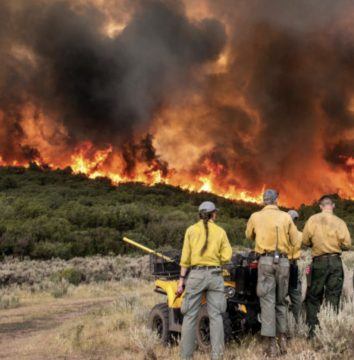 WHILE FOR DECADES there has been scientific consensus that the climate is changing, only in the past few years has it become possible for scientists to link that change to particular weather events. Even as it advances, however, attribution science, also called probabilistic extreme event attribution, has uncertainties built into it. Broadly speaking, it’s done by comparing two computer models — one that reflects the world as it is, and another that reflects the world as it would have been without global warming — to determine whether the probability of a weather event was affected by climate change and, if so, by how much.
But the results come with caveats. For instance, attribution science doesn’t determine whether climate change made an event possible, but rather if it made the event more likely. The method is also difficult to apply in locales that have little historical data on weather patterns. And certain kinds of events — hurricanes and droughts, for instance — are harder to model than others. Hard evidence of climate change’s influence on Hurricane Sandy, which battered the northeastern U.S. in 2012, didn’t come until years after the fact.
But for wildfires like the ones currently burning in the West, the links with climate change are relatively easy to model and affirm.
More here.
Wildlife photographer of the year 2020 winners
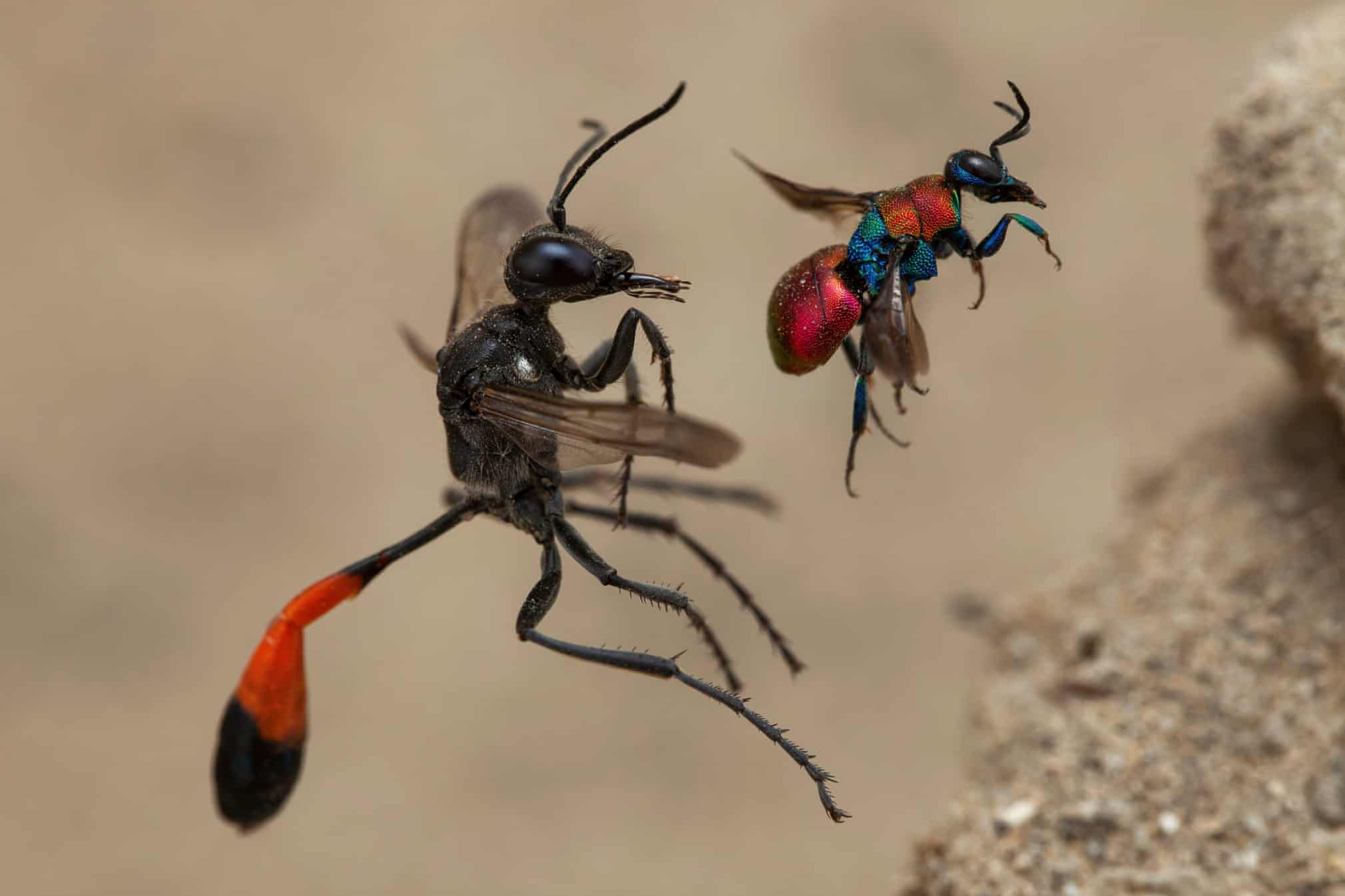
More, from The Guardian, here.
Is Machiavelli good, then, or is he evil?
Tim Parks in the New York Review of Books:
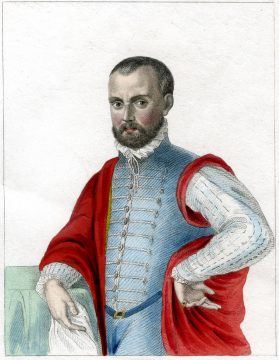
“Is Machiavelli good, then, or is he evil?” asks the French scholar Patrick Boucheron in his discussion of The Prince, a book whose “whole program is to uncouple political action from conventional morality.” Is he advising political leaders to be treacherous, violent, and dishonest (as Diderot believed), or revealing to ordinary people the mechanisms behind their leaders’ dishonesty, violence, and treachery (as Rousseau believed)? “We would like to have an answer,” Boucheron writes, but the matter is better “set aside.” Machiavelli was simply saying “the truth about things.” Still, the question hangs in the air, if only because Boucheron’s anxiety over the deteriorating morality of politics today has him turning to the Italian for guidance.
More here.
Ruth Falcon (1942 – 2020)
Sunday Poem
i sing of Olaf glad and big
i sing of Olaf glad and big
whose warmest heart recoiled at war:
a conscientious object-or
his wellbelovéd colonel (trig
westpointer most succinctly bred)
took erring Olaf soon in hand;
but–though an host of overjoyed
noncoms (first knocking on the head
him) do through icy waters roll
that helplessness which others stroke
with brushes recently employed
anent this muddy toiletbowl,
while kindred intellects evoke
allegiance per blunt instruments–
Olaf (being to all intents
a corpse and wanting any rag
upon what God unto him gave)
responds, without getting annoyed
“I will not kiss your fucking flag”
straightway the silver bird looked grave
(departing hurriedly to shave)
but–though all kinds of officers
(a yearning nation’s blueeyed pride)
their passive prey did kick and curse
until for wear their clarion
voices and boots were much the worse,
and egged the firstclassprivates on
his rectum wickedly to tease
by means of skilfully applied
bayonets roasted hot with heat–
Olaf (upon what were once knees)
does almost ceaselessly repeat
“there is some shit I will not eat”
our president, being of which
assertions duly notified
threw the yellowsonofabitch
into a dungeon, where he died
Christ (of His mercy infinite)
i pray to see; and Olaf, too
preponderatingly because
unless statistics lie he was
more brave than me:more blond than you.
by E. E. Cummings
from The Complete Poems: 1904-1962
Liveright Publishing Corporation
The $16-Trillion Virus
Jonathan Shaw in Harvard Magazine:
 THE FINAL TALLY OF ECONOMIC DAMAGE caused by SARS-CoV-2 will have to wait for the pandemic’s end, but in the meantime, two eminent economists have estimated the cost in the United States alone at $16 trillion. Eckstein professor of applied economics David Cutler, an expert on health care, and Eliot University Professor and president emeritus Lawrence H. Summers, former U.S. Secretary of the Treasury, lay out the grim prognosis in a Journal of the American Medical Association article: “The SARS-CoV-2 (severe acute respiratory syndrome coronavirus 2) pandemic,” they write in a Viewpoint, “is the greatest threat to prosperity and well-being the U.S. has encountered since the Great Depression.”
The costs through the fall of 2021, assuming the pandemic is largely controlled by then, break down as follows:
- $7.6 trillion in lost economic output, according to estimates by the Congressional Budget Office;
- $4.4 trillion in losses due to premature deaths (assuming a relatively conservative statistical value of $7 million is placed on each life lost, and that current trajectories continue, which would lead to 625,000 cumulative deaths associated with the pandemic through next year in the United States);
- $2.6 trillion in health-care costs associated with long-term complications among survivors;
- $1.6 trillion in increased mental-health costs attributable to the pandemic if the mental-health effects last just a year.
Cutler and Summers point out that their total, $16.2 trillion, is approximately 90 percent of the annual GDP of the United States, and far exceeds the costs associated with conventional recessions in this country.
More here.
We Learn Faster When We Aren’t Told What Choices to Make
Michele Solis in Scientific American:
 In a perfect world, we would learn from success and failure alike. Both hold instructive lessons and provide needed reality checks that may safeguard our decisions from bad information or biased advice. But, alas, our brain doesn’t work this way. Unlike an impartial outcome-weighing machine an engineer might design, it learns more from some experiences than others. A few of these biases may already sound familiar: A positivity bias causes us to weigh rewards more heavily than punishments. And a confirmation bias makes us take to heart outcomes that confirm what we thought was true to begin with but discount those that show we were wrong. A new study, however, peels away these biases to find a role for choice at their core. A bias related to the choices we make explains all the others, says Stefano Palminteri of the French National Institute for Health and Medical Research (INSERM), who conducted a study published in Nature Human Behaviour in August that examines this tendency. “In a sense we have been perfecting our understanding of this bias,” he says.
…Delusions can be a hallmark of psychosis, in which they may involve extreme beliefs about alien abduction or being a god. Milder delusionlike thinking also touches otherwise healthy people, such as a sports fan with a superstition about wearing a lucky shirt to ensure a team’s win. More harmfully, the current coronavirus pandemic has wrought some delusions of its own, such as one that holds that mask wearing causes sickness.
So a false belief remains fixed, and any outcomes that contradict it are not accepted by the brain. If choice is the point of reference that governs our learning style (with or without confirmation bias), then maybe something about choice or an inflated sense of control pushes people toward delusions. Perhaps individuals with delusions are choosing to have particular experiences to support a false belief and choosing to interpret information in a way that supports that belief.
More here.
Erin Wall (1975 – 2020)
Rhonda Fleming (1923 – 2020)
Saturday, October 17, 2020
The Presidential Town Halls Were Mister Rogers Versus Nasty Uncle Trump
Susan Glasser in The New Yorker:
 Even Donald Trump has moments of self-awareness. During an interview last week with Rush Limbaugh, the right-wing talk-radio host whom he honored with the Medal of Freedom earlier this year, the President briefly abandoned his puffery to admit that he might be defeated—and that his own nastiness would be the reason why. “Maybe I’ll lose,” he told Limbaugh, “because they’ll say I’m not a nice person.” He added, “I think I am a nice person,” before pivoting back to his trademark name-calling. A few days later, the political liability of his brutish persona was clearly on Trump’s mind again. “Can I ask you to do me a favor?” he begged “suburban women” at a rally in Johnstown, Pennsylvania, on Monday. “Will you please like me, please, please?”
I do not know who will win the election less than three weeks from now. But I do know this: if Trump does lose, he’s right that his sheer unlikability will be a major contributing factor. He’s a bully and a boor. He’s overbearing, self-absorbed, impossible to shut up, and especially patronizing to women, which, of course, is one of the reasons why those suburban moms he is begging to vote for him are telling pollsters that they are decidedly against him.
More here.
National Populism in Power: the Consequences for Fundamental Rights
 Jordi Vaquer in Idees:
The world currently finds itself immersed in the so-called “third wave” of authoritarianism. Since the start of the twenty-first century, and especially over the last five years, more and more countries have been losing the characteristics of a democracy and becoming hybrid — Hybrid regimes combine characteristics of both democratic and authoritarian regimes. The term has been used to define a range of governments, including the electoral autocracies of the 1960s and 1970s (such as those in Mexico, Singapore, Senegal and Taiwan) and the so-called “illiberal democracies” of today. See L. Diamond (2002), “Elections Without Democracy: Thinking About Hybrid Regimes” in Journal of Democracy 13-2, pages 21-35. or openly autocratic regimes. For the first time since 2001, there are more autocracies (specifically, 92 countries, which together are home to 54% of the world’s population) than democracies, while 35% of the world’s population lives in countries governed by increasingly authoritarian regimes — AV ‘Autocratization Surges, Resistance Grows’ in Democracy Report 2020, VDem Institute, University of Gothenburg, March 2020.. The positive progress made in countries such as the Gambia, Ethiopia, Sudan, Armenia and Malaysia are exceptions within a global framework that is less and less favourable to liberal democracies with each day that passes.
The traditional means by which authoritarian regimes are installed, such as coups d’état and civil conflict, have played an important role in this new wave of authoritarianism (Thailand and Egypt are both excellent examples). However, the chief characteristic of this new political development is that the primary vector of authoritarianism is elected governments, which despite their clear disdain for the mechanisms that serve to control and balance power, still manage to gain and retain popular support in competitive elections. Moreover, they are doing so, and herein lies the great novelty — In the 1990s and 2000s, hybrid regimes were usually the result of incomplete transitions toward democracy and were mostly more open than the dictatorships that had preceded them. See T. Carothers (2002), “The End of the Transition Paradigm” in Journal of Democracy 13-1, pages 1-21., in countries with a relatively consolidated democratic history and a tradition of pluralism.
More here.