
Alexei Navalny in The Guardian:
 Exactly one year ago, I did not die from poisoning by a chemical weapon, and it would seem that corruption played no small part in my survival. Having contaminated Russia’s state system, corruption has also contaminated the intelligence services. When a country’s senior management is preoccupied with protection rackets and extortion from businesses, the quality of covert operations inevitably suffers. A group of FSB agents applied the nerve agent to my underwear just as shoddily as they incompetently dogged my footsteps for three and a half years – in violation of all instructions from above – allowing civil investigating activists to expose them at every turn.
To be fair, a regime based on corruption can perform more elementary tasks to perfection. The judicial system – the first thing autocrats intent on robbing their nation take control of – functions perfectly on a quid pro quo basis. That is why, when I went back to Russia after medical treatment, I was taken straight from the plane to prison. There is not much to celebrate in that, but at least I now have time to read the memoirs of world leaders.
More here.
 Deep learning, the artificial-intelligence technology that powers voice assistants, autonomous cars, and Go champions, relies on complicated “neural network” software arranged in layers. A deep-learning system can live on a single computer, but the biggest ones are spread over thousands of machines wired together into “clusters,” which sometimes live at large data centers, like those operated by Google. In a big cluster, as many as forty-eight pizza-box-size servers slide into a rack as tall as a person; these racks stand in rows, filling buildings the size of warehouses. The neural networks in such systems can tackle daunting problems, but they also face clear challenges. A network spread across a cluster is like a brain that’s been scattered around a room and wired together. Electrons move fast, but, even so, cross-chip communication is slow, and uses extravagant amounts of energy.
 W
W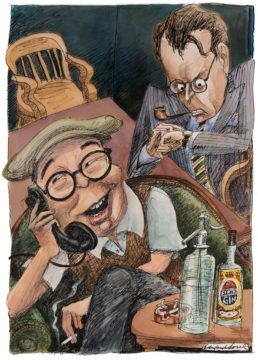 In the rat-infested trenches of France, Raymond Chandler became an alcoholic, and stayed one. In 1932, after booze had gotten him fired from a cushy job, he resolved to cut down on the gin and become a novelist. He began by selling hard-boiled detective yarns to the pulpy magazine Black Mask, then later sold his first novel, “The Big Sleep,” to Alfred A. Knopf. In 1943, Chandler’s third novel, “The High Window,” was read by the Paramount director Billy Wilder. He liked the way Chandler wrote dialogue, and offered him a contract of $750 a week for 10 weeks to work with him on a screenplay for “Double Indemnity,” James M. Cain’s novel. Chandler had never written for the screen, and didn’t like the idea of being subservient to a young Austrian-born Jew who had written dozens of screenplays in Berlin and Hollywood. But Chandler was broke, and had a sick wife to care for. He signed up.
 Chris Lehmann in The New Republic:
 THE UNITED STATES has forgotten the hobo. We recognize the problem of homelessness, but the rootless rambler who steals rides on freight trains seems a relic of a long gone past. Even the word itself, hobo, is outdated. The same goes for the word tramp, which, if used at all tends to be for slut-shaming purposes. The term bum remains, but it, too, is derogatory, perhaps only acceptable as a verb, as in, “Can I bum a smoke?”
 Emilie Bickerton in the NLR’s Sidecar:
 Kim Stanley Robinson in the FT:
 T
T When you go on a first date, do you struggle to make conversation? Read Morris Bishop’s
  There is a parallel between Timothy Brennan’s biography of Edward Said and the latter’s most famous book. Like Orientalism in 1978, Places of Mind appears at a time when colonialism and race have once again become subjects of public debate in North America and Western Europe. Reviewers have linked the reception of Said’s book and the politics it enunciated to that facing the supporters of movements like Black Lives Matter or Rhodes Must Fall. And it was to find out how we might understand such a trajectory that I was eager to read the biography. Said was one of the earliest non-European immigrants to achieve fame in the American academy, and I wanted to know how he managed to spark the first new debate on imperialism there since its formal dissolution.
 As many countries are going through another wave of infections, including some where the vast majority of the population has been vaccinated, many are starting to despair that we’ll ever see the end of the pandemic. In this post, I will argue that, on the contrary, not only is the pandemic already on its way out, but the virus will be relatively harmless after it has become endemic. This is going to happen not because the SARS-CoV-2 will become intrinsically less dangerous, although it might, but rather because what made the virus so dangerous was that nobody had immunity against it, so once it has become endemic it will infect fewer people and even those who end up infected will be much less at risk. Moreover, I will explain that, despite widespread anxiety about the emergence of new variants and the danger of immune evasion, the fact that SARS-CoV-2 is mutating will not prevent this outcome because of the way immunity works. Finally, I will argue that, although some people are calling to pursue the eradication of SARS-CoV-2 (as we have done with smallpox), we almost certainly couldn’t eradicate it even if we wanted to and that even if we could it wouldn’t be worth it.
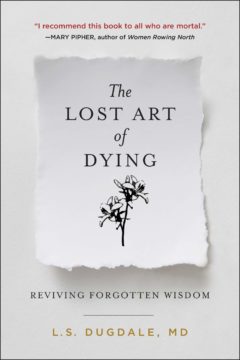 Matter and energy are neither created nor destroyed, or so says modern physics. The subatomic substrate that adds up to the eyes scanning these words, the fingers holding them within sight and all the rest of your soft, unaccountable self, used to belong to other things—an apple or a cow, maybe—and they will belong to yet others in the future. What we are now, as long as we are, is a temporary contraction.