
Category: Recommended Reading
How “The Chair” needs to do better by Sandra Oh
Kylie Cheung in Salon.com:
 By now Sandra Oh’s hive of devoted fans have likely binged all six episodes of her new Netflix dramedy, “The Chair.” As Dr. Ji-Yoon Kim, the newly appointed chair of the English department of a small liberal arts school called Pembroke, Oh’s meteoric rise comes at a time of scandal and uncertainty for her department, and it doesn’t help that she’s a woman of color subject to the racism and misogyny inherent to academia. “The Chair” has a lot going for it — namely, Oh’s presence, but also smart commentary and realism on the pressing issues facing American universities today. Still, there’s one pretty big problem that makes the show difficult to enjoy for audiences who wanted to see a story about a woman like Dr. Kim overcome barriers and rise to the occasion. That problem is Pembroke English professor Bill Dobson (Jay Duplass). Duplass is charming as ever in “The Chair,” but there’s nothing more frustrating than seeking out a show for fresh storytelling that centers the experience of a marginalized person and instead being hit with a storyline focused on a bumbling, white male doofus. There’s many a pressing issue Dr. Kim faces as chair of an under-enrolled English department, but she’s instead forced to clean up mess after mess created by a drunken, reckless and politically insensitive Dobson.
Audiences of “The Chair” can certainly sympathize with Dobson, who recently lost his wife and seems to have a strained relationship with his young adult daughter. The problem, however, isn’t that he’s sympathetic — it’s that too much energy and airtime are given to make us sympathize with yet another white man who can’t seem to get his act together, and makes this everyone else’s problem.
Sprawled across the show’s six, roughly 20 minute episodes are scenes of Dobson showing up late to classes, performing a Nazi salute as part of a tasteless joke, and refusing to apologize to students who confront him, interspersed with charming sequences of him being a wonderful babysitter to Dr. Kim’s young daughter JuJu (Everly Carganilla). “The Chair” unfortunately isn’t the first case of an interesting female character, character of color, or otherwise marginalized character being pushed to the side for a white man’s redemption arc, or some long-winded, flashback storytelling into why an awful white guy is awful (spoiler alert: it’s never actually his fault). The unsolicited white male rehabilitation storyline is a fixture in nearly every genre of story, and frustrating as it may be, it’s not always a pain to watch.
More here.
From “Me” by Elton John: How he and John Lennon became good friends
Elton John in Delancey Place:
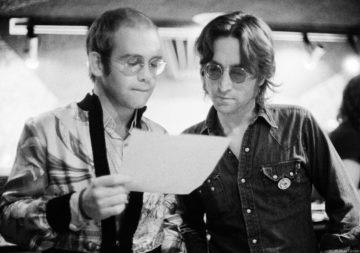 “I first met John Lennon through Tony King, who had moved to LA to become Apple Records’ general manager in the US. In fact, the first time I met John Lennon, he was dancing with Tony King. Nothing unusual in that, other than the fact that they weren’t in a nightclub, there was no music playing and Tony was in full drag as Queen Elizabeth II. They were at Capitol Records in Hollywood, where Tony’s new office was, shooting a TV advert for John’s forthcoming album Mind Games, and, for reasons best known to John, this was the big concept.
“I took to him straight away. It wasn’t just that he was a Beatle and therefore one of my idols. He was a Beatle who thought it was a good idea to promote his new album by dancing around with a man dragged up as the Queen, for fuck’s sake. I thought: We’re going to get on like a house on fire. And I was right. As soon as we started talking, it felt like I’d known him my entire life.
“We began spending a lot of time together, whenever I was in America. He’d separated from Yoko and was living in Los Angeles with May Pang. I know that period in his life is supposed to have been really troubled and unpleasant and dark, but I’ve got to be honest, I never saw that in him at all. I heard stories occasionally — about some sessions he’d done with Phil Spector that went completely out of control, about him going crazy one night and smashing up the record producer Lou Adler’s house. I could see a darkness in some of the people he was hanging out with: Harry Nilsson was a sweet guy, an incredibly talented singer and songwriter, but one drink too many and he’d turn into someone else, someone you really had to watch yourself around. And John and I certainly took a lot of drugs together and had some berserk nights out, as poor old Dr John would tell you. We went to see him at the Troubadour and he invited John onstage to jam. John was so pissed he ended up playing the organ with his elbows. It somehow fell to me to get him offstage.
More here.
Friday Poem
Thin
How anything
is known
is so thin—
a skin of ice
over a pond
only birds might
confidently walk
upon. A bird’s
worth of weight
or one bird-weight
of Wordsworth.
by Kay Ryan
from The Best American Poetry, 2006
Three Indian Labor Documentaries
Ratik Asokan at Artforum:
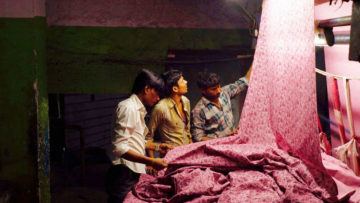 What is it like to work in an Indian factory? Three documentaries (all currently streaming for free) begin to answer this troubling question. Anjali Monteiro and KP Jayasankar’s Saacha: The Loom (2001) is an elegy for Mumbai’s shuttered cotton mills woven around the lives of two men, a poet and a painter. Rahul Roy’s The Factory (2015) chronicles a landmark 2012–15 strike at an automobile factory near New Delhi. Rahul Jain’s Machines (2016) unfolds amid the sordid interiors of a textile sweatshop in Gujarat. As with Chinese activist cinema, these are for the most part works of witness, recording struggles and injustices that politicians and the mainstream media ignores. Together, they offer a tracking shot of India’s landscape of labor. The picture that emerges is disquieting and frequently shocking.
more here.
Q&A with Rahul Jain – MACHINES
Alice Neel’s Populist Paintings
Jillian Steinhauer at The Nation:
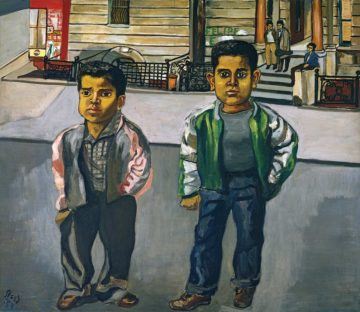 Neel took the call to realism to heart: She went out into the streets of Philadelphia to paint and attended a local sketch club where the models were ordinary people. (She was also part of the first generation of female art students allowed to study live male nudes.) The path of realism reflected how Neel understood her place in the world. “I had a conscience about going to art school,” she said. “Because when I’d go into the school, the scrub-women would be coming back from scrubbing office floors all night. It killed me that these old gray-headed women had to scrub floors, and I was going in there to draw Greek statues.”
In 1924, while away at summer school in the nearby countryside, Neel met the first in a line of men with whom she would have tumultuous relationships as well as children: the painter Carlos Enríquez, who came from a wealthy, landed Cuban family. Enríquez and Neel fell in love and quickly wed, then moved to Havana, where their lives were a study in class contrast.
more here.
Thursday, August 26, 2021
“I’ll Be in Another World”: A Rediscovered Interview with Jorge Luis Borges
Mark Childress and Charles McNair in the Los Angeles Review of Books:
MARK CHILDRESS AND CHARLES MCNAIR: Did you dream last night?
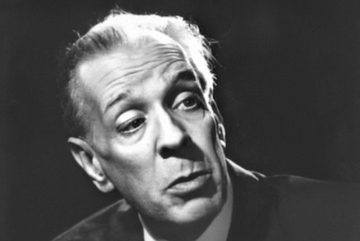 JORGE LUIS BORGES: I dream every night. I dream before I go to sleep, and I dream after waking up. When I begin to say meaningless words, I’m seeing impossible things.
I remember that a dream gave me a story. I had a very confused, a very tangled dream. And the only thing I remembered was this: “I sell you Shakespeare’s memory.” And I wrote a story about that [“La Memoria de Shakespeare”].
What a fine name Shakespeare is, yes? But he was quite bad, don’t you think so? A man who wrote “England, that demi-Paradise.” Sounds like a bad joke, no? I mean, Shakespeare’s letting you down all the time. A very uneven writer. He’s not dependable. You have a very fine line, and then you have, well, rhetoric.
More here.
Categories of mental functions such as perception, memory and attention reflect our experience of ourselves, but they are misleading about how the brain works
Jordana Cepelewicz in Quanta:
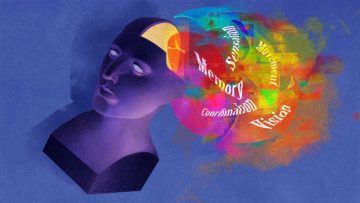 Not only do researchers often depict the brain and its functions much as mapmakers might draw nations on continents, but they do so “the way old-fashioned mapmakers” did, according to Lisa Feldman Barrett, a psychologist at Northeastern University. “They parse the brain in terms of what they’re interested in psychologically or mentally or behaviorally,” and then they assign the functions to different networks of neurons “as if they’re Lego blocks, as if there are firm boundaries there.”
But a brain map with neat borders is not just oversimplified — it’s misleading. “Scientists for over 100 years have searched fruitlessly for brain boundaries between thinking, feeling, deciding, remembering, moving and other everyday experiences,” Barrett said. A host of recent neurological studies further confirm that these mental categories “are poor guides for understanding how brains are structured or how they work.”
More here.
Who’s to blame for the Afghanistan chaos?
George Monbiot in The Guardian:
 Those of us who argued against the war possessed no prophetic powers. I asked the following questions in the Guardian not because I had any special information or insight, but because they were bleeding obvious. “At what point do we stop fighting? At what point does withdrawal become either honourable or responsible? Having once engaged its forces, are we then obliged to reduce Afghanistan to a permanent protectorate? Or will we jettison responsibility as soon as military power becomes impossible to sustain?” But even asking such things puts you beyond the pale of acceptable opinion.
You can get away with a lot in the media, but not, in most outlets, with opposing a war waged by your own nation – unless your reasons are solely practical. If your motives are humanitarian, you are marked from that point on as a fanatic. Those who make their arguments with bombs and missiles are “moderates” and “centrists”; those who oppose them with words are “extremists”. The inconvenient fact that the “extremists” were right and the “centrists” were wrong is today being strenuously forgotten.
More here.
John Allen Paulos interviewed by Christopher G. Moore
From pirates to ransomware: the secret economics of extortion
Tom Standage in More Intelligent Life:
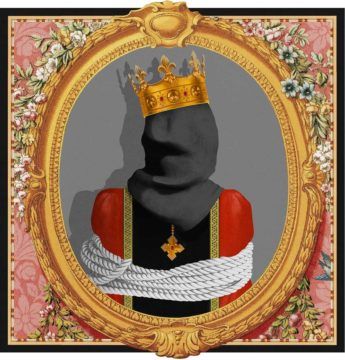 In 74bc a band of pirates made a terrible mistake when they captured a ship off the coast of Asia Minor, now Turkey. They kidnapped one of the passengers, a young Roman citizen named Julius Caesar, along with his entourage, and demanded a ransom of 20 talents (about 650kg in silver) for his release. Caesar, in his mid-20s and on his way to study rhetoric in Rhodes, burst out laughing. Didn’t they know who he was? He was worth 50 talents, not a mere 20! Unsurprisingly the pirates agreed to this higher ransom, and released some of Caesar’s associates to raise the money.
Pirates were the scourge of the Mediterranean, bribing their way around efforts to suppress them. But despite their fearsome reputation, Caesar refused to be intimidated. He told them to be quiet when he wanted to sleep, “as if the men were not his watchers, but his royal bodyguard”, writes Plutarch. He joined in their games and regaled them with speeches and poetry, mocking them as illiterate barbarians. Once he was free, he said, he would execute the lot of them. According to Plutarch, “the pirates were delighted at this, and attributed his boldness of speech to a certain simplicity and boyish mirth.”
When Caesar’s friends arrived with the ransom the pirates released him. He went straight to Miletus, a city on the coast of Asia Minor, raised a fleet and returned to the pirates’ camp. After helping himself to their treasure, he captured most of the pirates, took them to the city of Pergamon and asked the local governor to execute them. When the governor wavered, Caesar had the pirates crucified, even though he lacked permission to do so.
More here.
What Google Could Learn from a Fruit Fly
Christie Wilcox in Nautilus:
 Let’s say you’re at a big office party full of people, both coworkers and strangers, when someone walks up to you. You have a split second to determine if you know this person or not; you don’t want to make the faux pas of re-introducing yourself to your receptionist. Luckily, your brain is adept at what computer scientists call “novelty detection”—the ability to distinguish new information from details that have been encountered before. Most of the time we do it effortlessly. How exactly that skill works is a provocative scientific mystery, however.
Novelty detection is useful in all kinds of other settings, including ones that have nothing to do with social interactions. If you’re getting a mammogram, you want your radiologist and any image-analysis software she uses to be good at novelty detection, so she can accurately spot any mass that shouldn’t be there. If you’re shopping in a store, you want your credit card company to have good novelty detection, too. It’s nice that they are on the lookout for fraudulent transactions, but it would be nicer if they didn’t shut down your card every time you drive an hour away from home.
It just so happens that all of these detectors—your brain, medical analysis programs, and credit card fraud detectors—rely on similar algorithms to find new and unusual things. The main difference is that your brain’s novelty detection algorithm is much more accurate and efficient than the programmed ones, at least for now. Computer scientists like Saket Navlakha are therefore working to better understand the algorithms that succeed so well in biology, and then reverse-engineer them to improve the ones in our technology.
More here.
In memoriam: Syed Afzel Hussain Naqvi
Feisal Naqvi in The News:
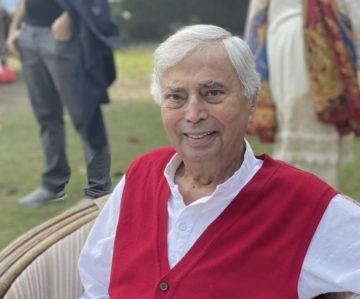 My father died at 2:15 pm last Sunday. I would like to say that he died in my arms, but the truth is that by the time I heard my sister scream and ran in from the next room, he had already moved on from this world.
Every father looms large in the imagination of his children. But my father was larger than life in every way. He was 6′ 3″ and born 86 years ago when such height was more unusual than it is now. More relevantly, he carried all of us and our troubles like an unruffled Atlas. And by all of us, I mean not just his children or even his children’s children. I mean the entire extended clan of people he was related to as well as humanity beyond the ties of blood. There was no cousin too distant for him to not keep tabs on. He was the one man making sure that no child was left behind. Even in our village, he financed three schools and was never happier than when he could dragoon one of his many descendants into contributing more.
More here.
On Subjectivity And A Visit To Kierkegaard’s Grave
Meghan O’Gieblyn at Bookforum:
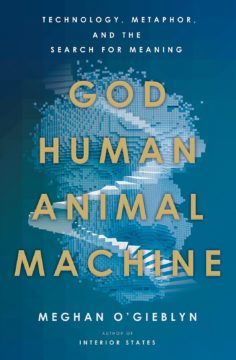 The question of subjectivity had been very much on my mind that summer. A few months earlier I’d been commissioned by a magazine to review several new books on consciousness. All of the authors were men, and I was surprised by how often they acknowledged the deeply personal motivations that led them to their preferred theories of mind. Two of them, in a bizarre parallel, listed among these motivations the desire to leave their wives. The first was Out of My Head, by Tim Parks, a novelist who had become an advocate for spread mind theory—a minority position that holds that consciousness exists not solely in the brain but also in the object of perception. Parks claimed that he first became interested in this theory around the time he left his wife for a younger woman, a decision that his friends chalked up to a midlife crisis. He believed the problem was his marriage—something in the objective world—while everyone else insisted that the problem was inside his head. “It seems to me that these various life events,” he wrote, “might have predisposed me to be interested in a theory of consciousness and perception that tends to give credit to the senses, or rather to experience.”
more here.
An Astonishing Dual Portrait of a Poet and His City
Richard Brody at The New Yorker:
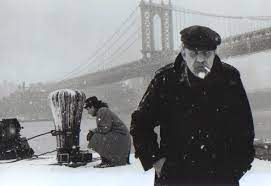 Every great urban filmmaker has a personal metaphysics of the city, a sense that the synergies and mysteries of urban life can find their ideal form in images. That’s what Pola Rapaport reveals in her first feature, “Broken Meat,” from 1991, which is showing, starting Wednesday, on Metrograph’s virtual cinema (with her introduction) and is also streaming on Vimeo.
It’s a film in a particular and too often narrowing mode: a documentary portrait of an artist, the poet Alan Granville, whose work doesn’t appear to have attracted much attention beyond the movie itself. “Broken Meat” is the title of one of his works, which Rapaport reads, during a train ride, early in the film. The poet’s obscurity itself comes off as something of his life’s work, his self-chosen destiny, as he describes his lifelong hero, Vincent van Gogh. Considering a reproduction of a self-portrait that adorns his wall, Granville says that van Gogh’s gaze is not “disturbed” but “steadfast,” and that the artist awakened Granville’s “first awareness that a person could lead an undiscovered life.” Granville acknowledges that he himself is “largely an unfulfilled poet,” with no realistic hope of recognition, and the gap between his vast literary aspirations and his actual circumstances is the documentary’s anguished drama.
more here.
Broken Meat
Wednesday, August 25, 2021
The best books about the post-human Earth
Cal Flyn in The Guardian:
 We humans have a profound impact on the world around us. Bob Paine, the groundbreaking American ecologist, once described us as a “hyperkeystone” species: our actions affect the lives and habitats of other creatures more than any other species on Earth. So much so, some scientists have adopted the term Anthropocene to refer to the current era, defined by atomic testing, the climate crisis and the development of plastics. Evidence of human activity will survive long after we are gone, both within the fossil record and in the state of the planet more generally, which we will have influenced in long-reaching and unpredictable ways.
There is some wonderful writing on this subject, not least David Farrier’s Footprints, a fascinating nonfiction book that seeks to predict the traces we will leave behind: from the nuclear waste sealed deep within concrete tombs to the future rust-stained remains of our megacities. The World Without Us by Alan Weisman was a 2007 mega-bestseller along similar lines, which asks what would happen if, for some unspecified reason, all humans disappeared from the planet tomorrow. Drawing from hundreds of interviews with engineers, scientists and archaeologists, it unfolds like a thriller: bridges collapse, subway tunnels flood, skyscrapers fall to the ground.
More here.
This Physicist Discovered an Escape From Hawking’s Black Hole Paradox
Natalie Wolchover in Quanta:
 In 1974, Stephen Hawking calculated that black holes’ secrets die with them. Random quantum jitter on the spherical outer boundary, or “event horizon,” of a black hole will cause the hole to radiate particles and slowly shrink to nothing. Any record of the star whose violent contraction formed the black hole — and whatever else got swallowed up after — then seemed to be permanently lost.
Hawking’s calculation posed a paradox — the infamous “black hole information paradox” — that has motivated research in fundamental physics ever since. On the one hand, quantum mechanics, the rulebook for particles, says that information about particles’ past states gets carried forward as they evolve — a bedrock principle called “unitarity.” But black holes take their cues from general relativity, the theory that space and time form a bendy fabric and gravity is the fabric’s curves. Hawking had tried to apply quantum mechanics to particles near a black hole’s periphery, and saw unitarity break down.
So do evaporating black holes really destroy information, meaning unitarity is not a true principle of nature? Or does information escape as a black hole evaporates?
More here.
Toward a Binational Alternative in Israel: On the Illusion of the Two State Solution
Omri Boehm in Literary Hub:
 In the 25years that have passed since the assassination of Yitzhak Rabin, his two-state Oslo legacy has been driven into the ground. In 1993, when the agreement was first signed, approximately 110,000 settlers were living in the West Bank, and 146,000 were living in occupied territories surrounding Jerusalem. By now, the numbers have increased to approximately 400,000 settlers in the West Bank and 300,000 around Jerusalem. This situation will not be reversed. In 2021, roughly 10 percent of Israel’s Jewish population lives on occupied territory—subject to Israeli law, represented by Israel’s parliament—and enjoys the opportunities and prosperity of a flourishing first-world country, with public schools, factories, banks, a system of highways, and a research university at their disposal. Around them, however, are almost 3 million Palestinians who, for 53 years now, have lived under Israel’s aggressive military regime.
Even intransigent two-state supporters agree that not all of these settlers can be evacuated, but they insist that the challenge posed by their presence is exaggerated. On this view, whereas the West Bank’s map is stained by approximately 130 spots marking Israeli settlements, about 110 of them count populations of less than 5,000. Another 60 settlements, the argument goes, have populations of less than 1,000, and many of them are, in the first place, located next to the 1967 border: by introducing only minor corrections to the border, it is allegedly possible to leave most settlers within Israel’s proper territory, and to compensate the Palestinians with other pieces of land from other areas. Given this, it is claimed that the tendency to “grossly overstate” the obstacle that settlements pose to a future two-state solution is based not on a sober analysis of the situation, but on an ideological support of one-state politics.
Unfortunately, this optimism is itself highly ideological, and can only be preserved if one avoids a careful look at the map.
More here.