
George Abraham in Guernica:
 I gave my first lecture, at my first academic job, behind a wall of plexiglass, speaking to an awkwardly spaced out group of masked students who had maybe already given up – and honestly, who could blame them? I walked in sweating and late because my building’s social distancing protocol required me to run up five floors and down two to get to my third floor classroom. Leaning into the mic, I opened with the joke: “Welcome to apocalyptic poetry!”
My students chuckled nervously. Maybe the joke was that it was day one of the fall semester, and who really wanted to be in a required advanced poetic form class? Or maybe it was my way of cutting the tension of our gathering, united by the sole purpose of discussing poetry in a time that, back then, felt newly apocalyptic to some.
Soon, apocalypse became a tired punchline. Languishing through mere existence, I did what any young Palestinian instructor of literature would likely do: I returned to Audre Lorde, who reminds us “poetry is not a luxury,” and June Jordan, who gives us models for writing against and despite the state.
More here.
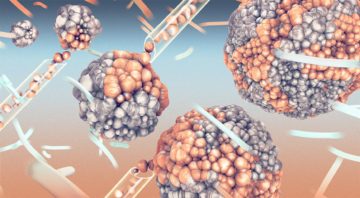 It’s 2036, and you have kidney failure. Until recently, this condition meant months or years of gruelling dialysis, while you hoped that a suitable donor would emerge to provide you with replacement kidneys. Today, thanks to a new technology, you’re going to grow your own. A technician collects a small sample of your blood or skin and takes it to a laboratory. There, the cells it contains are separated out, cultured and treated with various drugs. The procedure transforms the cells into induced pluripotent stem (iPS) cells, which, like the cells of an early embryo, are capable of generating any of the body’s tissues. Next, the technician selects a pig embryo that has been engineered to lack a gene required to grow kidneys, and injects your iPS cells into it. This embryo is implanted in a surrogate sow, where it develops into a young pig that has two kidneys consisting of your human cells. Eventually, these kidneys are transplanted into your body, massively extending your life expectancy.
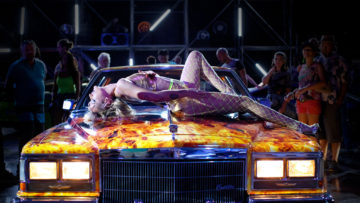 The curse of genre is that it encourages filmmakers to downplay causes in the interest of effects. In the best genre movies, the quantity and power of these effects serve as sufficient compensation for the thinned-out drama. “Titane,” the new film by Julia Ducournau, is a genre film, a twist on horror with a twist on family—like Ducournau’s first feature, “Raw.” But “Titane” is far stronger, far wilder, far stranger. The radical fantasy of its premise—a woman gets impregnated by a car—wrenches the ensuing family drama out of the realm of the ordinary and into one of speculative fantasy and imaginative wonder that demands a suspension of disbelief—which becomes the movie’s very subject.
 BLVR: It’s interesting that you make the distinction between art and not-art, because your writing doesn’t seem to make that distinction.
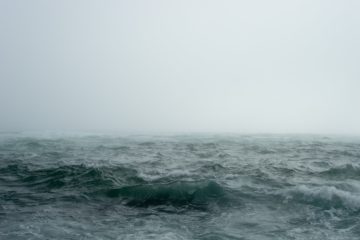 The fundamental struggle with water has never really abated since it first began on the shores of the Persian Gulf. The multiple transitions, from nomadism to sedentism, from hunting and foraging to domesticated agriculture, from small rural communities to a productive, specialized, urbanized society, were severe disruptions. But while individuals would have lived through them as gradual, incremental transformations, over the course of Homo sapiens’ existence, they amounted to shocking events. From the moment Homo sapiens, late in its history, decided to stay in one place, surrounded by a changing environment, it began to wrestle with water, an agent capable of destruction and life-giving gifts.
 T
T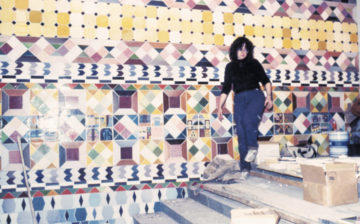 IN AN APPRECIATIVE 2016 REVIEW of new work by Valerie Jaudon, critic David Frankel noted that the Pattern and Decoration movement, of which Jaudon was a prominent member, had long been held in disrepute. “In the early ’80s,” Frankel wrote, “I remember a colleague at Artforum at the time saying it could never be taken seriously in the magazine.”1 In retrospect, what makes this dismissal so striking is that, in the mid-’70s, Artforum contributed significantly to P&D’s emergence into the spotlight, publishing key texts by its advocates along with numerous reviews of its shows. Amy Goldin’s “Patterns, Grids, and Painting” (1975) and Jeff Perrone’s “Approaching the Decorative” (1976) were among the early touchstones for P&D’s heterogeneous cohort, riled by the unmitigated critical support for diverse ascetic and masculinist tendencies pervasive in the painting of the moment. However, by the mid-’80s, eclipsed by newer developments—the Pictures generation, neo-geo, et al.—P&D was increasingly coming under fire for positions now considered controversial: for the purported essentialism of its versions of second-wave feminism, for a naive advocacy that masked acts of Orientalizing and primitivizing, for cultural imperialism. More fundamental “problems” largely went unnoted, including a lack of the kind of conceptual depth expected of cutting-edge practices: In their commitment to the decorative, P&D artists prioritized surface over subject matter, the former serving primarily as a vehicle for sensuous effects. Not least, the art world’s entrenched sexism fostered the occasion for its denizens to belittle and sideline a movement renowned for the dominant role played by women in its genesis and trajectory.
 Anil Seth
 The first time I learned I was Muslim was in preschool.
 COVID-19 deaths and cases are starting to decline and some
 I first became aware of the photographs of Deana Lawson because of a piece that Zadie Smith wrote about Lawson in The New Yorker a few years ago and I remember it being quite a good piece, which is not unusual for a piece by Zadie Smith and, to be completely truthful, I find that I am often much more moved and impressed when Zadie Smith writes about visual art than I am by the novels of Zadie Smith. But perhaps I am just being bitter in saying this because in fact I should also say that I once sort of thought that I was a little bit friends with Zadie Smith since she had liked an article I’d written about a collection of her essays and we engaged in something of an ongoing email exchange and then one day I noticed that we were both scheduled to do something at a literary event, to give a talk or give a reading or whatever people do at literary events and I thought I would drop by to say hi to her and maybe have a coffee and suddenly I was in a long line of people trying to get a moment with Zadie Smith as she was sitting at a table signing books. She was surrounded by different sorts of handlers and managers and, I guess, bodyguards and when I finally got up to Zadie Smith and when she realized that she sort of knew me through an email exchange there was an awkward chit chat between the two of us mixed with some overly long pauses and it felt, I must say, like I was standing there for several hours when in fact it must have only been a couple of minutes and the whole time she looked deeply pained and sorry for me and then her handlers sort of scooted me along down the hall and I finally realized that I am not friends with Zadie Smith at all, not even a little bit, and that she lives in a world that truly and completely has nothing to do with my own. She lives in a world of real and genuine fame and I do not. She ‘knows’ hundreds of people like me and mostly she just wants them to go away. And I don’t blame her at all for that. Not one bit. During that awkward couple of minutes standing in front of her book-signing table I wanted me to go away too.
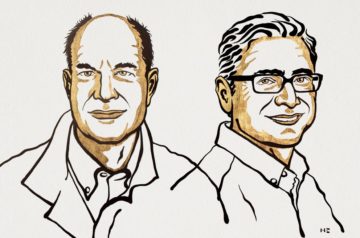 The Nobel Assembly at Karolinska Institutet has today decided to award the 2021 Nobel Prize in Physiology or Medicine jointly to David Julius and Ardem Patapoutian for their discoveries of receptors for temperature and touch.