
Emma Levy in The Seattle Times:
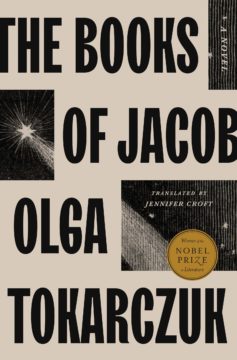 The Seattle Times chatted with Nobel Prize winner Olga Tokarczuk about her immersive, visionary 1,000-page novel that follows the extraordinary life of Jacob Frank, a Polish Jew who believed himself to be the Messiah and commanded a large religious movement in the 18th century.
What did you see in the story of Jacob Frank? What do Jacob’s followers see in him?
Jacob Frank is a complicated character who escapes univocal judgment. His supporters remembered him as a handsome man while the opponents recalled an ugly hunchback. Nobody knows for certain what he was like, we can only guess. The controversy that surrounded him, and the enormous influence he held over people from all social classes has provoked me to fill in the blanks in his biography. His followers saw him not only as an inspired mentor but also as a chance to improve their social standing: most of the Frankists hailed from the small-time bourgeoisie of Podolia. Jacob might have been admired for his ascension above rules of society. This is a character in a state of perpetual transformation, especially after the trauma he endured in the Częstochowa prison. From an influential guide and leader to the masses, he turned into a cynical political player, driven by his own ambitions. He descended into hubris, became an emperor’s favorite and even an adviser to Maria Therese [ruler of the Habsburg Empire]. He stood above the law and his direct connection to divinity guaranteed that he would be obeyed.
More here.
 On April 4,
 I think we’re laboring under a moment in which many believe that the sole function of art is to provide moral guidance.
 Wet earth. Loam. Bitter ash, brine on the wind. The unfurling of cedar, a smell that takes me out of this place and back to bathtubs in Japan; a portal of a scent, sacred and red. These are the smells of the Pacific Northwest wood from where I write this. In the daytime, as light pours around the unfamiliar landscape, I think of it as a new smell, something to gulp. But last night, clambering up the half-hill toward the cottage where I am staying, I took another breath and was suddenly tearful. The damp soil transformed into the smell of my Jiji, wood-smoke mimicking cigarette-smoke lingering in the folds of his shirt.
 “We often begin to understand things only after they break down. This is why, in addition to being a worldwide catastrophe, the pandemic has been a large-scale philosophical experiment,” Jonathan Malesic, author of The End of Burnout: Why Work Drains Us and How to Build Better Lives,
  Robin D. G. Kelley in Boston Review:
 James McAuley in The New Yorker (Photograph by Rit Heize / Xinhua / Getty):
 Alex Yablon , Nicholas Mulder, Javier Blas in Phenomenal World:
 In “Indelible City,” Louisa Lim charts how her own identity as a Hong Konger had never been so clear until China’s brutal attempts to crush pro-democracy protests in 2019. She had been feeling increasingly alienated from a densely populated place where extreme inequality, soaring costs and shrinking real estate made “the very act of living” — even for “still very privileged” people like her — completely exhausting. Lim’s experience as a reporter amid a swell of protesters changed that. She could feel her face flush and her throat well up — not from the tear gas, of which there was plenty, but from a surge of emotions: “I’d fallen in love with Hong Kong all over again.”
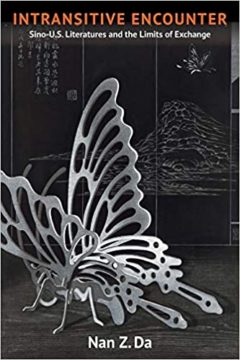 JS: What do you see as the differences between academic writing and other forms of writing?
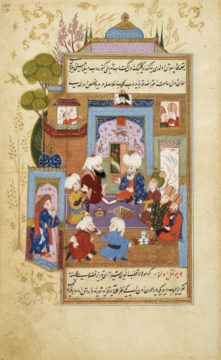 The notion of fana’, commonly translated from Arabic as annihilation or obliteration, provides a potential point of contact between Sufi practices and Buddhist notions of nirvana, a word which, in Sanskrit, derives from the type of extinction one sees when one snuffs out the flame of a candle. Are there similarities between these notions, ones which might be constructed without radically oversimplifying the issues at hand? On the surface, ‘annihilation’ and ‘extinction’ might seem similar. But what a Buddhist extinguishes is craving, while what a Sufi annihilates is themselves before God. And yet, as will become clear, there are crucial parallels that can help us see the ways in which what these traditions have to teach us today have crucial resonances within and through their very real differences.
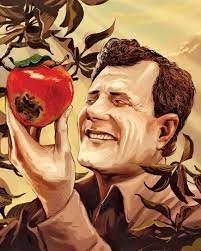 By the time I arrived in Yamhill, Oregon,
  Over the last few years, an