
Stuart Ritchie in his Substack newsletter, Science Fictions:
 Let’s start with something everyone agrees on: the world’s fertility rate has declined. Whether you’re in a low-, middle-, or high-income country, with few exceptions the “total fertility rate”—the number of children per woman—dropped pretty precipitously across the latter part of the 20th Century.
The vast majority of this decline has absolutely nothing to do with testosterone. The main reason for it is economic development: people tend to have fewer children as they and their countries become richer – and that’s incredibly good news. Other things that lower the fertility rate are also related to progress and prosperity: education (particularly of women), urbanisation, the availability of contraception, and so on.
But there also might be negative trends in fecundity – meaning a person’s biological ability to have kids, as opposed to simply whether they have kids or not (the latter being what people call “fertility”). It would be more worrying if fecundity was dropping, because that would take the choice of whether to have kids out of many people’s hands.
More here.
 Researchers have worked with hunters for decades as part of regular wildlife surveillance to manage deer populations and track the spread of infectious diseases, such as chronic wasting disease and bovine tuberculosis. But these days, the scientists are also looking for the virus that causes COVID-19 in humans.
 I have no special love for the SAT. Aside from the fact that my test came back with a big, red, “NO HARVARD FOR YOU, DUMMY” stamped on it, it always seemed a bit arbitrary. After all: Why should my eligibility for college depend on knowing words like “nefarious” and “egregious”? That seems…there must be a better word for this…crappy. We know that SAT scores correlate with household income, and evidence suggests that studying
  Like German author Judith Schalansky, I like paying attention to maps. They are time-stamps, relics and quantifiable measure, and, generally, works of art. Unlike Schalansky though, who wrote an entire
 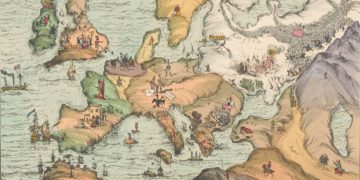 In 1816 an American lawyer named J.F. Dumoulin wrote
  Lockdown was, among other things, a sudden collective experiment in volume control. Sound waves from the regular rush-hour thrum of cities usually penetrate more than a kilometre below the Earth’s surface. When Covid-19 forced humans inside,
  Vaccines to prevent certain types of cancer already exist. They target viruses: hepatitis B virus, which can trigger liver cancer, and human papillomavirus, which causes cervical and some other cancers. But most cancers are not caused by viruses. The Lynch vaccine trial will be one of the first clinical tests of a vaccine to prevent nonviral cancers.
 On the night of April 22, the Composer doesn’t sleep …
 Though theorized in the 1930s and
  The term “neoliberalism” is often used to condemn an array of economic policies associated with such ideas as deregulation, trickle-down economics, austerity, free markets, free trade, and free enterprise. As a political movement, neoliberalism is seen as experiencing its breakthrough 40 years ago with the election into office of Ronald Reagan and Margaret Thatcher. And since the 2007–08 financial crisis, an explosion of academic work and political activism has been devoted to explaining how neoliberalism is fundamentally to blame for the massive growth in inequality.
 With Russian shells raining down on Ukrainian cities, an uneasy ceasefire in Yemen, the attack on Palestinians at prayer in Jerusalem and many other conflicts around the world, it might seem to some to be inappropriate to talk about peace.
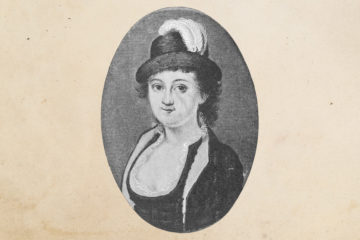 Eva Frank was born in 1756, in modern-day Ukraine, to Jacob and Hannah Frank, along with their existing children. Jacob had been raised in a family staunchly committed to the radical teachings of Shabtai Tzvi, the Jewish messianic claimant who died in 1676 after ultimately converting to Islam, and whose widely embraced prophecies and antinomian preaching—which specifically called for overturning Jewish law—nearly upended European Jewry. Around 1751, five years before Eva’s birth, Jacob proclaimed that he was Shabtai Tzvi’s successor on Earth. Building on Jewish mystical teachings and Shabtai Tzvi’s legacy, he fashioned himself as the Messiah on earth who had come to teach a new way of religious life that would bring the Messianic era. He quickly attracted thousands of followers, known as “Frankists”, and reportedly took the antinomian embrace of holy subversion even further than Shabtai Tzvi, hosting intricate rituals that overthrew the taboos of incest, menstruation, and adultery, often with the aid of sacred objects, including Torah scrolls. Though there is ongoing debate about the extent of such rituals in practice, as opposed to simply wild rumors, scholars Cristina Ciucu and Regan Kramer argue in their article published in Clio. Women, Gender, History that
 Science is all about expanding the realm of human perception. Sometimes that means making the invisible visible, like when Galileo turned a telescope toward Jupiter, discovered moons around another planet and