
Category: Recommended Reading
Performers Who Hurt Themselves, From Chris Burden To Jackass
Nikki Shaner-Bradford at Bookforum:
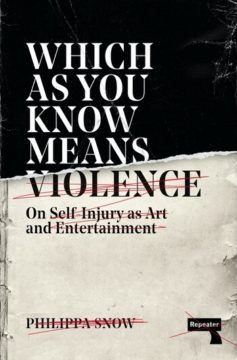 WHEN I FINISHED MY FIRST READ of Which as You Know Means Violence, critic Philippa Snow’s debut “on self-injury as art and entertainment,” I returned to my own cultural hallmark of suffering, the 2006 film adaptation of The Da Vinci Code. Reading Snow’s analysis of artist Chris Burden’s 1974 crucifixion atop a Volkswagen Beetle alongside the comical stunts of Johnny Knoxville and his squad of Jackass pranksters, I thought frequently of Paul Bettany’s fanatical Silas, who torments himself to such extremes that he plays at the brink of absurdity. Silas spends most of his screen time scurrying around church cloisters in monk’s robes and a bloody cilice, or flagellating his back in penance, a commitment to suffering so all-consuming and ridiculous that, by his third murderous jump-scare, it’s a challenge not to laugh mid-flinch.
more here.
Cooking with Taeko Kōno
Valerie Stivers at The Paris Review:
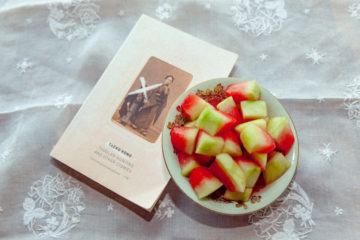 The Japanese writer Taeko Kōno is a maestro of transgressive desire whose stories often—and deliciously—use food as a metaphor for sexual appetite. Kōno, who died in 2015, is considered one of Japan’s foremost feminist writers and one of its foremost writers of any kind. She won many of the country’s top literary prizes, including the Akutagawa, the Tanizaki, the Noma, and the Yomiuri. The single selection of her work in English, Toddler-Hunting & Other Stories, first published by New Directions in 1996 and translated by Lucy North and Lucy Lower, contains ten dark, deceptively simple stories about women who find the gender roles in Japanese society unbearable, and are warped by them.
Kōno’s heroines are abandoned wives, girlfriends who don’t want to marry, and women who lack maternal instincts. Her mothers are monsters. Her little girls feel “inner discomfort” with their gender. Most characters desire pain or humiliation during sex.
more here.
Monuments and Documents: Panofsky on the Object of Study in the Humanities
John Guillory at the website of the University of Chicago Press:
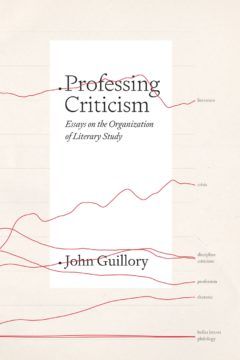 In this essay, I argue for a reorientation of discourse about the humanities to the objects of humanistic study rather than claims for their value or effect. Returning to an essay Erwin Panofsky published in 1940, “The History of Art as a Humanistic Discipline,” I build on Panofsky’s rich distinction between “monuments” and “documents” as the two sides of the humanistic object of study. By “monuments,” Panofsky refers to all of those human artifacts, actions, or ideas that have urgent meaning for us in the present. By “document,” he refers to all of those traces or records by means of which we recover monuments. Monuments and documents bring the long time of human existence, past or future, into relation to the short time of human life, a relation that defines the objects of study in all the humanities and confirms the undeniable interest of that study.
More here.
Tokyo at Night

More here.
Economists win Nobel prize for showing why banks fail
Philip Ball in Nature:
 Ben Bernanke at the Brookings Institution in Washington DC, Douglas Diamond at the University of Chicago in Illinois and Philip Dybvig at Washington University in St. Louis, Missouri, shared equal parts of the 10-million-Swedish-krona (US$915,000) award, formally known as the Sveriges Riksbank Prize in Economic Sciences in Memory of Alfred Nobel.
The research of the three laureates has helped to explain both why banks exist in the form they do and why they have fragilities that can be devastating to the economy, as shown in the Wall Street crash of 1929 and the Great Depression that followed, and in the global financial crisis of 2007–09. Insights from their work were essential in enabling banks, governments and international institutions to cope with the COVID-19 pandemic without catastrophic economic consequences, the Nobel committee said in its 10 October announcement.
More here.
The medical test paradox, and redesigning Bayes’ rule
Tuesday Poem
The Earth’s Wild Places
Your eyes, your mouth, your hands,
the public highways.
Hands, like truck stops,
semis rumbling in the corners,
Eyes like the bank clerk’s window
foreign exchange.
I love all the parts of your body
friends hug your suburbs
farmlands are given a nod
but I know the path
to your wilderness.
It’s not that I like it best,
but we’re almost always
alone there,
and it’s scary but also calm.
by Gary Snyder
from This Present Moment
Counterpoint Press, Berkeley,2015
What Is It Like to Have a Brain?: “Nineteen Ways of Looking at Consciousness”
Henry Cowles in LARB:
 When the blackbird flew out of sight,
It marked the edge
Of one of many circles.
BLACKBIRDS AREN’T ALL BLACK. They can be red-winged or red-shouldered, saffron-cowled or tricolored, rusty or yellow-hooded or chestnut-capped. And that’s just the members of the family Icteridae called blackbirds. Orioles and grackles, with their oranges and iridescence, are part of the family too. Old World blackbirds, many of which are called thrushes, are only distantly related; black birds like ravens and most crows aren’t blackbirds at all. To me, this fuzziness is part of the joke of “Thirteen Ways of Looking at a Blackbird,” a poem by Wallace Stevens first published in 1917. Across the poem’s 13 cantos, birds whirl and whistle, cast their shadows or eye us from the trees. Whether or not they’re all blackbirds — and, if so, what kind, with what colors? — the singular “a” of Stevens’s title is clearly misdirection. There are as many birds as there are perspectives, if not more, and as ever, what is true of the poem is true of the world. The more ways we look, the more we realize how much there is to see. Glance by glance, the blackbirds multiply.
Think about anything often enough, from enough angles, and it’s bound to splinter and refract. Our minds are like kaleidoscopes, packed with mirrors we twist to see the world anew. Sometimes we’re twisting consciously, sometimes unconsciously. But no matter what, we end up seeing patterns that are more a product of the tool in hand than of the world on its other end. Stevens’s poem, on this reading, is less about blackbirds than about the lenses we use to spy on them. It’s a warning, in other words, not to mistake the kaleidoscope for the universe.
More here.
Human Brain Cells Grow in Rats, and Feel What the Rats Feel
Carl Zimmer in The New York Times:
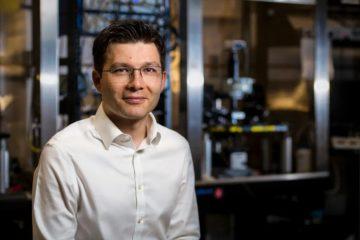 Scientists have successfully transplanted clusters of human neurons into the brains of newborn rats, a striking feat of biological engineering that may provide more realistic models for neurological conditions such as autism and serve as a way to restore injured brains.
In a study published on Wednesday, researchers from Stanford reported that the clumps of human cells, known as “organoids,” grew into millions of new neurons and wired themselves into their new nervous systems. Once the organoids had plugged into the brains of the rats, the animals could receive sensory signals from their whiskers and help generate command signals to guide their movements. Dr. Sergiu Pasca, the neuroscientist who led the research, said that he and his colleagues were now using the transplanted neurons to learn about the biology underlying autism, schizophrenia and other developmental disorders.
More here.
Sunday, October 16, 2022
‘Could I understand the people who rushed into the Capitol?’: George Saunders on how stories teach empathy
George Saunders in The Guardian:
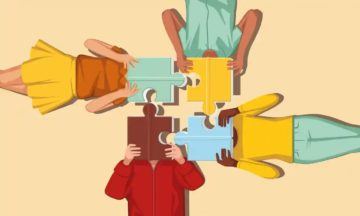 In the US, we are feeling the sickening after-effects of an attempted insurrection committed by people, many of whom, before that day, had never acted against their country or shown the least sign of being violent. What’s happening over here? Good question. And the truth is, nobody knows.
But here’s one way of looking at it: these people were told a false story and acted on it, with a level of passion and violence that would suggest true belief.
That false story – a set of false stories, really, bundled together – came to them via their newsfeeds and radio talk shows and partisan televisions shows with an alluring hi-tech gleam. In the face of this onslaught, their story receptors proved inadequate to the moment, and they exhibited a failure of what Hemingway called one’s “built-in, shockproof, shit detector”.
The stories these people fell for were laced with agenda, told for profit, designed to agitate, titillate, divide and antagonise; thrown together quickly; misshapen by the demands of the delivery vehicle, which limited the number of characters used or prioritised likes and shares. These stories entered the minds of their audience the way any story does, and their audience processed them earnestly, as if there was something vital to learn in them, because that’s what our minds do.
More here.
Douglas Hofstadter: Wacky Jabber
Douglas Hofstadter in Inference Review:
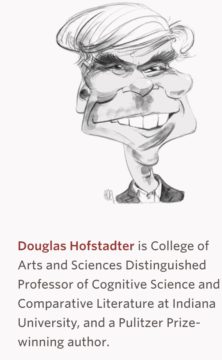 Actually, until 1961, when I was 16, I’d never given any thought to Sweden at all, but everything shifted on a dime when my Dad shared the 1961 Nobel Prize in Physics. That December, our family flew to Stockholm for the ceremonies and it was unforgettable. Not only were the solemn, yet deeply joyous, festivities a once-in-a-lifetime occurrence, but I was powerfully struck by the classic European beauty of Stockholm in the midst of that romantically dark and snowy Scandinavian winter—such a clean and sophisticated city with its old-fashioned trams, its glittering neon signs, its colorful store windows, its elegant ladies and gentlemen, and, last but not least, its strange, alien language.
When, one day in the Grand Hôtel, which certainly lived up to its name, our family first laid eyes on my Dad’s Nobel diploma, colorfully and exquisitely hand-calligraphed in Swedish, I tried to make some sense of the citation—“För hans banbrytande undersökningar över elektronspridningen mot atomkärnor och därvid gjorda upptäckter rörande nuckleonernas struktur”—but I couldn’t do much with it. Although I knew a weensy bit of German, I didn’t know a word of any of its cousin languages, such as Swedish. And yet I instantly noticed something that looked odd; a tiny little thing that, to my eye, stuck out like a sore thumb. Even if you know zero Swedish, I urge you to try to spot the spot that was an eyesore to me. Hint: it’s just one word toward the end. And by the way, in English, what those italicized words mean is this: “For his pathbreaking investigations of electron-scattering from atomic nuclei, and for his discoveries, made thereby, concerning the structure of nucleons.”
More here.
The internet is already over
Sam Kriss in Numb at the Lodge:
 In 1977, Ken Olsen declared that ‘there is no reason for any individual to have a computer in his home.’ In 1995, Robert Metcalfe predicted in InfoWorld that the internet would go ‘spectacularly supernova’ and then collapse within a year. In 2000, the Daily Mail reported that the ‘Internet may be just a passing fad,’ adding that ‘predictions that the Internet would revolutionise the way society works have proved wildly inaccurate.’ Any day now, the millions of internet users would simply stop, either bored or frustrated, and rejoin the real world.
Funny, isn’t it? You can laugh at these people now, from your high perch one quarter of the way into the twenty-first century. Look at these morons, stuck in their grubby little past, who couldn’t even correctly identify the shape of the year 2022. You can see it perfectly, because you’re smart. You know that the internet has changed everything, forever.
More here.
The worst Nobel Prizes ever awarded in science (and one in literature)
Scotty Hendricks at Big Think:
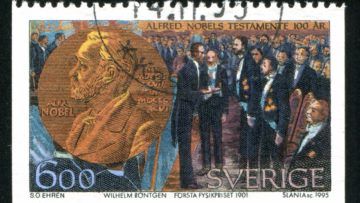 Nobel Prizes used to be awarded fairly quickly after the discovery, achievement, or event that prompted them. The instructions left by Alfred Nobel seemed to warrant this speed. However, this has occasionally led to awards for discoveries that later turned out to be bunk. Perhaps no case of this is clearer-cut than the 1926 prize in medicine, which was awarded “for [Fibiger’s] discovery of the Spiroptera carcinoma.”
In brief, Dr. Fibiger’s research appeared to show that a certain roundworm parasite could cause cancer in rats. However, later experiments proved that the “cancers” he claimed to have observed were lesions caused by insufficient vitamin A. The roundworms he examined didn’t cause cancer, although certain parasites are known to do so.
More here.
Bruno Latour (1947 – 2022) Philosopher
Jan. 6 shook US democracy. Has Jan. 6 committee helped shore it up?
Christa Bryant in The Christian Science Monitor:
 The House committee tasked with investigating the Jan. 6 attack on the Capitol made its closing arguments to the American public today and voted 9-0 to subpoena former President Donald Trump. They highlighted snippets from more than a million Secret Service communications in the days and hours leading up to the breach of the Capitol, bolstering their thesis that then-President Donald Trump had incited a mob and bears singular responsibility for the violence that ensued. “Armed and Ready, Mr. President!” read one snippet of intelligence presented in a Secret Service email on Dec. 24, 2020, about two weeks before the Jan. 6 joint session of Congress to formalize Joe Biden’s election victory.
More here.
Angela Lansbury (1925 – 2022) Actor And Singer
Anita Kerr (1927 – 2022) Singer And Composer
Study finds unexpected protective properties of pain
From Phys.Org:
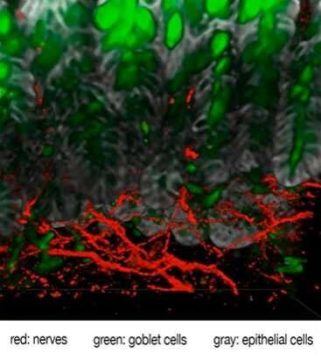 Pain has been long recognized as one of evolution’s most reliable tools to detect the presence of harm and signal that something is wrong—an alert system that tells us to pause and pay attention to our bodies. But what if pain is more than just a mere alarm bell? What if pain is in itself a form of protection? A new study led by researchers at Harvard Medical School suggests that may well be the case in mice. The research, published Oct. 14 in Cell, shows that pain neurons in the mouse gut regulate the presence of protective mucus under normal conditions and stimulate intestinal cells to release more mucus during states of inflammation.
The work details the steps of a complex signaling cascade, showing that pain neurons engage in direct crosstalk with mucus-containing gut cells, known as goblet cells. “It turns out that pain may protect us in more direct ways than its classic job to detect potential harm and dispatch signals to the brain. Our work shows how pain-mediating nerves in the gut talk to nearby epithelial cells that line the intestines,” said study senior investigator Isaac Chiu, associate professor of immunobiology in the Blavatnik Institute at HMS. “This means that the nervous system has a major role in the gut beyond just giving us an unpleasant sensation and that it’s a key player in gut barrier maintenance and a protective mechanism during inflammation.”
More here.
Sunday Poem
To Travel
—after the Finnish of Gosta Agren
If you should go to Samarkand
you might find Scheherazade
reproduced a thousand times,
tinsel-clad, in gift shops,
and Al-al-Din’s gold-plated domes
slung with Soviet tourist signs
and tarnished, on a brassy sky.
But staying is a kind of leaving.
From here, the fields of Oxfordshire
stretch almost sovereign-golden.
And when the wheat is rolled in bales
like wheels, and black tractor rills
run to the bare horizon, there shall be,
in the wordless autumn air, Samarkand,
the idea of Samarkand.
by Kate Clanchy
from The National Poetry Library