Joel Whitney in Jacobin:
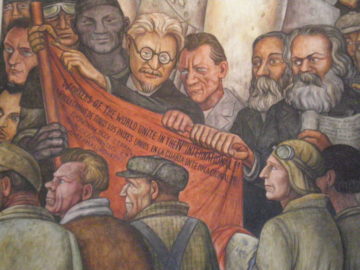 Diego Rivera painted Pan American Unity for the 1940 San Francisco World’s Fair in an airplane hangar, accompanied by an armed guard. Shortly before he commenced work on the mural, his wife — the artist Frida Kahlo — and Leon Trotsky began an affair. Though Rivera remained an admirer of the hero of the October Revolution, he expelled Trotsky from his home in Mexico. The security budget required to protect the former military leader had already been putting a strain on the household’s finances. This was the last straw.
Pan American Unity features no image of Trotsky. Stalin appears on the painting’s fourth panel as one set of a triad of ghouls cloaked in a gray ether, alongside Hitler and Mussolini. They are surrounded by portraits of actors, chief among them Charlie Chaplin, who assumes a number of his satirical personas. A single arm, tattooed with a swastika and holding a dagger tightly, emerges out of the cloud, but it is held at bay by another, much larger, arm draped in an American flag and flanked by bombers and paratroopers. This is Rivera’s ode to anti-fascist Hollywood.
More here.
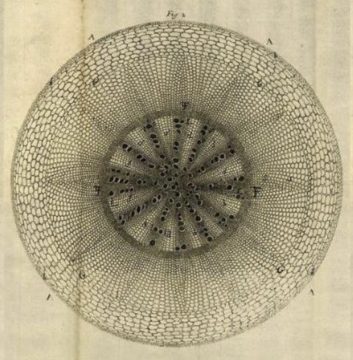 Modern genetics was launched by the practice of agriculture: the Moravian monk Gregor Mendel discovered genes by cross-pollinating peas with a paintbrush in his monastery garden in Brno. The Russian geneticist Nikolai Vavilov was inspired by crop selection. Even the English naturalist Charles Darwin had noted the extreme changes in animal forms created by selective breeding. Cell biology, too, was instigated by an unassuming, practical technology. Highbrow science was born from lowbrow tinkering.
 In his classic book from 1990, Three Rival Versions of Moral Inquiry, the Marxist-turned-Catholic-Thomist philosopher Alasdair MacIntyre discusses three basic modern and postmodern approaches to philosophical inquiry: encyclopedia, genealogy, and tradition. The genealogical method, pioneered by Friedrich Nietzsche and elaborated by Michel Foucault, presents a historical narrative in which ideas develop and grow over time. According to this thinking, being and truth are conditioned by history (historicized) and thus develop in tandem with the twists and turns of science, technology, economics, language, and culture.
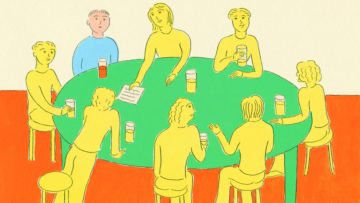 At the end of my sophomore year of college, I found myself at a career crossroads. The pandemic hit a few months earlier and like most students across the country, I was kicked off campus and sent back home. As I spent the remainder of the school year sitting idly in my childhood bedroom, I had no choice but to wrestle with the ever-looming question: What do I really want to do with my life?
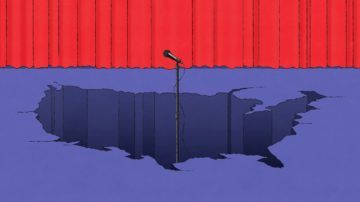 Tours have always been good for getting me out of my bubble, this one even more so. Driving across the Midwest, I saw one Trump 2024 sign after another—this while the election was an entire three years away. “You know you’re in a place that’s inhospitable to liberals when you see fireworks stores,” Adam said in rural Indiana as we passed one powder keg after another.
 W
W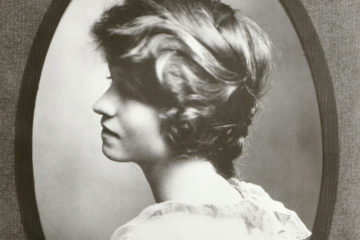 According to poetry scholar John Timberman Newcomb, Millay is “
 The founders of statistical mechanics in the 19th century faced an uphill battle to convince their fellow physicists that the laws of thermodynamics could be derived from the random motions of microscopic atoms. This insight turns out to be even more important than they realized: the emergence of patterns characterizing our macroscopic world relies crucially on the increase of entropy over time. Barry Loewer has (in collaboration with David Albert) been developing a theory of the
  Nothing destroys progress like conflict. Fighting massacres soldiers, ravages civilians, starves cities, plunders stores, disrupts trade, demolishes industry, and bankrupts governments. It undermines economic growth in indirect ways too. Most people and business won’t do the basic activities that lead to development when they expect bombings, ethnic cleansing, or arbitrary justice; they won’t specialize in tasks, trade, invest their wealth, or develop new ideas. These costs of war incentivize rivals to steer clear from prolonged and intense violence.
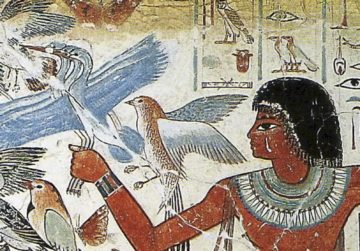
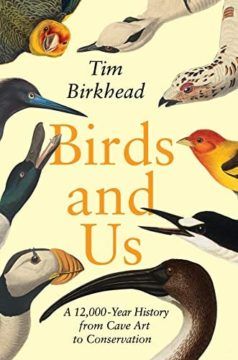 Relationships between ancient humans and birds had a deeply religious element. Birkhead locates the “ground zero” of an early human civilization built around animal worship in ancient Egypt. Within the catacombs at Tuna el-Gebel in Egypt, there are four million mummified birds contained in jars and coffins. In addition to mummifying ibises, ancient Egyptians preserved a variety of creatures in cemeteries throughout the Nile Valley. Birds, however, are among the most prominent animals. Clearly, the lovingly embalmed birds were considered sacred; and ancient Egypt was a civilization in which humans and birds lived in harmony.
 Protests enter their second week. I’m waiting on the street for the taxi to arrive when I see an old religious man coming towards me. At first, I’m afraid he wants to mention I’m not wearing a hijab. All of a sudden, he brings his phone in front of me and shows me Mahsa Amini’s photo, saying, “Can you believe it, ma’am? They killed someone’s daughter. I myself have a daughter. I swear to God, I haven’t slept for a week.”
 Ned and Sunny stretch out together on the warm sand. He rests his head on her back, and every so often he might give her an affectionate nudge with his nose. The pair is quiet and, like many long-term couples, they seem perfectly content just to be in each other’s presence.
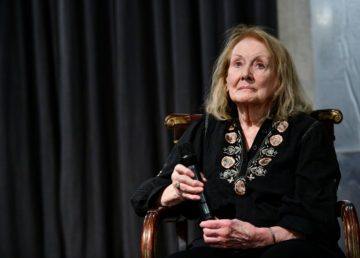 Annie Ernaux, who was awarded the Nobel Prize in Literature last Thursday, was not on the other end of the telephone when the committee rang to deliver the news. Last year, she received a prank text telling her she had won the illustrious award, which might be one reason why her first response when the committee did get through to her was incredulous: “Are you sure?”
 Matrix multiplication, which