
Nathan Heller in The New Yorker:
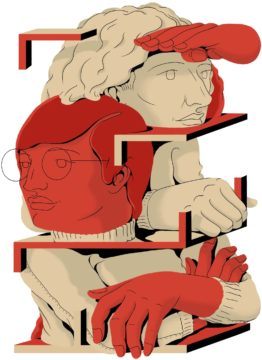 Around you, there is piracy and chaos. But you’re enterprising, and keep to your path. At university, you hardly sleep, and you eat what you can afford. Why do you work yourself this way? It’s not as if you’re getting paid for it. Another version of yourself, in another time, though, is. Now, living in the California sun with some success, you reflect on your poor, wan, sleepless younger self and feel a wave of gratitude, and then of prickly regret. The kid you were had different dreams; it strikes you as unfair that you sit pretty on the spoils of that person’s efforts. If you could take some of your wealth and send it backward in time, to your younger self, you would.
We usually think of inequalities as extending from bottom to top: I earn a little wealth over eight hours; Bill Gates earns much more. But there are also inequalities that extend longitudinally, from the past into the future. Your young self does labor for which your older self collects rewards. Such timing issues—how much money you receive or can spend now and later—have effects on your financial fate. In a more equal world, you cannot help but think, people would draw on their lifetime wealth throughout their lives, not merely at the pinnacle of their careers. You notice that older generations and big corporations rule the roost in the United States, but it’s not clear why this should be so.
More here.
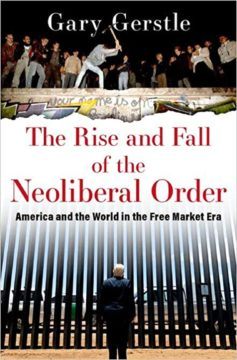 Intellectual histories of recent American public life typically foreground disintegration in order to capture the mood of a country on the brink. These moments are not only about the United States’s ongoing culture wars or its “
 In 1868, the mathematician Charles Dodgson (better known as Lewis Carroll) proclaimed that an encryption scheme called the Vigenère cipher was “unbreakable.” He had no proof, but he had compelling reasons for his belief, since mathematicians had been trying unsuccessfully to break the cipher for more than three centuries.
 The scientist James Lovelock’s discoveries had an immense influence on our understanding of the global impact of humankind, and on the search for extraterrestrial life. A vigorous writer and speaker, he became a hero to the green movement, although he was one of its most formidable critics.
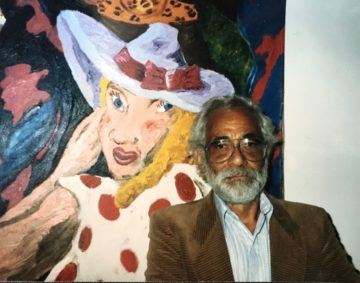 “Art and Race Matters: The Career of Robert Colescott,” a clamorous retrospective at the New Museum, bodes to be enjoyed by practically everyone who sees it, though some may be nagged by inklings that they shouldn’t. For more than three decades, until he was slowed by health ailments in the two-thousands—he died in 2009, at the age of eighty-three—the impetuous figurative painter danced across minefields of racial and sexual provocation, celebrating libertine romance and cannibalizing canonical art history by way of appreciative parody. He was born in California, the son of musicians from New Orleans. His mother, certainly, and possibly his father, who worked as a railroad waiter, had enslaved ancestors, but both of them—and Colescott—could pass for white. As Matthew Weseley, the co-curator of the show with Lowery Stokes Sims, recounts in the splendid catalogue, Colescott’s mother insisted on the ruse, which he adopted. The mild-mannered modernism of his early works, sampled at the New Museum, affords no hints to the contrary.
 Sūnya, nulla, ṣifr, zevero, zip and zilch are among the many names of the mathematical concept of nothingness. Historians, journalists and others have variously identified the symbol’s birthplace as the Andes mountains of South America, the flood plains of the Tigris and Euphrates Rivers, the surface of a calculating board in the Tang dynasty of China, a cast iron column and temple inscriptions in India, and most recently, a stone epigraphic inscription found in Cambodia.
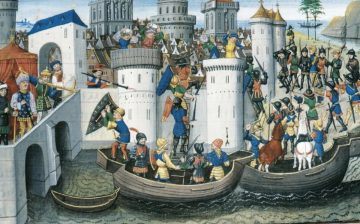 The Green New Deal is so dead that uttering the name now sounds like a bitter joke. Other ambitious plans like Jay Inslee’s were ignored. Biden’s more realistic plan was killed by Joe Manchin. Polls like the one that Wallace-Wells cite above
  While I defend the existence and utility of IQ and its principal component, general intelligence or g, in the study of individual differences, I think it’s completely irrelevant to AI, AI scaling, and AI safety. It’s a measure of differences among humans within the restricted range they occupy, developed more than a century ago. It’s a statistical construct with no theoretical foundation, and it has tenuous connections to any mechanistic understanding of cognition other than as an omnibus measure of processing efficiency (speed of neural transmission, amount of neural tissue, and so on). It exists as a coherent variable only because performance scores on subtests like vocabulary, digit string memorization, and factual knowledge intercorrelate, yielding a statistical principal component, probably a global measure of neural fitness.
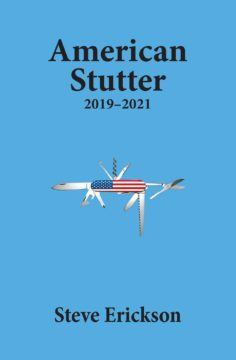 American Stutter, 2019–2021, novelist Steve Erickson’s journal of our ongoing plague year — the everything-at-once-all-the-time mash-up of election, pandemic, and still-unresolved attempted coup — springs from a clarifying rage that not only scorns right-wing perfidy but also looks askance at liberal good intentions (and their too-often ether-brained descendants, progressive good intentions). In Erickson’s view, liberal humanism is just not up to the job of preventing America from becoming a democracy in name only. His voice in this book is simultaneously that of a soldier exhorting his fellow combatants to get off their asses and rush with him into enemy fire, and of a disillusioned man wiping the dirt off his hands as he walks away from the grave of American democracy. It is hopeful and fierce and already grieving.
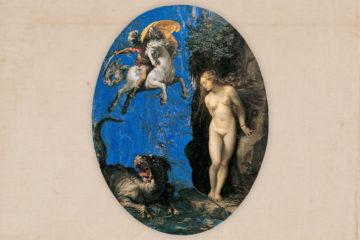 There’s something odd about the sky in Giuseppe Cesari’s rendition of Perseus and Andromeda. The blue is too bright, too saturated; it has a hyperreal quality that feels appropriate for a myth. This luminous sky and its fuzzy wisps of cloud were not picked out by an artist’s brush, but rather, formed by geological forces. The painting is worked on a chunk of polished lapis lazuli. It’s a visual pun: in the myth, Andromeda was chained to a rock, just as her image is secured to a stone in this painting. Cesari returned to this story over and over, producing versions on wood panels, on limestone, and on slate. Each substrate contributes to the painting in its own way:
  “I am for Kool-art, 7-Up art, Pepsi-art, Sunshine art, 39 cents art, 15 cents art. . . . I am for an art of things lost or thrown away on the way home from school.” When the artist Claes Oldenburg, who authored these words in 1961, died this week at ninety-three, one had a sense that it had been a long while since his vision, for good or ill, had engaged the center ring of the art world’s attention. If he had not exactly disappeared from view, he had faded a little. Examples of his outsized, monumental tributes to the sheer thingness of ordinary things, celebrated in the Whitman-esque list above, could be found in many American cities—a giant clothespin in Philadelphia, shuttlecocks in Kansas City—but, though his sculptures are often beloved, they exist by now more as local color than as visionary art. They have become, in an irony that Oldenburg would have appreciated, numbered among the vernacular eccentricities that have always dotted the American landscape: the giant elephant in Margate, the duck on Long Island, or the giant pickle that once stood at Fifth Avenue and Broadway.