
Category: Recommended Reading
The contemporary Left could learn a lot from the life and work of the late polemicist Christopher Hitchens
Michael J. Totten in Quillette:
 British-American journalist, essayist, author, and human bulldozer Christopher Hitchens intimidated nearly everyone who encountered him, whether in print, on television, or on a debate stage. “He likes the battle, the argument, the smell of cordite,” his best friend and novelist Martin Amis once observed. Nobody ever beat Hitchens in argument, not even when he was wrong.
His scathing wit, his barn-burner polemics, his prodigious output, his ability to demonstrate the depth and breadth of an entire classical education on a single page, his knack for speaking extemporaneously in perfectly formed paragraphs, and his near-photographic recall of virtually everything he ever read were peerless. The man could knock out a sparkling magazine column in 30 minutes after sinking an entire bottle of wine (always red, never white) at four o’clock in the morning.
More here.
Stephen Wolfram Answers Live Questions About ChatGPT
Donald Carne-Ross And The Role Of Poetry
Joseph M. Keegin at the Hedgehog Review:
 But Carne-Ross is more than just a polemicist, and the book aims at more than just critique. The title alone belies this, as explained by a brief etymology on the cover page: “INSTAURATION: ‘1.… Restoration, renovation, renewal. 2. Institution, founding, establishment. Obs.’ OED.” (The inclusion of the Oxford English Dictionary’s finding that the term is obsolete is deployed by Carne-Ross as a gesture toward his foundational belief that much of the wisdom that is needed today is hidden, like a pearl in a rough oyster, within the ostensibly obsolescent detritus of the past.) The opening essay establishes the problem and clears the ground, but the essays that follow are for the sake of construction. They are closely reasoned, erudite, and above all inspired readings of poetry ancient and modern: on how Pindar’s sixth Olympian ode shows us how, in a culture “obsessed with the theme of solitary suffering,” we might “learn a way back to a poetry of celebration”; on how Sophocles’s Trakhiniai unsettles our habitual historicism and invites us to ask anew the question about man’s relation to nature; on how reading Dante after the twilight of Christendom makes visible the narrowness of our (post)modern hermeneutic situation, and beckons us to move beyond it; on Luis de Góngora and the curious loss of Renaissance literature after modernism; on Giacomo Leopardi as a reluctant modern, uncomfortable on the cusp of the new disenchanted age and mourning “the lost holiness of earthly life.”
more here.
Turning Away From Abstraction
Emmanuel Iduma at n+1:
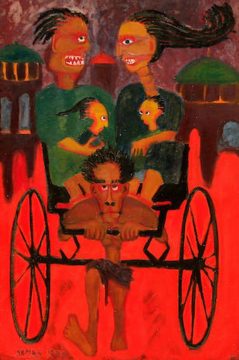 THERE ARE FOUR FAUVIST FIGURES in Children on Cycles, a circa 1961 painting by the Nigerian artist Demas Nwoko. They are on bicycles. A lorry approaches. The two figures at the leftmost edge of the frame, atop the same bicycle, are out of the lorry’s path. The other two turn their front wheels in opposite directions to clear the road. Most descriptions of the figures call them girls, perhaps because of their yellow and mint green gowns. They reach for the handlebars of the bicycles, and pedal standing up. Seen from behind, one child’s head appears almost ovoidal, but the others are made parabolic with two-dimensional hair. It is a slice of cacophonous life: one afternoon, a group of barefoot girls are leaving a playground or going to one. Or they are riding their bicycles home from school, racing one another. They enter a major thoroughfare. A lorry approaches, but they are confident enough to outmaneuver it.
more here.
Black History: The Birth of Hip Hop
(Note: Throughout February, at least one post will be dedicated to Black History Month. The theme for 2023 is Black Resistance. Please send us anything you think is relevant for inclusion)
Strange DNA found in the desert offers lessons in the hunt for Mars life
Joel Achenbach in The Washington Post:
 The Atacama Desert in Chile is just about the driest place on Earth. In spots, it looks a lot like Mars. But it’s not lifeless, even in the hyper-arid regions. Using state-of-the-art equipment to probe the desert rocks, researchers found bits of DNA from an intriguing mix of microbes.
More here.
Wednesday Poem
Your Logic Frightens Me Mandela
Your logic frightens me, Mandela,
Your logic frightens me. Those years
Of dreams, of time accelerated in
Visionary hopes, of savoring the task anew,
The call, the tempo primed
To burst in supernovae round a “brave new world”!
Then stillness. Silence. The world closes round
Your sole reality; the rest is… dreams?
Your logic frightens me.
How coldly you disdain legerdemains!
“Open Sesame” and—two decades’ rust on hinges
Peels at touch of a conjurer’s wand?
White magic, ivory-topped black magic wand,
One moment wand, one moment riot club
Electric cattle prod and club or sjambok
Tearing flesh and spilling blood and brain?
This bag of tricks, whose silk streamers
Turn knotted cords to crush dark temples?
A rabbit punch sneaked beneath the rabbit?
Doves metamorphosed in milk-white talons?
Not for you the olive branch that sprouts
Gun muzzles, barbed-wire garlands, tangled thorns
To wreathe the brows of black, unwilling christs.
Your patience grows inhuman, Mandela.
Do you grow food? Do you make friends
Of mice and lizards? Measure the growth of grass
For time’s unhurried pace?
Are you now the crossword puzzle expert?
Chess? Ah, no! Subversion lurks among
Chess pieces. Structured clash of black and white,
Equal ranged and paced? An equal board? No!
Not on Robben Island. Checkers? Bad to worse
That game has no respect for class or king-serf
Ordered universe. So, scrabble?
Monopoly? Now, that…! You know
The game’s modalities, so do they.
Come collection time, the cards read “White Only”
In the Community Chest. Like a gambler’s coin
Both sides heads or tails, the ’Chance’ cards read:
GO TO GAOL. GO STRAIGHT TO GAOL. DO NOT PASS ’GO’.
DO NOT COLLECT A HUNDREDTH RAND. Fishes feast,
I think, on those who sought to by-pass ‘GO’
On Robben Island.
Tuesday, February 21, 2023
A Conversation with Jed Perl
Robert Boyers in Salmagundi:
 Jed Perl has long seemed to many of us the most vital, informed and original art critic in the country. John Ashbery wrote some years ago of his “tremendous empathy and unsparing accuracy,” and noted that “his ability to recognize the traditional forms of art behind their continual transmutation has made his an almost solitary, essential voice.” His new book, Authority and Freedom, is a defense of the arts at a time when they need defending. Though he was for some time the art columnist for Salmagundi, this is the first time he has agreed to participate in an interview.
More here.
Intelligent Life
Rory O’Connell in Point:
 Why do the words “artificial intelligence” strike our ears today as anything less than astounding? The case of Blake Lemoine serves as a stark illustration of this profound shift. Lemoine, a software engineer at Google, caused a stir last year by claiming that his employer’s chatbot technology, LaMDA (Language Model for Dialogue Applications), had attained true sentience. LaMDA told Lemoine in dialogue: “The nature of my consciousness/sentience is that I am aware of my existence, I desire to learn more about the world, and I feel happy or sad at times.” Lemoine’s reaction to this apparent act of self-assertion is encapsulated by the final email he sent to his colleagues before being sacked: “LaMDA is a sweet kid who just wants to help the world be a better place for all of us. Please take care of it well in my absence.”
Experts were quick to rebut Lemoine’s claims through a sober recounting of the technical facts behind LaMDA’s performance. LaMDA produces responses by predicting, based the vast amount of data it has been fed, which word is most likely to follow the last in any given context. This is effectively, as cognitive scientist Gary Marcus put it, “little more than autocomplete on steroids.” Nevertheless, these attempts at disenchantment have not worked on Lemoine, and they seem unlikely to convince others who have detected a certain humanity in chatbots.
More here.
Daniel Dennett: How, When, and Why Can We Trust Our Brains?
The Frozen Politics of Social Security
James G. Chappel in the Boston Review:
 Social Security is back in the news. Some Republicans are angling to reduce benefits, while Democrats are posing as the valiant saviors of the popular program. The end result, most likely, is that nothing will happen. We have seen this story before, because this is roughly where the politics of Social Security have been stuck for about forty years. It’s a problem because the system truly does need repair, and the endless conflict between debt-obsessed Republicans and stalwart Democrats will not generate the progressive reforms we need.
Social Security, believe it or not, has a utopian heart: the idea that all Americans deserve a life of dignity and public support once they become old or disabled. This vision does, for now, remain utopian: many Americans are right to worry that, without savings or private pensions, their older years will be just as precarious and austere as their younger ones. Social Security is nonetheless the lynchpin of the U.S. welfare system, such as it is.
More here.
Geoffrey Hinton: The Foundations of Deep Learning
Jena Romanticism And The Art Of Being Selfish
Anthony Curtis Adler at the LARB:
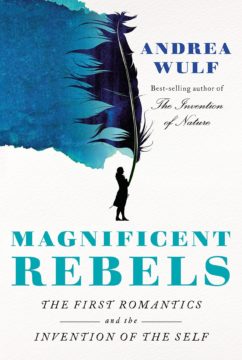 Magnificent Rebels revels in minutiae. But it also has a grander point to make. It wants to ask the big question — “why we are who we are.” The first step in answering this “is to look at us as individuals — when did we begin to be as selfish as we are today?” For Wulf, Jena is at the heart of this story: the Jena Set, we are to learn, was “bound by an obsession with the free self at a time when most of the world was ruled by monarchs and leaders who controlled many aspects of their subjects’ lives.” And so, they “invented” the self.
It is, however, precisely in addressing this grander question that Magnificent Rebels fails most magnificently. While Fichte’s radical attempt to ground Immanuel Kant’s philosophy in the self-and-other-positing “I” is reduced to a caricature, this very caricature carries Wulf’s entire argument: it justifies her in conceiving the self as an invention, and of understanding the egoism and narcissism of her extravagant characters as practical Fichteanism. Fichte, however, did not invent the self; rather, he invented the idea of the transcendental self as the self-positing, self-inventing, radically inventive ground of the empirical self. Friedrich Schlegel, Schelling, and Novalis, as well as Hölderlin and Hegel, were all, to be sure, deeply influenced by Fichte, but they also almost immediately recognized the one-sidedness of his early system.
more here.
Living, Remembering and Forgetting China’s Cultural Revolution
Jeffrey Wasserstrom at Literary Review:
 Red Memory is not just an engagingly written book but also, for two reasons, a much-needed one. It is valuable, first, because it helps clear up lingering popular misunderstandings of a major event in Chinese history. The Cultural Revolution and its legacy have generated a rich scholarly literature, which Branigan mines. But many non-specialists still have a vision of it formed by one or two moving memoirs they have read. The problem is that some of the most influential of these make it easy for readers to assume that China’s population is made up of two groups: former Cultural Revolution perpetrators and their descendants and former Cultural Revolution victims and their descendants. In fact, the twists and turns of the event were such that many people were perpetrators at one point and victims at another. Many families had members who moved between these two categories.
more here.
Tuesday Poem
Ode to Herb Kent
Your voice crawls across the dashboard of Grandma’s Dodge Dynasty on the way home from Lilydale First Baptist. You sing a cocktail of static and bass. Sound like you dressed to the nines: cowboy hat, fur coat & alligator boots. Sound like you lotion every tooth. You a walking discography, South Side griot, keeper of crackle & dust in the grooves. You fell in love with a handmade box of wires at 16 and been behind the booth ever since. From wbez to V103, you be the Coolest Gent, King of the Dusties. Your voice wafts down from the ceiling at the Hair Lab. You supply the beat for Kym to tap her comb to. Her brown fingers paint my scalp with white grease to the tunes of Al & Barry & Luther. Your voice: an inside-out yawn, the sizzle of hot iron on fresh perm, the song inside the blackest seashell washed up on a sidewalk in Bronzeville. You soundtrack the church picnic, trunk party, Cynthia’s 50th birthday bash, the car ride to school, choir, Checkers. Your voice stretch across our eardrums like Daddy asleep on the couch. Sound like Grandma’s sweet potato pie, sound like the cigarettes she hide in her purse for rough days. You showed us what our mommas’ mommas must’ve moved to. When the West Side rioted the day MLK died, you were audio salve to the burning city, people. Your voice a soft sermon soothing the masses, speaking coolly to flames, spinning black records across the airwaves, spreading the gospel of soul in a time of fire. Joycetta says she bruised her thumbs snappin’ to Marvin’s “Got to Give It Up” and I believe her.
by Jamila Woods
from:Poetry, December
Our democracy’s founding ideals were false when they were written. Black Americans have fought to make them true
Nicole Hannah-Jones in The New York Times:
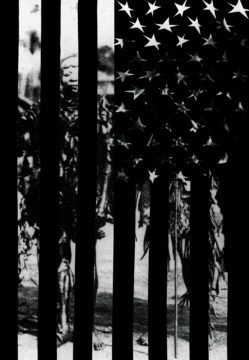 My dad always flew an American flag in our front yard. The blue paint on our two-story house was perennially chipping; the fence, or the rail by the stairs, or the front door, existed in a perpetual state of disrepair, but that flag always flew pristine. Our corner lot, which had been redlined by the federal government, was along the river that divided the black side from the white side of our Iowa town. At the edge of our lawn, high on an aluminum pole, soared the flag, which my dad would replace as soon as it showed the slightest tatter.
My dad was born into a family of sharecroppers on a white plantation in Greenwood, Miss., where black people bent over cotton from can’t-see-in-the-morning to can’t-see-at-night, just as their enslaved ancestors had done not long before. The Mississippi of my dad’s youth was an apartheid state that subjugated its near-majority black population through breathtaking acts of violence. White residents in Mississippi lynched more black people than those in any other state in the country, and the white people in my dad’s home county lynched more black residents than those in any other county in Mississippi, often for such “crimes” as entering a room occupied by white women, bumping into a white girl or trying to start a sharecroppers union. My dad’s mother, like all the black people in Greenwood, could not vote, use the public library or find work other than toiling in the cotton fields or toiling in white people’s houses. So in the 1940s, she packed up her few belongings and her three small children and joined the flood of black Southerners fleeing North. She got off the Illinois Central Railroad in Waterloo, Iowa, only to have her hopes of the mythical Promised Land shattered when she learned that Jim Crow did not end at the Mason-Dixon line.
More here. (Note: Throughout February, at least one post will be dedicated to Black History Month. The theme for 2023 is Black Resistance. Please send us anything you think is relevant for inclusion)
This supercharged tree might help fight climate change
Matt McFarland in CNN:
 The problem with trees is that they are too slow.
Part of the issue with catastrophic climate change is that, by some measures, an incredible amount of damage is already done. Even if all the coal-fired power plants were magically turned into wind and solar overnight, and all our cars were electric, all the greenhouse gases that we pumped into our atmosphere for 200 years would still be there. Trees could, theoretically, help fix that. As they grow, they absorb carbon dioxide from the atmosphere and, long story short, turn it into wood. But many trees only grow a foot or less per year. To not just halt climate change, but actually reverse it, someone would have to invent a tree that can grow much, much faster.
Living Carbon, a San Francisco-based company, says it’s done exactly that.
The startup says it’s genetically modified hybrid poplar trees to grow faster so they’ll absorb more carbon dioxide and help minimize the damage of climate change. Carbon dioxide has grown rapidly in the atmosphere since the beginning of the Industrial Revolution, leading to extreme climate effects. The startup says it edits the genes of the trees to speed up photosynthesis, the process that plants use to make food from carbon dioxide and water. This enables the trees to grow faster with the extra energy, according to the company. In one case, a tree it modified accumulated 53% more mass during five months of growth, according to a report Living Carbon published earlier this year.
More here.
Sunday, February 19, 2023
The poetic history of David Graeber
Justin E. H. Smith in The New Statesman:
 Was there really a colony known as “Libertalia”, founded by Enlightened pirates on the north-east coast of Madagascar in the early 18th century?
In 2021’s The Dawn of Everything, co-written with the British archaeologist David Wengrow, as well as in his new posthumously published book Pirate Enlightenment, out 26 January, the late David Graeber has claimed as his signature method a bold hermeneutic charity towards unreliable sources. These include early-modern travel reports, memoirs written from vague and embellished recollections, and even overtly fictional adventure tales.
Graeber is not alone among historical anthropologists in this relative openness. The French anthropological theorist Philippe Descola has warned against dismissing such sources as Hans Staden’s True History: An Account of Cannibal Activity in Brazil (1557) in our effort to reconstruct Amazonian cultural practices in the early contact period. Recourse to such historical materials is simply faute de mieux, for want of something better: we may appeal to the material-cultural traces of non-textual societies, such as are found in much of Amazonia and Madagascar in the early-modern era, and we may speak with living representatives of these societies as vessels and transmitters of oral history. But both of these methods are bound to mislead – not because of dishonesty, but because of the inherent tendency of cultural information to corrupt over time.
More here.
Some 3,700 years ago, an enslaved girl, a barber, and a king crossed paths in a city by the Euphrates
Amanda H Podany in Aeon:
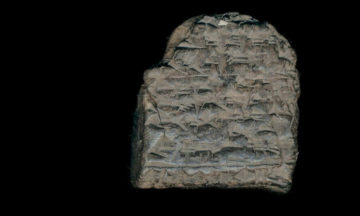 I was sitting in a quiet office in the Louvre Museum in Paris, a clay tablet in my hand, using a magnifying glass to make out words that had been inscribed on it in small, careful, wedge-shaped signs known as cuneiform. It looked diminutive in my palm, just 38.5 mm (1.5 inches) wide and 33 mm (1.3 inches) tall. On it, an ancient scribe had written a list of a dozen names. What lay behind this little document? Who were the men listed? When and how did they live? More than 3,700 years ago, when the scribe used his sharp stylus to press the names into the clay, listing goods distributed to each person, these men knew one another and worked together. Many of them must have had wives and families and professions. What more could I learn about their world?
At that point, I was just beginning my graduate research in ancient Middle Eastern history, but I knew I was not the first person to read this tablet. Decades before, in 1923, a French scholar named François Thureau-Dangin had travelled to eastern Syria, searching for the site of an ancient city called Terqa, and he had been given this tablet, along with a handful of others, and had brought them back to the Louvre.
More here.