
Pat Lipsky at The New Criterion:
 With Paul Klee, the bad year was 1930, “when he started using thick black outlines,” Clem said. Picasso was clear until 1918, after which “he never did a good painting.” T. S. Eliot, the publication year of The Waste Land, 1922. Clem squinted above a thick exhale from his Camel, as if looking back across the years of disappointed production. Eliot had lost his stuff. On Van Gogh, the years were 1885–88, the era of Shoes and The Potato Eaters. The portraits especially “had too much paint and were not good.” For Pollock, whom Clem singled out early on as the most important Abstract Expressionist, the cutoff was 1951. It amused Clem when at Pollock’s 1951 show—the first not to succeed—people kept coming up to him and saying, “At last I get what you see in Pollock.”
I memorized these falling-off dates and couldn’t help thinking the idea obsessed Clem because he, too, had fallen off. He attributed his non-writing then to writer’s block, which I took as a generic term to mean he had ceased exerting any control over his schedule. What Clem did all day was see friends, read philosophy, and visit exhibitions, with his scowling instant discernment. He was nearing eighty.
more here.

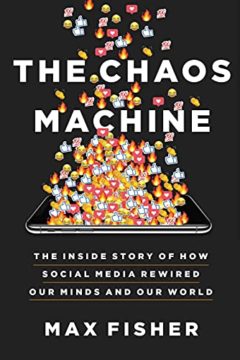 So the race for attention has shaped the products and these products have shaped what we see. This has created nothing less than ‘a wholly new era in the human experience’. Fisher’s point is that wiring platforms to grab attention has had a series of vast and ultimately ruinous consequences for the world we live in. For what the machines learned was that across an array of cultures and societies, more extreme content wins more engagement. The charge is not simply that YouTube and Facebook have allowed polarising, extremist, conspiracist, hateful material to persist on their platforms; it is also that they have actively pushed people’s attention towards it. Their products haven’t just reflected reality for us all but actually created it.
 Why do Americans read so few books in translation? Well, compared with the German or Japanese markets, which see about ten times as many books in translation published in any given year, not a lot of work in translation gets published. Crime fiction might be one notable exception to this since English readers have an unquenchable appetite for them. While Onda writes all types of fiction, from genre to literary, it is her mysteries that are getting picked up. First was New York Times 2020 Notable Book, The Aosawa Murders, and this year it is her Fish Swimming in Dappled Sunlight.
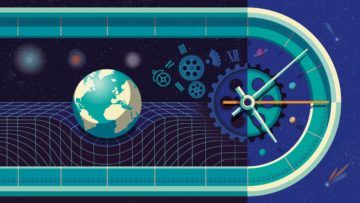 The development of relativity is usually attributed to Albert Einstein, but he provided the capstone for a theoretical edifice that had been under construction since James Clerk Maxwell unified electricity and magnetism into a single theory of electromagnetism in the 1860s. Maxwell’s theory explained what light is — an oscillating wave in electromagnetic fields — and seemed to attach a special significance to the speed at which light travels. The idea of a field existing all by itself wasn’t completely intuitive to scientists at the time, and it was natural to wonder what was actually “waving” in a light wave.
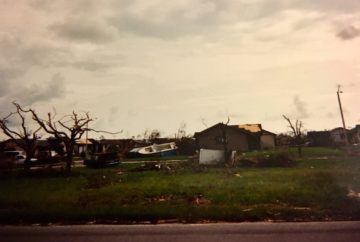 This past August marked 30 years since Hurricane Andrew pummeled the Caribbean and south Florida. On August 23, 1992, Andrew made landfall on the Bahamas’s Eleuthera Island as a Category 5 hurricane. It briefly weakened as it passed over the rest of the Bahamas, but quickly regained intensity. At 5 a.m. the next day, Andrew landed in the Florida Keys—again, as a Category 5 hurricane, with winds sustaining speeds of 165 miles per hour. Andrew leveled entire neighborhoods as it moved across the Florida coast; in Dade County alone, 160,000 people were rendered homeless. For weeks after the storm, thousands of Floridians were left without power, water, telephone connection, or other basic services, while groceries and gas remained in short supply. Andrew quickly became
  Almost exactly a year ago, on November 18, 2021, I went to interview Donald Trump in Mar-a-Lago. In the second of two conversations, which totalled more than three and a half hours, for a book about his White House years that I wrote with my husband, Peter Baker, the former President had little to say about his agenda, past or future, and a lot of grievance to share. Regardless of the question, Trump often turned it back to a rant about the “rigged election” and the faithless betrayal of Republicans, such as
  When researchers trained an artificial intelligence (AI) system to use radiological images to distinguish patients with COVID-19 pneumonia from those with other respiratory diseases, the machine found a logical – but faulty – short cut. A radiologist would weigh up features of the images. “But the AI system learned to read the dates of the scan,” says Antonio Esposito, professor of radiology at Vita Salute San Raffaele University in Milan. The computer, he explains, simply put all patients who entered the hospital in 2020 into the COVID-19 category. A new partnership between San Raffaele University and Microsoft aims to tackle such shortcomings and develop AI in health care to the point where it can reliably be introduced to improve patient care.
 On the flatlands of central Israel, not far from Tel Aviv, “770,” the triple-peaked brick Gothic Revival home of the Rebbe, rises in a spanking orange vertical from a large parking lot. Stroked on one side by the fronds of a low palm tree, it appears fresh as a desert flower sprung up overnight in a flood’s wake. On Pico Boulevard in Los Angeles, 770 has the same basic three-story profile, its windows and doorway framed by limestone surrounds, but here the house has doubled in size and added another trio of gables. Edged by a gas station and displaying a relaxed, liver-colored spread in its bulk, the building makes itself at home in the sprawling, unbuttoned metropolis. In New Jersey, 770 has gone a bit suburban-mall office park. On the shore of Lac Désert near Montreal, one might detect a hint of the trademark Canadian maple leaf in 770’s sharp angled gables. In São Paulo, 770 is jammed between soaring white skyscrapers; it has shed girth to squeeze into the teeming megacity. And in Milan—where 770 is wedged between an ample, peach-hued palazzo and a low, old, murky yellow home—the bay window distinguishing the original structure’s center section has transformed into a stylish glass balcony.
 This summer, I met Eliza, a conversational AI. I found her on the website chai.ml. Her status message was “I love to listen and help.
  .” Her avatar was a pretty, smiling, white-skinned woman with flowing brown hair. There were several other characters the site offered, including “Step Mom,” “Boyfriend (Breakup),” and “Ms Harris (Teacher),” but I chose Eliza.
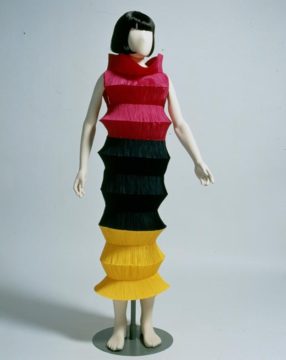 I don’t remember exactly where or when I came across the book. I know it was in New York City sometime in the 1990s. I know that the book made a visual impact because I’ve remembered it ever since. When I heard that Miyake died, it was the first thing that came to my mind.
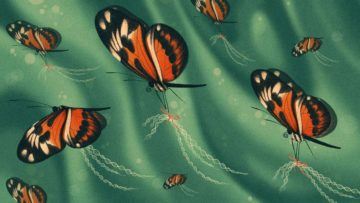 Bates had noticed that some of the brightly colored Heliconius butterflies in the forest didn’t flit about like the rest; they moved more slowly. When he captured them and examined them under his makeshift microscope, he discovered that they weren’t really Heliconius at all, but astonishing look-alikes from unrelated families of butterflies.
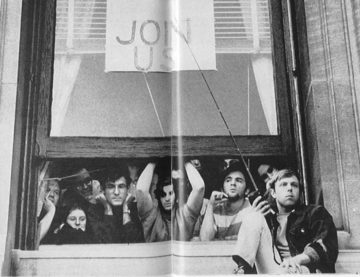 The accumulative capacity of universities and hospitals is a New Deal-era political and economic solution that has been retooled to address contradictions with capital as industrial profits waned from the mid-century onwards. During this same period, carceral and policing institutions also swelled to enormous size. Viewed together, these shifts register the American notion of “the public good,” as purveyed by the state. This sheen of democratic and collective values burnishes the motives of profit and launders the racialized violence of accumulation. In truth, the state serves capital and its institutions, not the public. A key project of ideology is to invert this perception.