
Lara Feigel at The Guardian:
 Postwar Italian neorealism was one of the most exciting literary movements of the 20th century, but it’s only recently that the female neorealists have had the attention they deserve. In 2018, the publisher Daunt began its vital championing of Natalia Ginzburg, and now Pushkin brings us Alba de Céspedes. These women were famous in their lifetimes but have been forgotten since, and I think we owe their rediscovery to our own need for a reinvigorated realist novel during a moment almost as crisis-laden as Italy in the 1940s.
It’s telling that many of today’s most sophisticated realists, Rachel Cusk and Sally Rooney among them, have been crucial in championing Ginzburg. And it’s no coincidence that all this began with Ferrante fever. Elena Ferrante herself owes so much to neorealism, and it’s she who has driven the rediscovery of Céspedes.
more here.
 On Sept. 29 and 30, 1941, in a ravine just outside Kyiv called Babyn Yar (“Babi Yar” in Russian), Nazis executed nearly 34,000 Jews over the course of 36 hours. It was the deadliest mass execution in what came to be known as the “Holocaust by Bullets.” We were never supposed to know it happened. In 1943, as the Nazis fled Kyiv, they ordered the bodies in Babyn Yar to be dug up and burned, to erase all memory of what they’d done.
 W
W
 The specter of being trapped in a world of illusions has haunted humankind much longer than the specter of A.I. Soon we will finally come face to face with Descartes’s demon, with Plato’s cave, with the Buddhist Maya. A curtain of illusions could descend over the whole of humanity, and we might never again be able to tear that curtain away — or even realize it is there.
 Between 1910 and 1940, thousands of Chinese immigrants were detained—sometimes for months—in facilities on Angel Island, off the coast of San Francisco.
 A record outbreak of
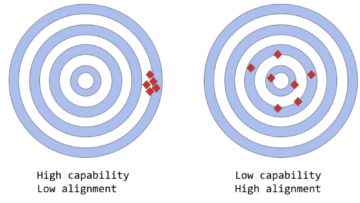
  The very deepest worries center around the question of AGI, Artificial General Intelligence, and the question of the Singularity. AGI is a form of artificial intelligence so advanced that it could understand the world at least as well as a human being in every way that a human being can. It is not too far a step from such a possibility to the idea of AGIs that can produce AGIs and improve both upon themselves and further generations of AGI. This leads to the Singularity, a point at which this production of super-intelligence goes so far beyond that which humans are capable of imagining that, in essence, all bets are off. We can’t know what such beings would be like, nor what they would do. Which sets up the alignment problem. How do you possibly align the interests of super intelligent AGIs with those of puny humans? And as many have suggested, wouldn’t a super intelligent self-interested AGI be rather incentivized to get rid of us, since we are its most direct threat and/or inconvenience? And even if super AGIs did not want to exterminate humans, what is to ensure that they would care much what happens to us either way?
 There are certain sweet-smelling, sugarcoated lies current in the world which all politic men have apparently tacitly conspired together to support and perpetuate. One of these is that there is such a thing in the world as independence: independence of thought, independence of opinion, independence of action.
 Scientists who study happiness know that being kind to others
  It’s all wrong. The wrongness is pervasive; you could not, if asked, identify the it or the its that went wrong. Wrongness leaches into everything, like the microplastics you read about, which may or may not be reducing sperm count in men, which may or may not be good, in the long run—it’s something to do with the environment. Someone wanted you to feel one way or the other about it, but you can’t remember who or why or whether you agreed with him. Everyone speaks so authoritatively, whether it’s on the evening news or a podcast, in an Internet video or a book, or even in one of those Twitter threads that begins (irksomely, you once felt, but now you don’t notice) with the little picture of a spool. Authority makes them all sound the same; it crosses all their faces and leaves many of the same furrows. Only afterward, trying to add it all up, do you half-remember that none of them agreed with each other. But the wrongness you can be sure of. It is like God, undergirding all things.
 The creators have used a combination of both Supervised Learning and Reinforcement Learning to fine-tune ChatGPT, but it is the Reinforcement Learning component specifically that makes ChatGPT unique. The creators use a particular technique called Reinforcement Learning from Human Feedback (RLHF), which uses human feedback in the training loop to minimize harmful, untruthful, and/or biased outputs.
 For years, philanthropists have poured money into progressive climate groups, while