
Alex Bronzini-Vender in the Los Angeles Review of Books:
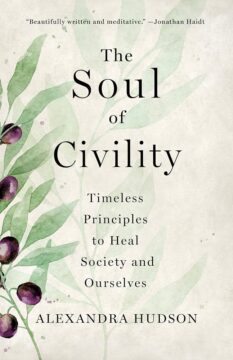 I understand why many find civility a deeply questionable—if not totally worthless—discourse: cries for civility are often just attempts to silence desperate demands for justice, cloaked in the language of liberal rationality and tolerance. As Martin Luther King Jr. himself famously put it, civility is too often a weapon of the “white moderate, who is more devoted to ‘order’ than to justice; who prefers a negative peace which is the absence of tension to a positive peace which is the presence of justice.” Many of us are skeptical when someone brings up civility, and for good reason.
Nevertheless, I found Alexandra Hudson’s new book The Soul of Civility: Timeless Principles to Heal Society and Ourselves unexpectedly compelling. Civility, as Hudson rightly defines it, does not preclude, and even requires, conflict. Hudson writes that civility is rooted in “shared humanity.” To truly recognize someone as your equal, you must be willing to tell them hard truths. And rather than merely bemoaning the loss of vaguely defined civility in American culture, Hudson offers a deeply informed, cross-cultural study of what civility is, and, arguably even more importantly, isn’t.
More here.
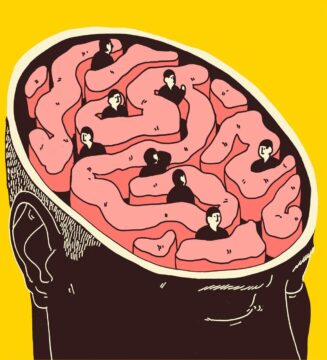 The hardest question in neuroscience [is] a very simple one, and devastating in its simplicity. If even small artificial neural networks are mathematical black boxes, such that the people who build them don’t know how to control them, nor why they work, nor what their true capabilities are… why do you think that the brain, a higher-parameter and more messy biological neural network, is not similarly a black box?
 In 2021 the polling firm Ipsos asked 21,000 people in 30 countries to choose from a list of nine actions which ones they thought would most reduce greenhouse gas emissions for individuals living in a richer country. Most people picked recycling, followed by buying renewable energy, switching to an electric/hybrid car, and opting for low-energy light bulbs. When these actions were ranked by their actual impact on emissions, recycling was third-from-bottom and low-energy light bulbs were last. None of the top-three options selected by people appeared in the “real” top three when ranked by greenhouse gas reductions, which were having one fewer child, not having a car, and avoiding one long-distance flight.
 The media headlines of the past year suggest that things have gotten a lot worse since 2017—and both Thomas and
  S
S Brutalist architecture. You either love it or hate it, right? However you feel, we can all agree that Brutalism is an architectural style that continues to elicit strong reactions some seventy years into its existence. At times, it seems like everyone hates it. Take, for instance, Ian Fleming,
  Nigeria is the
 One recurring point of contention in political debates is what language we should use to discuss matters of moral and political significance. Many on the progressive left prefer particularist moral language, which emphasizes the specific needs and grievances of particular groups. Others prefer to use universalistic language, which refuses to draw distinctions between groups and focuses on what unites us. The paradigm of this disagreement is the debate between those who prefer the slogan “all lives matter” and those who prefer “black lives matter,” although the conflict is larger than this. For example, many progressives have adopted slogans like “black is beautiful” or “the future is female” that those on the
  M
M At an
At an  W
W Others explored even darker recesses. In 1925, Alwar’s ruler mowed down five hundred farmers and then torched their village after they had the temerity to protest against his rapacious land tax – an episode far grislier than the Amritsar Massacre of six years earlier. The penultimate ruler of Patiala’s appetite for quail – he devoured twenty-five in a single sitting – was equalled only by his appetite for tax and sex. Some 60 per cent of the state’s income was spent on his sustenance. Bureaucrats were jailed for failing to supply him with a ‘constant stream of young peasant girls for his sexual gratification’. It was left to his son and successor, Yadavindra Singh, to deal with Partition. ‘Death to all Muslims,’ he intoned on learning in 1947 that Pakistan coveted his kingdom, in which Sikhs were the largest group, before leading a conga through his palace. As it was, his problem solved itself. Around the time of Partition, fear whittled down the Muslim population in the Punjab princely states from a million to under fifty thousand. Patiala went to India.
 Senior Biden administration leaders have self-consciously styled Biden’s approach as a move away from the neoliberal presumptions of the