
Sasha Frere-Jones at Bookforum:
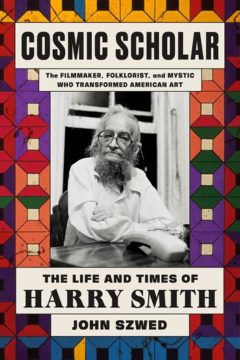 Smith was a loud ghost running wires between worlds, a “gnomish” saint who made connections more often than he made stuff. Hostile to the existence of galleries and museums and other obstacles to free circulation, Smith spent his life feeling for a pattern that might connect all the holy detritus in his ark: crushed Coke cans, paper airplanes, Seminole quilts, Ukrainian eggs, books, records, dead birds, string figures. The movies he painstakingly built from Vaseline and dye and paper cutouts changed how filmmakers saw the material of film itself. The problem for the historian is that Smith excelled in eliminating his own “excreta” (his word), throwing films under buses and tossing projectors out of windows. His close friend during the “Berkeley Renaissance” of 1948, the artist Jordan Belson, said that Smith “had nothing but insults and sarcasm for most art and most artists.” (This quote comes from the fantastic American Magus, a collection of interviews with those in Smith’s close circle first published in 1996, and one of Szwed’s sources.)
more here.
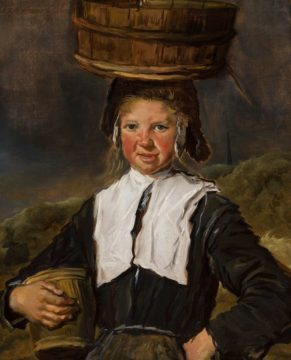 Hals was not the second- or third-best Dutch painter of the seventeenth century; he was the best of the nineteenth. In the eighteen-sixties, the French art critic Théophile Thoré (who famously rescued Vermeer from oblivion) kicked off a revival of Hals, making him a favorite of art collectors and painters—Gustave Courbet and Édouard Manet, Mary Cassatt and James McNeill Whistler, Robert Henri and George Luks. (Luks reportedly said that the only two great painters in history were Hals and himself.) By 1900, the city of Haarlem had installed a statue of Hals in a public park. Even as he fell behind Rembrandt and Vermeer in the twentieth century, his paintings would retain a sheen of newness. According to the painter Lucian Freud, Hals was “fated always to look modern.”
 Jacob Elordi is by far the bigger name among the two stars of
 Most people who have pulled an all-nighter are all too familiar with that “tired and wired” feeling. Although the body is physically exhausted, the brain feels slap-happy, loopy and almost giddy. Now, Northwestern University neurobiologists are the first to uncover what produces this punch-drunk effect. In a new study, researchers induced mild, acute sleep deprivation in mice and then examined their behaviors and
  The night I saw Killers of the Flower Moon I dreamed wildly, fitfully. Until I went to bed, I spent my waking hours thinking about the film, and then I suppose I continued to think about it as I slept. I have many questions about it. There are so many details I’d like to discuss. I wish I had seen it with friends, rather than (as is customary for my job) by myself with only my notebook to aid in exegesis. Killers of the Flower Moon, which was directed by Martin Scorsese, screen-written by Scorsese and Eric Roth, and based on the monumental nonfiction book of the same name by David Grann, is a tremendous feat of filmmaking, but it’s not a simple one, not an easy one.
 In 1978, the painter Nicky Nodjoumi returned to Tehran from New York just in time for the women’s mass marches against the shah. While there, Nodjoumi joined 30 students and professors in the production of posters at Tehran University’s Faculty of Fine Arts. The group held an exhibition to which some 5,000 people a day came, and a space for people to make their own posters. This particular effort of nonsectarian democracy in action—working with but keeping independent of all parties and factions—was short-lived. The art spaces were burned down by a hardline Muslim organization in 1979.
 T
T Psychedelic drugs have been undergoing a major makeover in psychiatry, earning mainstream acceptance that has eluded them for decades. In 2019, a variant of ketamine — an animal tranquillizer well known as a club drug — was approved by the US Food and Drug Administration (FDA) for treating post-traumatic stress disorder (PTSD). In May, Oregon opened its first treatment centre for administering psilocybin — the hallucinogenic compound found in magic mushrooms — following the state’s decision to legalize it (psilocybin remains illegal at the federal level). And, after decades of effort, the Multidisciplinary Association for Psychedelic Studies, a non-profit research organization in San Jose, California, formally asked the FDA for approval to market MDMA — also known as molly or ecstasy — as a treatment for PTSD.
 Awakening to the snowy sunny morning of Tuesday, March 7, 2023, I took due pleasure in looking out through my white curtains at white sun glare that appeared almost warm from within. Why not stroll outdoors? Should I take a chill, this warm room would receive me again—and, after all, certain dark brown puddles in the vacant lots along Second Street implied that spring might impend, never mind that unpleasantly cold breeze on the river, or the refusal of First Street’s prizeworthy icicle crop to even begin dripping. You see, I like to believe in spring almost as does a Christian in heaven. Why fret about unborn summer problems? The wind might numb my face, but my hands felt warm enough in their leather work gloves. In brief, I was a doughty tourist here in Reno, Nevada, on whose downtown I had fixed with the design of finding three homeless men—for in the United States, cities often rot from the center out. Since Reno’s incorporation dates to 1903, her downtown, I reasoned, ought by now to hold a skid row, or at least a few vagrants. Right away I won a jackpot of sorts: between Second and Third at Bell ran a long slushy alley with glary mountains of snow at its eastern end, while several blocks to the west a man in a blue parka, from whose wheeled conveyance hung at least fifteen black garbage bags, kept inspecting and adjusting his setup under the surveillance of a row of sparrows on a power line. I surveilled him, too.
 “I have discovered a potion for memory and wisdom,” the Egyptian god of the underworld tells the King of Thebes in an exchange recounted by Plato. This “magic potion,” it turns out, is writing. Previously, stories and histories, facts and fables were passed on orally. Minstrels would commit to memory the whole of the story of Troy, for example, which Homer ultimately put to the page. This was challenging work, time consuming, and imprecise. Stories were liable to variation, and exaggeration. Heroes were perhaps overly exalted. Details, dates, even characters would change over time. Writing solved many of these problems, and perfected our ability to recall.
 A 2019 study