David Shariatmadari at The Guardian:
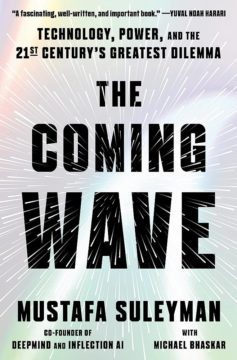 The Coming Wave distils what is about to happen in a forcefully clear way. AI, Suleyman argues, will rapidly reduce the price of achieving any goal. Its astonishing labour-saving and problem-solving capabilities will be available cheaply and to anyone who wants to use them. He memorably calls this “the plummeting cost of power”. If the printing press allowed ordinary people to own books, and the silicon chip put a computer in every home, AI will democratise simply doing things. So, sure, that means getting a virtual assistant to set up a company for you, or using a swarm of builder bots to throw up an extension. Unfortunately, it also means engineering a run on a bank, or creating a deadly virus using a DNA synthesiser.
The most extraordinary scenarios in the book come from the realm of biotech, which is already undergoing its own transformation thanks to breakthroughs such as Crispr, the gene-editing technology. Here, AI will act as a potent accelerant. Manufactured products, Suleyman tells us, could one day be “grown” from synthetic biological materials rather than assembled, using carbon sucked out of the atmosphere.
more here.
 In 1947, the Black German musician Fasia Jansen stood on a street in Hamburg and began to sing the music of Brecht in her thick Low German accent to anyone passing by. Perhaps she’d learned the songs from prisoners and internees at Neuengamme, the concentration camp where she’d been forced to work four years earlier. Perhaps she’d learned them in the early days after the war, when she’d performed with Holocaust survivors at a hospital in 1945. One thing was clear: As Jansen wrestled with her trauma, song was at the center of her experience.
 Herman Mark Schwartz in The Syllabus:
 Samuel Moyn in Boston Review:
 In 2012, the mathematician Shinichi Mochizuki claimed he had solved the abc conjecture, a major open question in number theory about the relationship between addition and multiplication. There was just one problem: His proof, which was more than 500 pages long, was completely impenetrable. It relied on a snarl of new definitions, notation, and theories that nearly all mathematicians found impossible to make sense of. Years later, when two mathematicians translated large parts of the proof into more familiar terms, they pointed to what one called a “
 A recent rise in activism in Iran has added a new chapter to the country’s long-standing history of murals and other public art. But as the
 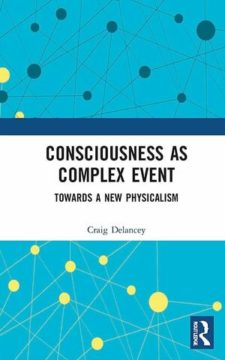 In Consciousness as Complex Event: Towards a New Physicalism, Craig DeLancey argues that what makes conscious (or “phenomenal”) experiences mysterious and seemingly impossible to explain is that they are extremely complex brain events. This is then used to debunk the most influential anti-physicalist arguments, such as the knowledge argument. A new “complexity-based” way of thinking about physicalism is then said to emerge.
 The opening sentence of Jacob Mikanowski’s sweeping history of Eastern Europe—“a place,” he asserts, “that doesn’t exist”—calls to mind a seminal 1983 essay by the recently deceased Czech-French novelist, Milan Kundera. In A Kidnapped West: A Tragedy of Central Europe, Kundera reminded his readers that Poland, Hungary, and Czechoslovakia were historically and culturally closer to the West than to the Soviet East, and should therefore be thought of as central rather than eastern European. Alas, his appeal fell on deaf ears, and the region remains “eastern,” shorthand for a place where, rumor has it, nobody smiles and the smell of burned cabbage wafts through the corridors of charmless, concrete apartment blocks. Indeed, western prejudice was never more in evidence than during the early days of Russia’s invasion of Ukraine, when many commentators painted the war as just another incomprehensible scuffle in the other Europe, among the denizens of lands once obscured by the Iron Curtain.
 An artificial-intelligence system can describe how compounds smell simply by analysing their molecular structures — and its descriptions are often similar to those of trained human sniffers.