
Pratinav Anil at The Guardian:
 This is, by my count, Robert Service’s 12th book that touches on the Russian Revolution, either substantively or tangentially. So far, we’ve had a biographical triptych on Stalin, Trotsky and Lenin; a trilogy on the last; two broad surveys of modern Russia; a monograph on the last tsar and another on the Bolsheviks; and a general account for students. By now, he could churn out another history on autopilot. He is, thankfully, too clever for that. What we have here is the work of a lifetime, a reflective volume alert to local and geopolitics, art and culture, high society and the affairs of ordinary people. If he had served up a larger slice of history, encompassing the consolidation of Stalinism rather than ending the narrative with Lenin’s demise, he could have claimed with some justification to have written the definitive word on the revolution.
Over the years, Service has acquired a reputation for impeccable, almost smug, even-handedness. This has strengths and weaknesses.
more here.
 The Latin American Boom of the 1960s and ‘70s is associated with some of contemporary Spanish-language literature’s most towering figures, among them Julio Cortázar, Carlos Fuentes, Mario Vargas Llosa, and Gabriel García Márquez. But of all the
 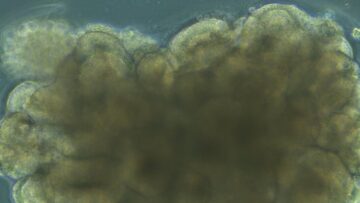 A tiny ball of brain cells hums with activity as it sits atop an array of electrodes. For two days, it receives a pattern of electrical zaps, each stimulation encoding the speech peculiarities of eight people. By day three, it can discriminate between speakers. Dubbed Brainoware, the system raises the bar for biocomputing by tapping into 3D brain organoids, or “mini-brains.” These models, usually grown from human stem cells, rapidly expand into a variety of neurons knitted into neural networks.
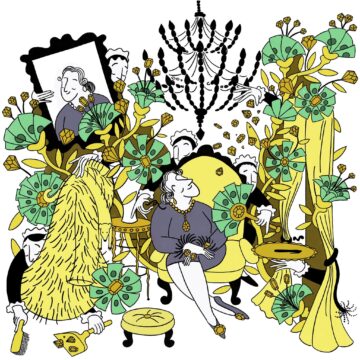 “Class consciousness takes a vacation while we’re in the thrall of this book,” Barbara Grizzuti Harrison
  Sometimes when I’m looking out across the northern meadow of Brooklyn’s Prospect Park, or even the concrete parking lot outside my office window, I wonder if someone like Shakespeare or Emily Dickinson could have taken in the same view and seen more. I don’t mean making out blurry details or more objects in the scene. But through the lens of their minds, could they encounter the exact same world as me and yet have a richer experience? One way to answer that question, at least as a thought experiment, could be to compare the electrical activity inside our brains while gazing out upon the same scene, and running some statistical analysis designed to actually tell us whose brain activity indicates more richness. But that’s just a loopy thought experiment, right?
 “Earthrise, that iconic photograph
 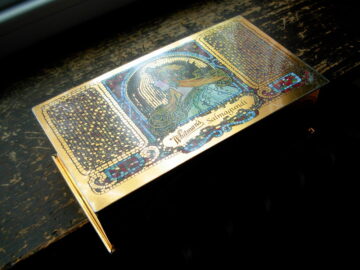 Art is useless, said Wilde. Art is for art’s sake—that is, for beauty’s sake. But why do we possess a sense of beauty to begin with? A question we will never answer. Perhaps it’s just a kind of superfluity of sexual attraction. Nature needs us to feel drawn to other human bodies, but evolution is imprecise. In order to go far enough, to make that feeling strong enough, it went too far. Others are powerfully lovely to us, but so, in a strangely different, strangely similar way, are flowers and sunsets. Art, in turn, this line of thought might go, is a response to natural beauty. Stunned by it, we seek to rival it, to reproduce it, to prolong it. Flowers fade, sunsets melt from moment to moment; the love of bodies brings us grief. Art abides. “When old age shall this generational waste, / Thou shalt remain.”
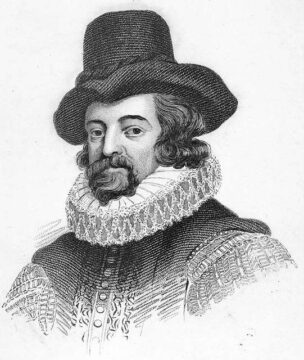 In form, Francis Bacon’s New Atlantis is modeled loosely on Thomas More’s Utopia. A ship full of European sailors lands on a previously unknown island in the Americas where they find a civilized society in many ways superior to their own. The narrator describes the customs and institutions of this society, which in Bacon is called “Bensalem,” Hebrew for “son of peace.” Sometimes Bacon echoes, sometimes improves upon, More’s earlier work. But at the end of the story, Bacon turns to focus solely on the most original feature of the island, an institution called Solomon’s House, or the College of the Six Days Works.
 It’s been a year of endless einsteins. In March, a troupe of
  Natural Selection is the pressure that drives evolution up the slopes of Mount Improbable. Pressure really is rather a good metaphor. We speak of ‘selection pressure’, and you can almost feel it pushing a species to evolve, shoving it up the gradients of the mountain. Predators, we say, provided the selection pressure that drove antelopes to evolve their fast running legs. Even as we speak, though, we remember what this really means: genes for short legs are more likely to end up in predators’ bellies and therefore the world becomes less full of them. ‘Pressure’ from choosy females drove the evolution of male pheasants’ sumptuous feathers. What this means is that a gene for a beautiful feather is especially likely to find itself riding a sperm into a female’s body. But we think of it as a ‘pressure’ driving males towards greater beauty. No doubt predators provided a selection pressure in the opposite direction, towards duller plumage, since bright males would presumably attract predator, as well as female, eyes. Without the pressure from predators the cocks would be even brighter and more extravagant under pressure from females. Selection pressures, then, can push in opposite directions, or in the same direction or even (mathematicians can find ways of visualizing this) at any other ‘angle’ relative to one another, Selection pressures, moreover, can be ‘strong’ or ‘weak’, and the ordinary language meanings of these words fit well. The particular path up Mount Improbable that a lineage takes will be influenced by lots of different selection pressures, pushing and tugging in different directions and with different strengths, sometimes cooperating with each other, sometimes opposing.
 At 11am local time on 13 December, countries adopted the text of an agreement that calls for “transitioning away from fossil fuels in energy systems, in a just, orderly and equitable manner, accelerating action in this critical decade, so as to achieve net zero by 2050 in keeping with the science.”
 W
W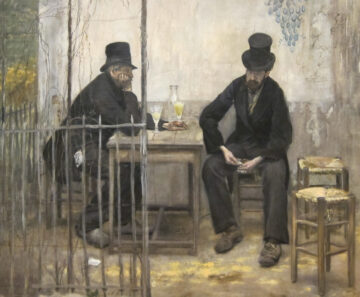 Baudelaire’s early suspicion that he had been born under a dark star seemed to be fulfilling itself. He considered becoming a monk but instead went to Belgium. “One becomes a Belgian through having sinned,” he quipped. “A Belgian is his own hell.” While walking to a church one day with the artist Félicien Rops, Baudelaire collapsed. Returning to Paris, he died in 1867 at the age of forty-six. The funeral was held in Montparnasse. Only sixty people showed up to honor the greatest poet France has ever created, but one of the mourners was Manet. Later, the journalist Victor Noir wrote, “in his last moments, his best friend was M. Manet; it was because the two natures understood each other so well.”
 Practicing yoga nidra—a kind of mindfulness training—might improve sleep, cognition, learning, and memory, even in novices, according to a pilot study published in the open-access journal PLOS ONE on December 13 by Karuna Datta of the Armed Forces Medical College in India, and colleagues. After a two-week intervention with a cohort of novice practitioners, the researchers found that the percentage of delta-waves in deep sleep increased and that all tested cognitive abilities improved.