Dinner with Darwin

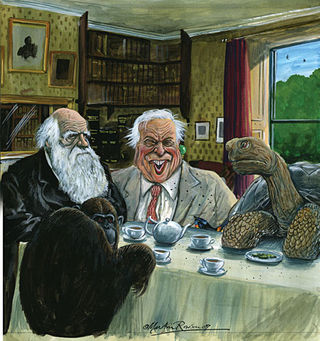
Darwindinner New Humanist asks Jerry Coyne, Steve Jones, James Randerson, and John von Wyhe (reprinted in eurozine):

The historian
NH: What would you tell him?

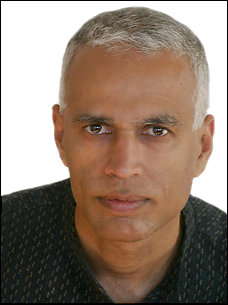
John van Wyhe: Although he would have thought little about it, and perhaps cared even less, as an historian I would have to tell him about the way the story of his life has evolved over the years. Initially he was the great scientific saint who banished religion from the realms of science, then he was a Freudian puppet reacting to his supposedly tyrannical father (thus “killing God” with his theory of evolution was like patricide), then he was said to have discovered evolution on the Galapagos in a eureka moment when he observed the beaks of the finches, then he was said to have held back his theory for 20 years because he was terrified of the consequences of publishing. At every anniversary a new myth like this appears, none of which has any grounding in the evidence. So what new myth(s) will be invented about Darwin in 2009, the bicentenary of his birth?…

The biologist
NH: What would you tell him?

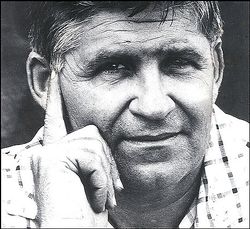
Jerry Coyne: So much to tell, and so little time! I'd tell him about all the amazing fossils that have been discovered since the Origin was published: transitional forms that link major groups such as reptiles with mammals, land animals with whales, fish with amphibians. These fossils constitute even more support for evolution – evidence that Darwin never had, although he predicted that transitional fossils would exist. He'd probably be most interested in the group of hominid fossils found in Africa dating back as far as six million years ago. These clearly show our ancestry from apes and completely confirm Darwin's guarded prediction, made in 1871, that “it is somewhat more probable that our early progenitors lived on the African continent”.
Friday Poem

///
Personal Helicon
Seamus Heaney

For Michael Longley

As a child, they could not keep me from wells
And old pumps with buckets and windlasses.
I loved the dark drop, the trapped sky, the smells
Of waterweed, fungus and dank moss.

One, in a brickyard, with rotted board top.
I savoured the rich crash when a bucket
Plummeted down at the end of a rope.
So deep you saw no reflection in it.

A shallow one under a dry stone ditch
Fructified like any aquarium.
When you dragged out long roots from the soft mulch
A white face hovered over the bottom.

Others had echoes, gave back your own call
With a clean new music in it. And one
Was scaresome, for there, out of ferns and tall
Foxgloves, a rat slapped across my reflection.

Now, to pry into roots, to finger slime,
To stare, big-eyed Narcissus, into some spring
Is beneath all adult digniity. I rhyme
To see myself, to set the darkness echoing.
///

John Howard Griffin Took Race All the Way to the Finish

From The Washington Post:

Grif In the fall of 1959 an obscure white journalist and novelist named John Howard Griffin, a native of Texas, went to a dermatologist in New Orleans with what can only be called an astonishing request: He wanted “to become a Negro.” A man of conscience and religious conviction, he was deeply troubled by the racial situation in his native South. He was “haunted” by these questions: “If a white man became a Negro in the Deep South, what adjustments would he have to make? What is it like to experience discrimination based on skin color, something over which one has no control?”

The dermatologist agreed to cooperate with Griffin's project, darkening his skin “with a medication taken orally, followed by exposure to ultraviolet rays.” Griffin, who had arranged with the editors of Sepia, the prominent black magazine, to write about his experiences, was in a hurry to get started and asked for “accelerated treatments,” which he soon supplemented with stain. He also shaved his head, “since I had no curl.” He did not look in the mirror until the process was complete, and when he did, he saw “the face and shoulders of a stranger — a fierce, bald, very dark Negro.” He was stunned:

“The transformation was total and shocking. I had expected to see myself disguised, but this was something else. I was imprisoned in the flesh of an utter stranger, an unsympathetic one with whom I felt no kinship. . . . I looked into the mirror and saw reflected nothing of the white John Griffin's past. No, the reflections led back to Africa, back to the shanty and the ghetto, back to the fruitless struggles against the mark of blackness. . . . I had tampered with the mystery of existence and I had lost the sense of my own being. This is what devastated me. The Griffin that was had become invisible.”

Thus began Griffin's six-week odyssey through the South, a journey that took him from New Orleans to Mississippi, Alabama and Georgia. In March of the next year Sepia published his story, and in 1961 an expanded version was published as a book, “Black Like Me.” The cumulative effect of the magazine story, the book and all the attendant publicity — Griffin was interviewed by the television journalists Dave Garroway and Mike Wallace and featured in Time magazine — was astonishing. The book became a bestseller. It awoke significant numbers of white Americans to truths about discrimination of which they had been unaware or had denied.

I was one of them. In 1961, I was 21 years old, newly graduated from Chapel Hill. I had written sympathetically about the emerging black protests for the student newspaper, but I was deeply ignorant about the truths of black life in America. That it took a white man to begin my awakening is, in hindsight, distressing, but Griffin's story managed to put me in a black man's shoes as nothing else had. (My first readings of James Baldwin's essays were still a couple of years in the future.) “Black Like Me” had a transforming effect on me, as apparently it did on innumerable others. That it has remained in print for more than four decades is testimony to its continuing influence, in great measure because it is taught in high schools and colleges.

Read now, for the first time since 1961, “Black Like Me” has lost surprisingly little of its power.

More here.

The Writing Life: Manil Suri

From The Washington Post:

Manil It was 1984. I'd been working as a mathematics professor at the University of Maryland Baltimore County for less than a year but already knew I needed something more to round out my life. I'd met mathematicians who ate, slept and breathed theorems and was certain I would never be one of them. So one day I wrote a short story. The title was “Unfulfilled Expectations.” Going through it, you couldn't help wonder whose expectations remained unfulfilled — except , of course, the reader's. It was a story only a mathematician would write.

You'd have to pry it out of my cold dead fingers now to read it, but back then the experience was heady, energizing. I agonized about whether to send it to the New Yorker or the Atlantic. (Thankfully, I never submitted it.) The next year, I wrote a second story, and then, a year or two later, another. I made all my characters as abstract as possible. My reasoning was that just as “x” and “y” are symbols that can be assigned any value, characters, too, should be empty outlines, left for a reader to fill in. It's an indispensable idea in algebra but a terrible one in fiction, as it took me some years to learn.

Around that time, a famous mathematician who also happens to be a renowned bridge player gave a lecture at our department. Afterward, a senior faculty member took me aside to complain about the “terrible” talk. Surprised, I asked him how he knew, since the lecture hadn't been in his field. “He wastes too much time playing bridge, so he can't possibly be good,” came the reply. I thought my colleague was joking until I saw the conviction on his face. That's when I decided to keep my own hobby a secret — after all, I was a professional academic. I wanted tenure.

More here.

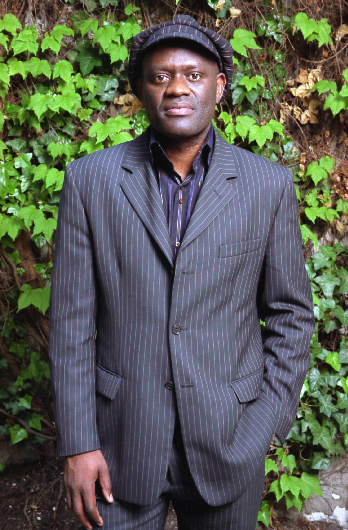
Alain Mabanckou’s Broken Glass

Laila Lalami reads the Congolese writer Alain Mabanckou's Broken Glass, a novel bursting with cultural references and irreverent humour.

From The National:

Ambisbi4 “In Africa, when an old person dies, a library burns.”

When the Malian writer and ethnologist Amadou Hampâté Bâ uttered these words at a Unesco assembly in 1960, he was attempting to draw attention to Africa’s tradition of oral storytelling. Little did he know that his aphorism would turn into one of the most persistent clichés about the continent, one that unfortunately reinforced the erroneous idea that there was no tradition of written literature in Africa prior to European colonialism. Early on in Alain Mabanckou’s new novel Broken Glass (to be published this month in translation from French to English), the proprietor of a seedy bar in Brazzaville, who is referred to only as Stubborn Snail, hears the slogan and derisively responds that it “depends which old person, don’t talk crap, I only trust what’s written down.”

In fact, Stubborn Snail is so sure of the power of the written word that he gives a notebook to his most regular customer, an old schoolteacher nicknamed Broken Glass, and asks him to write his customers’ stories. Broken Glass takes up the challenge, though he quickly warns the reader that “I’m writing this for myself as well, that’s why I wouldn’t want to be in his shoes when he reads these pages, I don’t intend to spare him or anyone else.” One suspects that Mabanckou shares these feelings, that he has no time for pious and well-meaning clichés about Africa, and that he intends to write as irreverently and as freely as he pleases.

More here.

The boy so set on getting to Cambridge he got 22 A-levels

Paul Harris and Laura Clark in The Daily Mail:

The remarkable young student, who modestly explains he has 'quite a thirst for knowledge', secured 22 A grades, one B and a C.

When he filled out his university application forms at home in Rawalpindi there was barely enough space to list his qualifications.

His Cambridge dream came true four months ago when he embarked on a computer science degree course at Trinity Hall. Now he is due to win another place – in the Guinness Book of Records.

ScreenHunter_01 Feb. 13 12.10

Yesterday Ali, 18, explained, perhaps superfluously, that he rather enjoys hard work. He's got even more qualifications in his sights to fulfil another ambition.

'I'm doing my current degree because I love it,' he said. 'But what I want to do for the rest of my life is to be a doctor, so I hope to go on to study medicine.'

Ali, who speaks Urdu, English and Punjabi, sat all the exams within 12 months at Rawalpindi's Roots College International. His entry was organised through accredited boards Ed-Excel and Cambridge International Examinations.

Ali also achieved a top score in the U.S. admissions test and was accepted by most Ivy League institutions, including Harvard and Yale. Apart from core science subjects he is almost entirely self taught. He studied for up to 12 hours a day, using energy drinks to help concentrate.

More here.

Sri Lanka’s Intractable Conflict

Sumedha Senanayake in Dissent:

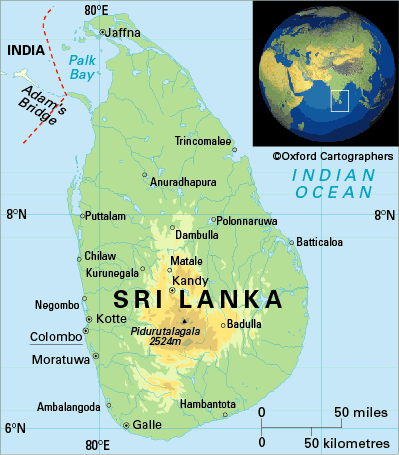
%7B5AEAA49B-C216-46FB-90AE-1FF604A115B0%7D_SriLanka Sri Lanka, a small teardrop-shaped island off the southern tip of India, has a population of approximately 21 million, with the majority Sinhalese comprising 70 percent of the population, Tamils 18 percent, and Muslims 9 percent.

The twenty-six-year civil war in Sri Lanka has become one of the world’s forgotten conflicts, despite leaving 70,000 people dead, as estimated by numerous media sources. After several failed attempts at a viable peace agreement—including a six-year Norway-brokered ceasefire that ended in January 2008—Sri Lankan President Mahinda Rajapaksa has put all his weight behind a massive military onslaught to defeat the LTTE. Military spending has swelled to about 20 percent of the national budget and, unlike past governments, the Rajapaksa administration has given the military its full support to defeat the LTTE.

But a military operation alone, however successful it may be, will not bring a lasting peace to Sri Lanka. In 2007, the Sri Lankan Army (SLA) claimed its first major victory since it launched its current military offensive in mid-2006 by wresting control of the Eastern Province from the LTTE. Now after a series of crucial military victories by the SLA, the government says that it is on the verge of defeating the LTTE and ending a conflict that has left the country’s economy in shambles.

More here.

Charles Darwin, Conservative?

Alvaro Vargas Llosa in The New Republic:

602darwin Darwin's teachings have been caricatured and grossly distorted. Social Darwinism, which turned his biological theory into a sociopolitical one to justify eugenics, harmed his reputation. But Darwin was an early opponent of slavery and, precisely because he identified a common origin in nature, he did more than anybody to debunk the notion that different races belong to different species.

Herein should lie Darwin's appeal to the right: The English naturalist gave scientific validity to the revolutionary idea that order can be spontaneous, neither designed by nor beholden to an all-powerful authority. The struggle for existence that drives natural selection according to Darwin has nothing predetermined about it. In fact, he maintained that the presence of certain habits, values and institutions, including religion–themselves part of man's adaptation to the environment–can impact evolution. The instinct of sympathy, for instance, drives some stronger members of the human species to help weaker ones, thereby mitigating the struggle for existence.

It is fascinating that conservatives who advocate for a spontaneous order–the free market–in political economy and decry social engineering as a threat to progress and civilization should resent Darwin's overwhelming case for the idea that order can design itself. In an essay in the British publication The Spectator, the conservative science writer Matt Ridley reflects on the paradox that the left has claimed Darwin even though leftist political ideas contradict his basic teaching: “In the average European biology laboratory you will find fervent believers in the individualist, emergent, decentralized properties of genomes who prefer dirigiste determinism to bring order to the economy.”

More here.

Thursday, February 12, 2009

The crisis of 2008: Structural lessons for and from economics

Daron Daron Acemoglu on the crisis in a Center for Economic Policy Insight:

The risk that the belief in the capitalist system may collapse should not be dismissed. After all, the past two decades were heralded as the triumph of capitalism, so their bitter aftermath must be the failure of the capitalist system. It should be no surprise that I disagree with this conclusion, since I do not think the success of the capitalist system can be found in or was based upon unregulated markets. As I mentioned above, what we are experiencing is not a failure of capitalism or free markets per se, but the failure of unregulated markets – in particular, of unregulated financial sector and risk management. As such, it should not make us less optimistic about the growth potential of market economies – provided that markets are based on solid institutional foundations. But since the rhetoric of the past two decades equated capitalism with lack of regulation, this nuance will be lost on many who have lost their houses and jobs.

The risk that we face is one of an expectational trap – consumers and policymakers becoming pessimistic about future growth and the promise of markets.

A backlash is thus inevitable. The question is how to contain it. Yet the policy responses of the past several months have only made matters worse. It is one thing for the population at large to think that markets do not work as well as the pundits promised. It is an entirely different level of disillusionment for them to think that markets are just an excuse for the rich and powerful to fill their pockets at the expense of the rest. But how could they think otherwise when the bailouts have been designed by bankers to help bankers and to minimise damage on those responsible for the debacle in the first place?

obama’s voices

Zadie-Smith

It’s my audacious hope that a man born and raised between opposing dogmas, between cultures, between voices, could not help but be aware of the extreme contingency of culture. I further audaciously hope that such a man will not mistake the happy accident of his own cultural sensibilities for a set of natural laws, suitable for general application. I even hope that he will find himself in agreement with George Bernard Shaw when he declared, “Patriotism is, fundamentally, a conviction that a particular country is the best in the world because you were born in it.” But that may be an audacious hope too far. We’ll see if Obama’s lifelong vocal flexibility will enable him to say proudly with one voice “I love my country” while saying with another voice “It is a country, like other countries.” I hope so. He seems just the man to demonstrate that between those two voices there exists no contradiction and no equivocation but rather a proper and decent human harmony.

more from the NYRB here.

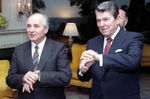
Dick & Ronnie & God & Gorby

Vfd-f-ronniegorby

Late in the afternoon of April 27, 1987, a secret visitor was smuggled into the White House. A helicopter swooped low and onto the landing pad. At the Diplomatic Entrance, Chief of Staff Howard Baker and National-Security Adviser Frank Carlucci greeted former president Richard Nixon. They escorted Nixon inside and up a private elevator to the second floor, the residence quarters of the White House, now occupied by Ronald and Nancy Reagan. Nixon had not set foot in the residence since August 9, 1974, the day he resigned from the presidency. Reagan and Nixon had known each other for years. After Reagan entered the White House, Nixon would send him occasional private notes, often flattering and unctuous. “Pat and my reactions were the same: ‘Thank God for Ronald Reagan,’” Nixon wrote in early 1981, after Reagan had granted a pardon to Mark Felt, the former associate director of the F.B.I., who had been convicted of approving illegal break-ins for surveillance. (Nixon did not know at the time that Felt had been Deep Throat, an agent of Nixon’s downfall.) At the end of 1981, Nixon wrote Reagan a note saying, “I like and admire [Poland’s Lech] Walesa, but in my book, Time missed the boat: President Reagan should have been Man of the Year.” Now Nixon was back.

more from Vanity Fair here.

dawkins on god’s balls and darwin

36_1190

How can you say that evolution is “true”? Isn’t that just your opinion, of no more value than anybody else’s? Isn’t every view entitled to equal “respect”? Maybe so where the issue is one of, say, musical taste or political judgement. But when it is a matter of scientific fact? Unfortunately, scientists do receive such relativistic protests when they dare to claim that something is factually true in the real world. Given the title of Jerry Coyne’s book, this is a distraction that I must deal with. A scientist arrogantly asserts that thunder is not the triumphal sound of God’s balls banging together, nor is it Thor’s hammer. It is, instead, the reverberating echoes from the electrical discharges that we see as lightning. Poetic (or at least stirring) as those tribal myths may be, they are not actually true.

more from the TLS here.

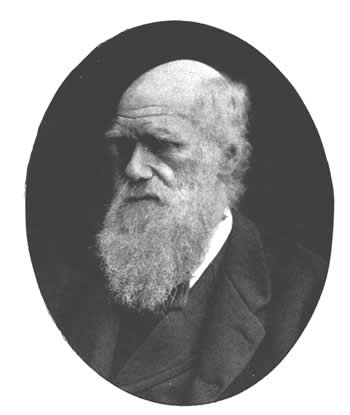
Charles Darwin at 200

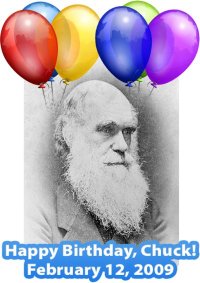
Happy bday chuck Today marks the 200th birthday of Charles Darwin. There's a website and a facebook page, naturally (no pun intended). It's impossible to overstate how much the naturalistic view of life that Darwin ushered in has shaped our world. Olivia Judson in the NYT on the great man:

Before the “Origin,” similarities and differences between species were mere curiosities; questions as to why a certain plant is succulent like a cactus or deciduous like a maple could be answered only, “Because.” Biology itself was nothing more than a vast exercise in catalog and description. After the “Origin,” all organisms became connected, part of the same, profoundly ancient, family tree. Similarities and differences became comprehensible and explicable. In short, Darwin gave us a framework for asking questions about the natural world, and about ourselves.

He was not right about everything. How could he have been? Famously, he didn’t know how genetics works; as for DNA — well, the structure of the molecule wasn’t discovered until 1953. So today’s view of evolution is much more nuanced than his. We have incorporated genetics, and expanded and refined our understanding of natural selection, and of the other forces in evolution.

But what is astonishing is how much Darwin did know, and how far he saw.

Thursday Poem

///

My Father
Harry Walsh

He is a wolf
that lit out
for the high timber
at first sight of me
rounding out his wife's belly.
But it didn't take too many
tough winters
to drive his range
downward
to the sheep.
My mother's breath
on my neck
is the name
I know him best by
on mornings
when I could freeze
dark the windows
with a whisper,
watching
for just a sight
of him passing.
///

Daniel Deronda: a Victorian novel that’s still controversial

From The Guardian:

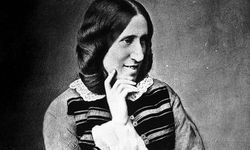
George-Eliot-001 George Eliot's final novel, Daniel Deronda, was also her most controversial. Few had a problem, upon its publication in 1876, with its portrayal of yearning and repression in the English upper class. But as Eliot's lover, George Henry Lewes, had predicted: “The Jewish element seems to me likely to satisfy nobody.”

Deronda was the first of Eliot's novels to be set in her own period, the late 19th century, and in it she took on what was a highly unusual contemporary theme: the position of Jews in British and European society and their likely prospects. The eponymous hero is an idealistic young aristocrat who comes to the rescue of a young Jewish woman and in his attempts to help her find her family is drawn steadily deeper into the Jewish community and the ferment of early Zionist politics.

More here.

Sid Vicious’ “My Way.”

Our own Morgan Meis in The Smart Set:

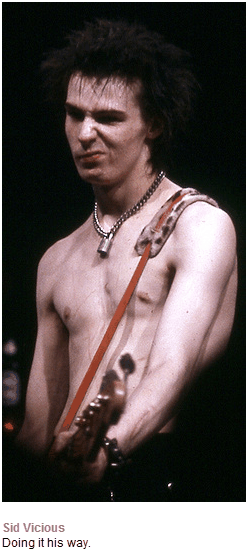
ScreenHunter_04 Feb. 12 02.10 One day this month, 30 years ago, John Simon Ritchie, otherwise known as Sid Vicious, woke up dead. He had spent the previous evening shooting heroin in celebration of his release from Riker's Island after an assault charge. Sometime during the night, his heart stopped. He was 21 years old.

No one can say exactly when Punk Rock was born and exactly when it died. Still, the death of Sid is as good an endpoint as any. Sid Vicious was punk. He couldn't play the bass much and could barely hold a tune. He was a drunken dope fiend given to fits of violence who, most likely, killed his girlfriend — the now-famous Nancy — with a stab to the gut. In short, unbeatable credentials.

Sid's swan song, his final fuck you to the world the rest of us live in, was his cover of Frank Sinatra's classic “My Way.” Sid starts the song with a deep-voiced, cracking, mocking parody of Sinatra. After the first stanza, the music kicks in and Sid switches to the whiny snarl that was his signature.

Sinatra's original song (written by Paul Anka as Frank's final apologia after a rough and tumble career) had something of a punk rock spirit itself. It's the song of a tough guy who, at the end of it all, is rather proud of himself for sticking to his guns. And he knows that you’re proud of him, too.

Sid's version of the song is, shall we say, more troubling.

More Leave a comment

We are in the midst of a Ferris wheel craze. In 2009.

Stefany Anne Golberg in The Smart Set:

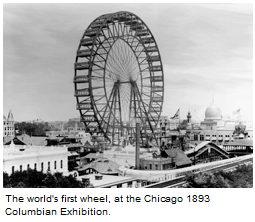
ScreenHunter_03 Feb. 12 02.03 There’s an international battle going on. The prize is height, width, rotation. Its weapons are not guns, nor tanks, nor arrows. The weapons of this battle are wheels. Ferris wheels.

This year, Germany will unveil the Great Berlin Wheel. Upon its completion, the wheel will be 606 feet high — as high as two football fields are long, as high as three Niagara Falls. It will be taller than what’s currently the tallest Ferris wheel in the world, the Singapore Flyer, a soon-to-be-disappointing 541 feet high. This year, China also plans to unveil the Beijing Great Wheel. At an awesome 682 feet high, it will be taller than both the Great Berlin Wheel and the Singapore Flyer (which only debuted as the world’s tallest Ferris wheel last year).

China has, in fact, built wheels in six cities since the start of the new millennium. The Great Dubai Wheel, at 607 feet, is set to enthrall visitors to Dubailand some time in 2009. There’s the Great Orlando Wheel in Florida (400 feet), and Australia’s four-story-high Southern Star, which just opened last month. There are whispers that a Great Wheel might hit Mumbai, though no one can say when. Or how tall.

In August of 2008, Iraq officials unveiled plans for the Baghdad Eye. Its inspiration — the 440-foot London Eye, built in 1999 — was the instigator of all this recent wheel-mania. At a proposed 650 feet, the Baghdad wheel would soar above the London Eye and most of its competitors, giving locals and visitors alike a spectacular view of the city.

More here.

Wednesday, February 11, 2009

Stolen Childhood: Slave Youth in 19th Century America

By Wilma King From Victoria's Past:

Oh, child! thou art a little slave: And all of thee that grows, Will be another's weight of flesh,–But thine the weight of woes Thou art a little slave, my child And much I grieve and mourn That to so dark a destiny My lovely babe I've borne.

– The Slave Mother's Address to her Infant Child

Child If childhood was a special time for enslaved children, it was because their parents made it so. They stood between them and slaveholders who sought to control them psychologically and to break their wills to resist. Parents also looked out for their children's physical well-being. Frederick Douglass recalled how his mother came to his rescue after the cook Aunt Katy refused to give him bread. His mother's intercession taught him that he “was not only a child, but somebody's child.” He remembered that being upon his mother's knee, at that moment, made him prouder than being a king upon a throne.”

Enslaved parents had an unusually heavy responsibility, for they not only had to survive, but they also had to ensure that their children survived under conditions that were tantamount to perpetual war between slaveholders fighting to control their chattel while the bond servants were struggling to free themselves from the control of others. The African heritage was an important factor in how enslaved mothers and fathers guided their children through the strife. This chapter examines the place of children in the slave family and community, the conditions surrounding their birth, the attitudes of enslaved children toward their parents and siblings, and the attitudes of slaveowners toward their youthful chattel.

Joinmetwo Child-rearing practices among African Americans had roots in their traditional customs; motherhood, however, took on two unique characteristics for enslaved women in the United States, First, because of an accepted pattern of matrilineal or matrifocal families in traditional African societies, many African women reared children without help form the Fathers. Moreover, the disproportionate number of men taken by salve traders left many women with dependent children to care for and a grater portion of the work, ordinarily completed by men, to perform. The women managed with the help of other women. Like their sisters in Africa, many American slave women adjusted to patenting without spouses due to circumstances beyond their control such as imbalances in the sex ratio and the propensity of slaveowners to sell men separately. Second, motherblood–an honorable status in African society–was no longer an exclusive matter between a woman and her partner once enslaved in North America. Parents viewed their children as family, while owners often saw them as chattel with profit-making potentials.

More here.