Make Bankers Accountable, A Facebook Group by Doctor Doom and The Black Swan

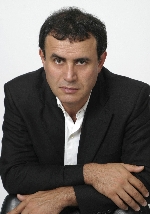
A “J'accuse” by Nouriel Roubini and Nassim Taleb over on Facebook, consider joining as an expression of disgust, if you're so disgusted and want to express via facebook:

Make bankers accountable for the mess! They got rich HIDING RISK and put INNOCENT people in this mess.

Join the “two horsemen” (Nouriel and Nassim) in extracting justice for the small guy.

Mission Statement: At Davos 2009, one of the 2 horsemen was quoted as saying that people like Robert Rubin, who received over $100 million serving as chairman of New York-based Citigroup Inc.'s executive committee, need to be punished for their failure to understand the risks their institutions were taking. He said that unless Rubin and others like him are made to mandatorily return their bonuses or are given some other punishment, the system that regrettably emerges is one “in which it’s the worst of capitalism and socialism, a situation in which profits were privatized and losses were socialized. We taxpayers have the worst.”

“This will stand as the biggest government-sponsored scam in history”. Bankers are way ahead; they MISPREPRESENTED their risks; the small guy is paying the price.

We cannot live in a society without accountability.

See the interview with them on CNBC, an interview so surreal that Krugman compares it to this Monty Python skit:
nationalize ’em

2-bio

A year ago I predicted that losses by US financial institutions would be at least $1 trillion and possibly as high as $2 trillion. At that time the consensus such estimates as being grossly exaggerated as the naïve optimists had in mind about $200 billion of expected subprime mortgage losses. But, as I pointed out then, losses would rapidly mount well beyond subprime mortgages as the US and global economy would spin into a most severe financial crisis and an ugly recession. I then argued that we would then see rising losses on subprime, near prime and prime mortgages; commercial real estate; credit cards, auto loans, student loans; industrial and commercial loans; corporate bonds; sovereign bonds and state and local government bonds; and massive losses on all of the assets (CDOs, CLOs, ABS, and the entire alphabet of credit derivatives) that had securitized such loans. By now writedowns by US banks have already passed the $1 trillion mark (my floor estimate of losses) and now institutions such as the IMF and Goldman Sachs predict losses of over $2 trillion (close to my original expected ceiling for such losses). But if you think that $2 trillion is already huge, our latest estimates RGE Monitor (available in a paper for our clients) suggest that total losses on loans made by U.S. financial firms and the fall in the market value of the assets they are holding will be at their peak about $3.6 trillion.

more from RGE Monitor here.

can’t stop levitating

Schuster2

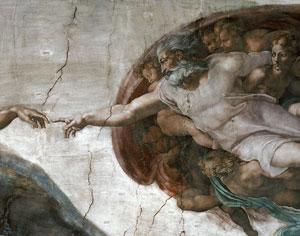
What happens to levitation, one of the great imaginative figures of art and literature, in the transition from a religious culture to the disenchanted universe of modern science? What becomes of ecstasy, rapture, ascension, transcendence, grace when these give way to “space oddity”: man enclosed in a tin can floating far above the world? Is the cosmonaut a prophet of the erotic future, avatar of man’s stellar renaissance, as Stanley Kubrick and Arthur C. Clarke once imagined? Or is he like Nietzsche’s madman, proclaiming as Gagarin himself was rumored to have said: “I don’t see any God up here”?

more from Cabinet here.

getting back to Belgrade

Drakulic-2009-02-06_84x84

It was the first day of spring with gusts of a cold wind blowing strongly as I walked down Mariahilfer Strasse in Vienna. It so happened that I overheard the conversation of three youngsters walking along. They spoke in Serbian about an event where also some Bosniaks and Croats were present. What drew my attention was not their language per se, you hear plenty of it in the subway and the streets of Vienna nowadays. It was an expression one of them used. “I did not expect there to be so many people who speak our language,” he said. It was apparent to me that by “our language” he did not mean one particular language such as Serbian, Bosnian or Croatian. On the contrary, the point was that the young man said “our language” on purpose, i.e. instead of naming that language by its proper name which would have been the politically correct thing to do. This is because “our language” is usually the expression refugees and immigrants – or, for that matter, a mixed group of people from former Yugoslavia meeting abroad – use as the name for their different languages of communication. The truth is that their language of common understanding has no common name any longer. It is not the Serbo-Croatian of before. So when one of the youngsters said our language, it was to name the minimum common denominator that established itself as a kind of norm after all the wars in the former Yugoslavia. Indeed, it serves as a code name indicating good intentions; we are not enemies, we can still understand each other in spite of everything that happened.

more from Eurozine here.

Wednesday Poem

///
Federico’s Ghost
Martín Espada

The story is
that whole families of fruitpickers
still crept between the furrows
of the field at dusk,
when for reasons of whisky or whatever
the cropduster plane sprayed anyway,
floating a pesticide drizzle
over the pickers,
who thrashed like dark birds
in a glistening white net,
except for Federico,
a skinny boy who stood apart
in his own green row,
and, knowing the pilot
would not understand in Spanish
that he was the son of a whore,
instead jerked his arm
and thrust an obscene finger.

The pilot understood.
He circled the plane and sprayed again,
watching a fine gauze of poison
drift over the brown bodies
that cowered and scurried on the ground,
and aiming for Federico,
leaving the skin beneath his shirt
wet and blistered,
but still pumping his finger at the sky.

After Federico died,
rumors at the labor camp
told of tomatoes picked and smashed at night,
growers muttering of vandal children
or communists in camp,
first threatening to call immigration,
then promising every Sunday off
if only the smashing of tomatoes would stop.

Still tomatoes were picked and squashed
in the dark,
and the old women in the camp
said it was Federico,
laboring after sundown
to cool the burns on his arms,
flinging tomatoes
at the cropduster
that hummed like a mosquito
lost in his ear,
and kept his soul awake.

translastion: Camillo Pérez-Bustillo & Author
///

Read more »

Why is the Obama administration clinging to an indefensible state-secrets doctrine?

Dahlia Lithwick in Slate:

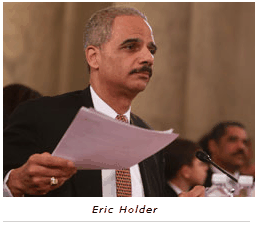
ScreenHunter_02 Feb. 11 11.22 Obama has tapped for the most senior positions in his Justice Department people who have been outspoken critics of the Bush administration's extreme and secretive arrogation of powers; people like Eric Holder, Dawn Johnsen, Martin Lederman, and David Barron. This, perhaps more than any single action on Obama's part, has signaled how serious he is about capping the last administration's geyser of President-Is-King nonsense.

How then, is it possible that Obama's Justice Department chose to stay the course on one of the most embarrassing legal theories advanced by the Bush administration—the so-called state-secrets privilege? If you're going to cling to any aspect of the “war on terror,” wouldn't it make sense to choose a power that could arguably forestall future terror attacks (like coercive interrogation) rather than the utterly bogus argument that courts are not fit to scrutinize government wrongdoing?

Yet in a San Francisco courtroom Monday, that is precisely what the new Justice Department did. Administration lawyers held to the Bush line of using the state-secrets privilege to urge the 9th Circuit to block a civil suit filed by five foreign detainees against Jeppesen Dataplan, a Boeing subsidiary. This suit was filed by the ACLU in 2007 on behalf of the five detainees and dismissed by a district court last February. The ACLU was hoping to reinstate the suit, which alleges that Jeppesen contracted with the CIA to fly detainees to countries where they were tortured under the CIA's “extraordinary rendition” program. The abuse these men describe in their court papers is appalling. Allegations have recently surfaced in the British papers that one of the detainees, Binyam Mohamed, had his “genitals . . . sliced with a scalpel.”

More here.

Dissonant Undertones in M.I.A.’s Music

Thomas Fuller in the New York Times:

ScreenHunter_01 Feb. 11 10.15 To many Americans, Maya Arulpragasam, known as M.I.A., is the very pregnant rapper who gyrated across the stage at Sunday’s Grammy Awards.

Yet in Sri Lanka, where she spent her childhood years, M.I.A. remains virtually unknown. And some who do know her work say she is an apologist for the separatist Tamil Tiger rebels fighting in the country’s long-running civil war.

M.I.A. — who has been nominated for an Oscar for the song she co-wrote for the hit film “Slumdog Millionaire” — has branded herself through music videos and interviews as the voice of the country’s Tamil minority. In the video for her song “Bird Flu,” for instance, children dance in front of what looks like the rebels’ logo: a roaring tiger.

“Being the only Tamil in the Western media, I have a really great opportunity to sort of bring forward what’s going on in Sri Lanka,” she said in an interview on the PBS program “Tavis Smiley” last month. “There’s a genocide going on.”

More here.

Born believers: How your brain creates God

Michael Brooks in New Scientist:

Mg20126941_700-1_300 While many institutions collapsed during the Great Depression that began in 1929, one kind did rather well. During this leanest of times, the strictest, most authoritarian churches saw a surge in attendance.

This anomaly was documented in the early 1970s, but only now is science beginning to tell us why. It turns out that human beings have a natural inclination for religious belief, especially during hard times. Our brains effortlessly conjure up an imaginary world of spirits, gods and monsters, and the more insecure we feel, the harder it is to resist the pull of this supernatural world. It seems that our minds are finely tuned to believe in gods.

Religious ideas are common to all cultures: like language and music, they seem to be part of what it is to be human. Until recently, science has largely shied away from asking why. “It's not that religion is not important,” says Paul Bloom, a psychologist at Yale University, “it's that the taboo nature of the topic has meant there has been little progress.”

More here.

Hidden memories guide choices

From Nature:

Memories Memories that we are not aware of may be just as accurate as those we recall, researchers have found. And they might also provoke unique changes in the brain's electrical activity during recall. The researchers have looked at a type of memory called 'implicit' memory. Whereas 'explicit' memory is full of the things we consciously remember, implicit memory contains memories we do not realize we have formed. The phenomenon has been demonstrated in patients with amnesia, who can, with training, learn to solve specific puzzles more quickly despite insisting that they have never seen the puzzle before.

In a study published in Nature Neuroscience, Joel Voss from the Beckman Institute for Advanced Science and Technology at the University of Illinois, Urbana-Champaign, and Ken Paller of Northwestern University in Evanston, Illinois, report that implicit memory may be at work when we recall images that we have seen before. “What is exciting is they are sort of bringing an experimental lens to the most twilight aspects of our memory,” says neuroscientist John Gabrieli of the Massachusetts Institute of Technology in Cambridge.

More here.

Tuesday, February 10, 2009

religion grounds human rights

Human-rights-abuse

In fact, most ethical issues, including those of human rights, require a synthetic judgment, one in which we must join normative first principles to the concrete matrices of experience by which we know events and read the existing ethos of our lives – that concrete network of events, traditions, relationships, commitments and specific blends of connectedness and alienation which shape the “values” of daily experience and our senses of obligation. It is not a case of “either or” but one of “both and.” The classic traditions of case-study, as well as the modern strictures of court procedure, exemplify this joining: they require both a finding of law, which involves the critical reflection on juristic first principles behind the law, and a finding of “fact,” which requires reliance on the experience-gained wisdom, often having to argue before a jury of peers. Moreover, they require an anticipatory assessment of the various consequences of various courses of action implied by a judgment about the interaction of principle and fact. Indeed, it is theologically paradigmatic that following the accounts of the Decalogue in both Exodus and Deuteronomy, surely prime example of universalistic abstract principles, the next several chapters are repositories of the casuistic results of the blending of the implications of those principles with the situations that people experienced concretely in their ethos. That joining rendered judgments that are held to contribute to the well-being of the common life and to the development of a morally righteous people. Similarly, much in the prophetic tradition makes the case against the infidelities of the people and/or the people in power by identifying the enduring principles in the covenants of old, the experience of social history in the present, and the prospects for a bleak, or a redeemed, future according to human deserts and divine mercy. And, for Christians specifically, to deny that any absolute universal can be connected to the realities of concrete historical experience in ways that lead to a redeemed future, is in fact a denial of the deepest insight of their faith: that Christ was both fully God and fully human, and that his life both fulfilled the commands of God, was concretely lived in the midst of a specific ethos, and nevertheless pointed to an ultimate future that we could not otherwise obtain.

more from Ovi here.

is god a mathematician?

Godmath

MARIO LIVIO IS an astrophysicist, a man whose work and worldview are inextricably intertwined with mathematics. Like most scientists, he depends on math and an underlying faith in its incredible power to explain the universe. But over the years, he has been nagged by a bewildering thought. Scientific progress, in everything from economics to neurobiology to physics, depends on math’s ability. But what is math? Why should its abstract concepts be so uncannily good at explaining reality? The question may seem irrelevant. As long as math works, why not just go with it? But Livio felt himself pulled into a deep question that reaches to the very foundation of science – and of reality itself. The language of the universe appears to be mathematics: Formulas describe how our planet revolves around the sun, how a boat floats, how light glints off the water. But is mathematics a human tool, or is reality, in some fundamental way, mathematics?

more from Boston Globe Ideas here.

Blossom Dearie

Blossom_Dearie_1292850c

The New Yorker critic Whitney Balliett once said that Blossom Dearie’s tiny wisp of a voice “would scarcely reach the second storey of a doll’s house”. Indeed hers was a style which on first hearing sounded detached and impassive. After a while, however, one began to notice the deftness of her phrasing, as well as the wit and intelligence of her interpretation. She accompanied herself at the piano with the lightest of touches, rarely improvising, but employing sophisticated and immaculately voiced harmonies. Marguerite Blossom Dearie was born on April 29 1926 at East Durham, near Albany, New York, where, it is said, the locals are noted for their clarity of diction. Surprisingly, her name, so unusual and so perfectly suited to her fragile, blowaway voice, was also completely genuine. Dearie is an old Scottish name, and her father, a barman of Scottish-Irish extraction, hit upon Blossom after seeing some peach blossom shortly after her birth. She studied classical piano as a child and became interested in jazz while playing in her high-school dance band.

more from Telegraph here.

How greed ruins academia in Pakistan

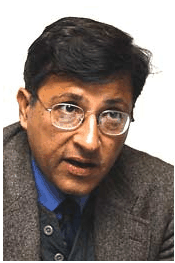
Pervez Hoodbhoy in Dawn:

ScreenHunter_05 Feb. 10 14.17 Pakistan's university system is breaking down, perhaps irreparably so. Thanks to the Higher Education Commission’s grand plans for a massive change, a tidal wave of money hit our public universities during the Musharraf years.

Although difficult financial times finally stemmed the flood, this enormous cash infusion served to amplify problems rather than improve teaching and research quality.

Naked greed is now destroying the moral fibre of academia. Professors across the country are clamouring to lift even minimal requirements that could assure quality education. This is happening in two critical ways. First, to benefit from three-fold increases in salaries for tenure-track positions, professors are speedily removing all barriers for their promotions. Second, they want to be able to take on more PhD students, whether these students have the requisite academic capacity or not. Having more students translates into proportionately more money in each professor’s pocket.

Nowhere is this more evident than at Quaid-i-Azam University, said to be Pakistan’s flagship public university. Barely two miles from the presidency and the prime minister’s secretariat, it was once an island of excellence in a shallow sea of mediocrity. Most other universities started lower, and their decay has gone further and faster than at QAU. Some are recognisable as universities in name only.

QAU’s departments of physics and economics were especially well known 35 years ago, which is when I joined the university. The faculty was small and not many PhD degrees were awarded in those days. Money was scarce, but standards were fairly good and approximated those at a reasonable US university. But as time passed, less care was taken in appointing new faculty members. Politics began to dominate over merit and quality slipped. That slow slippage is now turning into rapid collapse.

Last month, at a formal meeting, QAU professors voted to make life easy for themselves. The Academic Council, the key decision-making body of the university, decided that henceforth no applicant for a university teaching position, whether at the associate professor or professor level, could be required to give an open seminar or lecture as a part of the selection process. Open lectures were deemed by the council as illegal, unjust and a ploy for victimising teachers.

This is mind-boggling.

More here.

Tuesday Poem

///
The Crying Hill
Yusef Komunyaaka

Lately, I've stood between one self
& another self, trying to call across
the gone years, & my voice floats
from a tower of Babel, saying,
Yes, I need my arms around you
to anchor myself. Or, maybe I hear Ray
with the volume turned down, singing

…………“If I were a mountain jack
……………………………….I'd call my baby back.”

Or, I am hearing again that old man
facing a silent field of land mines,
circled by barbed wire, calling
his daughter's name over a loudspeaker
on his crying hill near the Golan Heights.
The sunlight glints off his eyeglasses.
She arrives like an apparition unbound
from a stone. Whenever he comes here,
he goes away with pocketsful of dirt.
He's lamenting her mother's ashes
given months ago to the Sea of Galilee
one sunset. What is she saying to him,
her head thrown back, her black hair
flowing around her? She has a bouquet
of red roses. But for a second, an eye
blink, he thought she'd been wounded.
Do the flowers mean a birth or death?
A whisper floats out of the loudspeaker.
He remembers when he was wild-hearted,
climbing these hills with his two friends,
Seth & Horus, both dead now for years.
They were kings, three laughing boys,
daring the small animals to speak.
///

African-American Civil Rights Movement (1955–1968)

From Wikipedia:

AfricanAmericans1 After the disputed election of 1876 and the end of Reconstruction, White Americans in the South resumed political control of the region under a one-party system of Democratic control. The voting rights of blacks were increasingly suppressed, racial segregation imposed, and violence against African Americans mushroomed. This period is often referred to as the “nadir of American race relations,” and while it was most intense in the South to a lesser degree it affected the entire nation. The system of overt, state-sanctioned racial discrimination and oppression that emerged out of the post-Reconstruction South and spread nation-wide became known as the “Jim Crow” system, and it remained virtually intact into the early 1950s. Systematic disenfranchisement of African Americans took place in Southern states at the turn of the century and lasted until national civil rights legislation was passed in the mid-1960s. For more than 60 years, they were not able to elect one person in the South to represent their interests. Because they could not vote, they could not sit on juries limited to voters. They had no part in the justice system or law enforcement, although in the 1880s, they had held many local offices, including that of sheriff.

Characteristics:

  • Racial segregation. By law, public facilities and government services such as education were divided into separate and unequal “white” and “colored” domains.
  • Disenfranchisement. When White American Democrats regained power, they passed laws that made voter registration more complicated. Black voters were forced off the voting rolls, and the number of African-Americans elected to office decreased. From 1890 to 1908, Southern states of the former Confederacy created constitutions with provisions that disfranchised most African Americans and, in many cases, poor White Americans.
  • Exploitation. Increased economic oppression of blacks, Latinos, and Asians, denial of economic opportunities, and widespread employment discrimination.
  • Violence. Individual, police, organizational, and mass racial violence against blacks (and Latinos in the Southwest and Asians in California).

More here.

Darwin, Ahead of His Time, Is Still Influential

Nicholas Wade in The New York Times:

Darwin-190 Darwin’s theory of evolution has become the bedrock of modern biology. But for most of the theory’s existence since 1859, even biologists have ignored or vigorously opposed it, in whole or in part. It is a testament to Darwin’s extraordinary insight that it took almost a century for biologists to understand the essential correctness of his views. Biologists quickly accepted the idea of evolution, but for decades they rejected natural selection, the mechanism Darwin proposed for the evolutionary process. Until the mid-20th century they largely ignored sexual selection, a special aspect of natural selection that Darwin proposed to account for male ornaments like the peacock’s tail.

And biologists are still arguing about group-level selection, the idea that natural selection can operate at the level of groups as well as on individuals. Darwin proposed group selection — or something like it; scholars differ as to what he meant — to account for castes in ant societies and morality in people. How did Darwin come to be so in advance of his time? Why were biologists so slow to understand that Darwin had provided the correct answer on so many central issues? Historians of science have noted several distinctive features of Darwin’s approach to science that, besides genius, help account for his insights. They also point to several nonscientific criteria that stood as mental blocks in the way of biologists’ accepting Darwin’s ideas.

More here.

The Two Languages of Academic Freedom

Stanley Fish in the New York Times:

Stanley_fish Last week we came to the section on academic freedom in my course on the law of higher education and I posed this hypothetical to the students: Suppose you were a member of a law firm or a mid-level executive in a corporation and you skipped meetings or came late, blew off assignments or altered them according to your whims, abused your colleagues and were habitually rude to clients. What would happen to you?

The chorus of answers cascaded immediately: “I’d be fired.” Now, I continued, imagine the same scenario and the same set of behaviors, but this time you’re a tenured professor in a North American university. What then?

I answered this one myself: “You’d be celebrated as a brave nonconformist, a tilter against orthodoxies, a pedagogical visionary and an exemplar of academic freedom.”

My assessment of the way in which some academics contrive to turn serial irresponsibility into a form of heroism under the banner of academic freedom has now been at once confirmed and challenged by events at the University of Ottawa, where the administration announced on Feb. 6 that it has “recommended to the Board of Governors the dismissal with cause of Professor Denis Rancourt from his faculty position.” Earlier, Rancourt, a tenured professor of physics, had been suspended from teaching and banned from campus. When he defied the ban he was taken away in handcuffs and charged with trespassing.

More here.

Waltzing With Ariel

Tony Karon in Rootless Cosmopolitan:

ScreenHunter_04 Feb. 10 09.56 Whereas Ariel Sharon saw the need to humor the Americans by indulging the rituals of Bush’s two-state vision, Netanyahu never bothered. In fact, it was Netanyahu’s rejection of Sharon’s tactical move to evacuate Gaza in order to tighten Israel’s grip on the West Bank that led to the Likud split that created the Kadima Party. Netanyahu isn’t stupid — even though right now there’s a good chance that he’d be able to build a ruling coalition only with blatantly rejectionist parties, he’ll make space for Kadima and Labor, hoping that he can stir the Pollyannaish hopes in Washington that their presence signals a “willingness” to make a peace agreement. Not that Netanyahu has any intention of doing so. Nor did Olmert, or Sharon.

Ariel Sharon campaigned furiously against Oslo, urging the settlers to “grab more hills” and making clear his own intention to stop the process. Sharon’s problem with Camp David was not that Arafat rejected what Barak’s “generous offer” (which even Barak’s chief negotiator, Shlomo Ben-Ami, later said he, too, would have rejected if he’d been Palestinian); it was that the offer had been made at all. That was why Sharon marched up the Temple Mount and onto the sanctuary around the Al-Aqsa mosque with a security detail of some 200 men, in the event that triggered the protests that mushroomed into the Second Intifada. And as soon as the fires were raging, Sharon triumphantly declared, “The Oslo Agreement is finished. It is null and void.”

More here.