Leading Rwanda Expert Killed in Buffalo Plane Crash

From the website of Human Rights Watch:

2009Alison_Des_Forges It is with enormous sadness that Human Rights Watch announces the death of our beloved colleague Dr. Alison Des Forges, who was killed in the crash of Flight 3407 from Newark to Buffalo on February 12, 2009. Des Forges, senior adviser to Human Rights Watch's Africa division for almost two decades, dedicated her life to working on Rwanda and was the world's leading expert on the 1994 Rwanda genocide and its aftermath.

“Alison's loss is a devastating blow not only to Human Rights Watch but also to the people of Rwanda and the Great Lakes region,” said Kenneth Roth, executive director of Human Rights Watch. “She was truly wonderful, the epitome of the human rights activist – principled, dispassionate, committed to the truth and to using that truth to protect ordinary people. She was among the first to highlight the ethnic tensions that led to the genocide, and when it happened and the world stood by and watched, Alison did everything humanly possible to save people. Then she wrote the definitive account. There was no one who knew more and did more to document the genocide and to help bring the perpetrators to justice.”

Des Forges, born in Schenectady, New York, in 1942, began working on Rwanda as a student and dedicated her life and work to understanding the country, to exposing the serial abuses suffered by its people and helping to bring about change. She was best known for her award-winning account of the genocide, “Leave None to Tell the Story,” and won a MacArthur Award (the “Genius Grant”) in 1999.

More here. [Thanks to Karen Ballentine.]
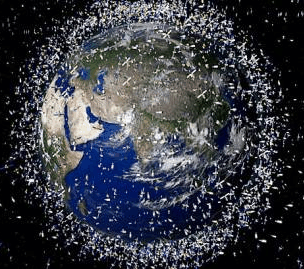
Space Collision Called ‘Catastrophic Event’

Vladimir Isachenkov of the Associated Press:

ScreenHunter_01 Feb. 15 19.35 The crash of two satellites has generated an estimated tens of thousands of pieces of space junk that could circle Earth and threaten other satellites for the next 10,000 years, space experts said Friday.

One expert called the collision “a catastrophic event” that he hoped would force President Barack Obama's administration to address the long-ignored issue of debris in space.

Russian Mission Control chief Vladimir Solovyov said Tuesday's smashup of a derelict Russian military satellite and a working U.S. Iridium commercial satellite occurred in the busiest part of near-Earth space — some 500 miles (800 kilometers) above Earth.

“800 kilometers is a very popular orbit which is used by Earth-tracking and communications satellites,” Solovyov told reporters Friday. “The clouds of debris pose a serious danger to them.”

Solovyov said debris from the collision could stay in orbit for up to 10,000 years and even tiny fragments threaten spacecraft because both travel at such a high orbiting speed.

More here.

Has molecular gastronomy reached the plateau of productivity?

Hype-cycle Martin Lersch asks over at the wonderful blog Khymos:

Molecular gastronomy was recently chosen as word of the month (not quite sure exactly which month this was). They give the following definition:

the art and practice of cooking food using scientific methods to create new or unusual dishes

This is not the best definition I’ve seen, to be honest. Why should one limit it to new or unusual dishes? When taken to extremes this only results in gimmickery. Strangely enough there are no hits when I search for “molecular gastronomy” at www.askoxford.com, so one might wonder whether they changed their mind? Personally I feel that molecular gastronomy should strive to improve both home cooking and restaurant cooking. That’s also what I tried to convey with my 10-part series with tips for practical molecular gastronomy.

The Webster’s New Millennium dictionary has this definition:

the application or study of scientific principles and practices in cooking and food preparation

This definition includes both the fundamental scientific aspects and the applications of these. But to me it’s too close to “food science”. Where is the enthusiasm? Where is the delicous meal with tempting aromas and textures? As you might know several definitions have been launched over the last couple of years. My favorite definition is still Harold McGee’s (although he does no longer use the definition himself): “Molecular gastronomy is the scientific study of deliciousness”. In my opinion it joins the two worlds which for too long have been separated – the world of science and the world of gastronomy and everything delicious.

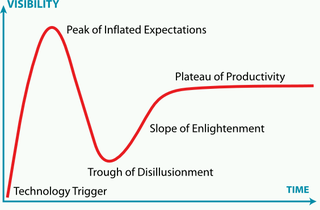
It was a German blog post by Benedikt Köhler over at molekularküche (German blog on molecular gastronomy) that made me aware of the Oxford dictionary definition, and he also reminded me of the hype cycle, a term coined by the US based analyst house Gartner (read more about it in the book “Mastering the hype cycle”). It features the following 5 phases shown below and I agree with Benedikt that these terms can also be applied to the rise and fall (and hopefully also resurrection) of molecular gastronomy…

Computers conquer the final frontier in board games

Go_board_part-thumb-150x150 Ewen Callaway in New Scientist. (Note, Monte Carlo simulations are hardly new. I think Fermi used them in the 1930s or 1940s.):

“A lot of people have thought of Go as the last bastion of human superiority over computers, at least as far as board games go,” Hearn said. “Previous to this no one would have imagined that a computer would be able to beat a professional.”

Go is played widely in Asia and holds a far more important position there than chess does in the West, said Elwyn Berlekamp, another mathematician who studies the game, based at the University of California in Berkeley.

The game is played by two players who place black and white stones on a 19-by-19 square board. Players alternate turns placing a stone on the board, and the goal is to encircle another player's stones to the point where she has no moves left.

Because there are about 10^171 possible games of Go, computers applying the same approach that has lead to their superiority in chess and checkers — mapping out every possible move at each point in a game — fail miserably, Hearn said. A chess game has 10^50 possibilities, a checkers game just 10^20.

However, a new mathematical approach called a Monte Carlo simulation has changed everything. In a Monte Carlo simulation a computer plays numerous random games of Go, but applies knowledge from previous games to future games. This allows the computer to rule out huge swaths of real estate on the Go board and concentrate its computing power on the best moves, Hearn said.

Professional Go players know their reign will soon end.

How the Crash Will Reshape America

Florida_geography_200 Richard Florida in The Atlantic:

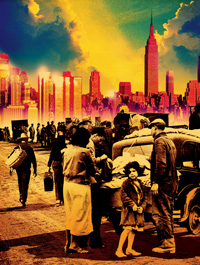
The historian Scott Reynolds Nelson has noted that in some respects, today’s crisis most closely resembles the “Long Depression,” which stretched, by one definition, from 1873 to 1896. It began as a banking crisis brought on by insolvent mortgages and complex financial instruments, and quickly spread to the real economy, leading to mass unemployment that reached 25 percent in New York.

During that crisis, rising industries like railroads, petroleum, and steel were consolidated, old ones failed, and the way was paved for a period of remarkable innovation and industrial growth. In 1870, New England mill towns like Lowell, Lawrence, Manchester, and Springfield were among the country’s most productive industrial cities, and America’s population overwhelmingly lived in the countryside. By 1900, the economic geography had been transformed from a patchwork of farm plots and small mercantile towns to a landscape increasingly dominated by giant factory cities like Chicago, Cleveland, Pittsburgh, Detroit, and Buffalo.

How might various cities and regions fare as the crash of 2008 reverberates into 2009, 2010, and beyond? Which places will be spared the worst pain, and which left permanently scarred? Let’s consider how the crash and its aftermath might affect the economic landscape in the long run, from coast to coast—beginning with the epicenter of the crisis and the nation’s largest city, New York.

On the Firebombing of Dresden

Dresden In Der Spiegel, an interview with Frederick Taylor on the military logic of bombing Dresden:

Taylor:…The Dresden attack was directly linked to the conduct of the war elsewhere — in this case on the Eastern Front. In Feb. 1945, Dresden was a major transport and communication hub less than 120 miles from the advancing Russians. The aim of the bombing was quite deliberately to destroy the center of the city, thereby making the movement of German soldiers and civilians impossible.

SPIEGEL ONLINE: And in that, it was quite effective.

Taylor: There were other targets too. Berlin was also seen as essential to continuing German resistance and was heavily bombed on Feb. 3. Raids on Dresden and Chemnitz were delayed by bad weather. And ultimately, only the Dresden raid was successful — horribly so as the 25,000 or more casualties bear witness. This was, in fact, a clear-cut case where maximum destruction was the central aim of the attack. There can be no question that the presence of many refugees was factored into the Allies' calculations. A Feb. 1, 1945 memorandum specifically noted the huge tide of refugees passing through the eastern German cities as a “plus point,” chillingly adding that attacking these cities would “result in establishing a state of chaos in some or all of these areas.”

Sunday Poem

For Saundra
Nikki Giovanni

i wanted to write
a poem
that rhymes
but revolution doesn't lend
itself to be-bopping

then my neighbor
who thinks i hate
asked – do you ever write
tree poems – i like trees
so i thought
i'll write a beautiful green tree poem
peeked from my window
to check the image
noticed that the school yard was covered
with asphalt
no green – no trees grow
in manhattan

then, well, i thought the sky
i'll do a big blue sky poem
but all the clouds have winged
low since no-Dick was elected

so i thought again
and it occurred to me
maybe i shouldn't write
at all
but clean my gun
and check my kerosene supply

perhaps these are not poetic
times
at all

Fault Lines: Turkey East to West

From lensculture:

photography and text by
George Georgiou

TurkeyTurkey is a strategically important nation, poised geographically and symbolically between Europe and Asia. But the tensions at the heart of Turkey are becoming increasingly severe. A struggle is taking place between modernity, tradition, secularism, Islamism, democracy and repression — often in unlikely and contradictory combinations. Usually these tensions and our gaze are focused almost exclusively on Istanbul, the Kurdish issue, or religion, ignoring the far deeper complexities of a large country searching for a modern identity.

While living in Turkey for four-and-a-half years, I was surprised at how quickly change was taking place: landscapes, towns, and cities reshaped, an extensive road network under construction, town centers “beautified,” and large apartment blocks springing up at a rapid rate around every town and city. Almost always, the architecture and infrastructure follow the same blueprint. Cities are becoming carbon copies of each other.

More here.

Saturday, February 14, 2009

flannery and the backwards chicken

Hesteropt

Brad Gooch opens “Flannery,” his biography of Flannery O’Connor, with a lost moment: an account of how when O’Connor was 5, the Pathe newsreel company sent a cameraman to her home in Savannah, Ga., to film a chicken she had trained to walk backward. Such an image highlights O’Connor’s lifelong fascination with birds, but most telling is that even at this age, she was elusive, standing just outside our grasp. “O’Connor’s screen debut,” Gooch writes, “exists in all its fragility in a Pathe film archive. . . . For all of four seconds, O’Connor, a self-possessed little girl, is glimpsed in glaring afternoon light, a wisp of curls peeking from beneath her cap, calmly coping with three chickens fluttering in her face.” Here we have a stunning metaphor for not only her writing but also her existence: brief, glancing, almost impossible to pin down.

more from the LA Times here.

Darwin, Rock Star?

Carl also discusses Darwin and Darwin-mania in Time:

It's only fitting to recognize the accomplishments of a great biologist. But there's a risk to all this Darwinmania: some people may come away with a fundamental misunderstanding about the science of evolution. Once Darwin mailed his manuscript of On the Origin of Species by Means of Natural Selection, or the Preservation of Favoured Races in the Struggle for Life to his publisher, the science of evolution did not grind to a halt. That would be a bit like saying medicine peaked when Louis Pasteur demonstrated that germs cause diseases.

Today biologists are exploring evolution at a level of detail far beyond what Darwin could, and they're discovering that evolution sometimes works in ways the celebrated naturalist never imagined. “The biological problems we're dealing with are much more complex,” says Massimo Pigliucci, an evolutionary biologist at Stony Brook University in New York. “That said, it's a lot of fun. I'm not complaining.”

Recalling The Satanic Verses

Satanic Verses In addition to being Valentine's day, today is the 20th anniversary of Khomeini's fatwa calling for the death of Salman Rushdie for The Satanic Verses (one of Rushdie's best and most beautiful novels).

Rumor has it that before publication, Rushdie was speaking of his novel, still in-progress, to a few people at a dinner at Edward Said's. When he got to the part about the story of Mahound, Eqbal Ahmad reportedly blurted out something like, “Are you mad? He'll kill you!” referring to Khomeini. Years later, when someone at the dinner brought up this near-prophetic remark to Rushdie, he allegedly replied, “Eqbal was wrong. I'm still alive.”

Lawrence Pollard in the BBC:

It must be both the most talked about and the least read book of recent times. Since it came out in 1988 The Satanic Verses has seemed more a principle to be argued over than a book to discuss.

From the very first call for it to be banned – made by Indian MP Syed Shahabuddin – its critics have proudly announced they didn't have to read it to know it was wrong.

And anecdotally, as I have been sitting re-reading the book, many colleagues have come up and admitted they had either bought it but never opened it or started and given up. So what is it like?

The Satanic Verses is three stories, told in three styles, threaded together in one novel.

In the first story, two contemporary Indians fall out of an exploding aeroplane and survive. One seems to become an angel floating around London, the other grows horns and cloven hoofs.

In another story a poor Indian girl of great beauty, surrounded by butterflies, leads a pilgrimage of Muslim villagers into the Arabian Sea, where they drown.

And in the third, most controversial strand, a prophet founds a religion in the desert. Although this story makes up only 70 of the 550 pages of the novel, it is the part which provoked the furious reaction we now call the Satanic Verses controversy.

Flying Blind

From The New York Times:

LORDS OF FINANCE The Bankers Who Broke the World

By Liaquat Ahamed

Liaquatahamed “We have involved ourselves in a colossal muddle, having blundered in the control of a delicate machine, the working of which we do not understand.” So wrote the great economic iconoclast John Maynard Keynes in an essay titled “The Great Slump of 1930,” published in December of that year. Thirteen months had passed since the crash of 1929; the world was living, in Keynes’s words, in “the shadow of one of the greatest economic catastrophes of modern history.” I shuddered when I read this quotation in “Lords of Finance,” a magisterial work by Liaquat Ahamed, a veteran hedge fund manager and Brookings Institution trustee. A grand, sweeping narrative of immense scope and power, the book describes a world that long ago receded from memory: the West after World War I, a time of economic fragility, of bubbles followed by busts and of a cascading series of events that led to the Great Depression.

The “delicate machine” Keynes referred to was of course the global economy. By 1930, when he wrote his essay, the West was in bad shape. A combination of divisive postwar politics, a refusal to abandon economic orthodoxy and a series of policy errors by the world’s four most important central banks — the Federal Reserve, the Bank of England, the German Reichsbank and the Banque de France — had led to the near collapse of capitalist economies in the West. “Industrial production had fallen 30 percent in the United States, 25 percent in Germany and 20 percent in Britain,” Ahamed writes. “Over 5 million men were looking for work in the United States, another 4.5 million in Germany and 2 million in Britain.”

And yet — and this is why I shuddered — it was also a moment not unlike the one we’re living through now.

More here.

IR theory for lovers: a valentine’s guide

Stephen M. Walt in Foreign Policy:

ScreenHunter_03 Feb. 14 09.40 To begin with, any romantic partnership is essentially an alliance, and alliances are a core concept on international relations. Alliances bring many benefits to the members (or else why would we form them?) but as we also know, they sometimes reflect irrational passions and inevitably limit each member's autonomy. Many IR theorists believe that institutionalizing an alliance makes it more effective and enduring, but that’s also why making a relationship more formal is a significant step that needs to be carefully considered.

Of course, IR theorists have also warned that allies face the twin dangers of abandonment and entrapment: the more we fear that our partners might leave us in the lurch (abandonment), the more likely we are to let them drag us into obligations that we didn't originally foresee (entrapment). When you find yourself gamely attending your partner’s high school reunion or traveling to your in-laws for Thanksgiving dinner every single year, you’ll know what I mean.

Realists have long argued that bipolar systems are the most stable. So if any of you lovers out there are thinking of adding more major actors to the system, please reconsider. As most of us eventually learn, trying to juggle romantic relationships in a multi-polar setting usually leads to crises, and sometimes to open warfare. It's certainly not good for alliance stability.

More here. [Thanks to Kris Kotarski.]

The Imp in a Bottle: Ponzi/Madoff in a Broader Perspective

John Allen Paulos in his excellent Who's Counting column at ABC News:

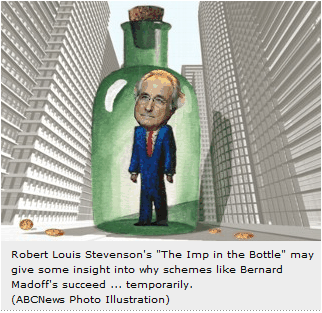
ScreenHunter_02 Feb. 14 08.53 A quite different illustration of our short-sightedness comes courtesy of Robert Louis Stevenson's “The Imp in the Bottle.” The story tells of a genie in a bottle able and willing to satisfy your every romantic whim and financial desire. You're offered the opportunity to buy this bottle and its amazing denizen at a price of your choice. There is a serious limitation, however.

When you've finished with the bottle, you have to sell it to someone else at a price strictly less than what you paid for it. If you don't sell it to someone for a lower price, you will lose everything and will suffer excruciating and unrelenting torment. What would you pay for such a bottle?

Certainly you wouldn't pay 1 cent because then you wouldn't be able to sell it for a lower price. You wouldn't pay 2 cents for it either since no one would buy it from you for 1 cent since everyone knows that it must be sold for a price less than the price at which it is bought. The same reasoning shows that you wouldn't pay 3 cents for it since the person to whom you would have to sell it for 2 cents would object to buying it at that price since he wouldn't be able to sell it for 1 cent. Likewise for prices of 4 cents, 5 cents, 6 cents, and so on.

We can use mathematical induction to formalize this argument, which proves conclusively that you wouldn't buy the genie in the bottle for any amount of money. Yet you would almost certainly buy it for 1,000 dollars. I know I would. At what point does the argument against buying the bottle cease to be compelling?

More here.

Big Science Role Is Seen in Global Warming Cure

John M. Broder and Matthew L. Wald in the New York Times:

12science190 Steven Chu, the new secretary of energy, said Wednesday that solving the world’s energy and environment problems would require Nobel-level breakthroughs in three areas: electric batteries, solar power and the development of new crops that can be turned into fuel.

Dr. Chu, a physicist, spoke during a wide-ranging interview in his office, where his own framed Nobel Prize lay flat on a bookcase, a Post-it note indicating where it should be hung on the wall.

He addressed topics that included global warming, renewable energy sources like solar and wind power, the use of coal and a proposed repository for nuclear waste at Yucca Mountain in Nevada.

More here.

Fateless -The Movie

Ruchira Paul in Accidental Blogger:

Fateless It's not often that a book or a movie makes me cry. A few weeks ago I watched Fateless, a film that brought tears to my eyes. For quite some time afterwards I could not get over the sepia tinted images of melancholy, gloom and suffering. Even more difficult to shake off was the impression made by the detached incomprehension of the young protagonist caught in the violent maelstrom.

Fateless is based on a novel by Imre Kertesz, a Nobel Prize winning Hungarian author who spent a year in Nazi concentration camps as a young boy. The movie is the account of one year in the life of fourteen year old Gyuri (Gyorgy ) Koves (some have speculated, Kertesz himself) after being shipped to Auschwitz, later shifted to Buchenwald and finally to Zeitz, a lesser known concentration camp in 1944. Through it all we experience the young boy's plight not as mere viewers but often as “Gyuri,” the teenager who has been transported from a life of middle class predictability to one of unfamiliar, unprecedented horror which is in equal parts, carefully planned out regimental cruelty and random violence. As Primo Levi pointed out in his brilliant books about Auschwitz, one needs some distance in time and place from carnage and degradation to truly recognize the scars left by past traumas. With proximity to pain, over time, mindless brutality and soul sapping privation can begin to look routine and mundane. And tragedy is multiplied many times over when children's fates are shaped by the corruption of the adult soul.

More here.

Saturday Poem

///
The Question of Influence
Bill Schneberger

Where do I get it
Who does it come from
How did it get here
What shall I do with it
When will it stop
Why do I ask

Is it
From the history of man
The myth of art
The silence of nature
The structure of form

Is it
From the commerce of art
The mountain not seen
The absence of stars tracking the sky
The lack of conception

Is it
From unfinished pieces
The loss of my father
The clatter of my heart
The want of something

Or

Is it
From never having seen Schenectady
And everything that happens in circles
///

Friday, February 13, 2009

The Fire Escapes of New York

25escapes.span Leonard Benardo and Jennifer Weiss in The NYT:

OFFICIALLY, of course, the urban fire escape is primarily an emergency exit, but in New York, this prosaic adornment of countless five- and six-story apartment houses has assumed myriad other functions: faux backyards, platforms for criminal getaways, oases for marginalized smokers and makeshift bedrooms popular during an age before air-conditioning.

And they are often visual knockouts, too. Strikingly designed fire escapes have complemented some of the city’s grandest structures, like the Puck Building on Lafayette Street, and enhanced even the dreariest structures.

First built in New York well over a century ago, mandated by the 1867 tenement law, fire escapes soon became a canvas for the virtuosity of local foundry workers, including recently arrived European immigrants. Throughout the city, these artisans created ornate objets d’art constructed and molded from wrought and cast iron. The designs that resulted present a decorative smorgasbord, and include such rich details as arabesques, filigree lacework and rosettes.

Kafka and the Kafkaesque

Kafka Alexander Provan in The Nation:

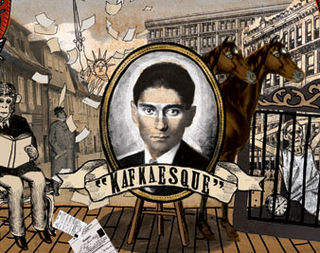
What is the Kafkaesque? It is the scene described in Kafka's story “A Report to an Academy,” in which an eloquent ape candidly recounts his arduous path toward civilization: “There is an excellent idiom: to fight one's way through the thick of things; that is what I have done.” It is, Begley suggests, that familiar existential predicament so often played out by Kafka's characters, who “struggle in a maze that sometimes seems to have been designed on purpose to thwart and defeat them. More often, the opposite appears to be true: there is no purpose; the maze simply exists.” It is the explosion of the international market for mortgage-backed securities and derivatives, in which value is not attached to the thing itself but to speculation on an invented product tangentially related to (but not really tied to) that thing. It is FEMA's process for granting housing assistance after Hurricane Katrina: victims were routinely informed of their applications' rejection by letters offering not actual explanations but “reason codes.” It is the Bush administration's declaration that certain Guantánamo Bay detainees who had wasted away for years without trial were “no longer enemy combatants” and its simultaneous refusal to release them or clarify whether they had ever been such. It is, as Walter Benjamin wrote, “the form which things assume in oblivion.” “Kafkaesque,” in other words, is a phrase that has come to represent very much about modern life while signifying very little.

For some, the haze of the Kafkaesque has become so dense–if not Kafkaesque–as to prevent readers from seeing the real Kafka. In his “definitive biography” Kafka: The Decisive Years, which was translated from the German in 2005, Reiner Stach assembles the available bits of information about the writer's life between 1910 and 1915 as if they were puzzle pieces, but he finds he has no key, or too many; loath to impose his interpretation of the various facts and accounts (though he must do so occasionally) or to indulge purveyors of the Kafka myth, he leaves the reader with a 600-page buildup to a titular punch line.