Rick Perlstein in the Washington Post:
So the birthers, the anti-tax tea-partiers, the town hall hecklers — these are “either” the genuine grass roots or evil conspirators staging scenes for YouTube? The quiver on the lips of the man pushing the wheelchair, the crazed risk of carrying a pistol around a president — too heartfelt to be an act. The lockstep strangeness of the mad lies on the protesters’ signs — too uniform to be spontaneous. They are both. If you don’t understand that any moment of genuine political change always produces both, you can’t understand America, where the crazy tree blooms in every moment of liberal ascendancy, and where elites exploit the crazy for their own narrow interests.
In the early 1950s, Republicans referred to the presidencies of Franklin Roosevelt and Harry Truman as “20 years of treason” and accused the men who led the fight against fascism of deliberately surrendering the free world to communism. Mainline Protestants published a new translation of the Bible in the 1950s that properly rendered the Greek as connoting a more ambiguous theological status for the Virgin Mary; right-wingers attributed that to, yes, the hand of Soviet agents. And Vice President Richard Nixon claimed that the new Republicans arriving in the White House “found in the files a blueprint for socializing America.”
When John F. Kennedy entered the White House, his proposals to anchor America’s nuclear defense in intercontinental ballistic missiles — instead of long-range bombers — and form closer ties with Eastern Bloc outliers such as Yugoslavia were taken as evidence that the young president was secretly disarming the United States.
From The Guardian:
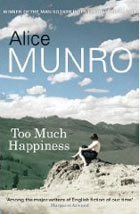 In “Fiction“, one of the 10 new stories collected in Too Much Happiness, a woman called Joyce takes a vague dislike to a guest at a family party. The guest, Maggie, whom Joyce thinks of as the sort of young woman “whose mission in life is to make people feel uncomfortable”, turns out to be a writer who's just published her first book. Joyce buys a copy on a whim a few days later, not sure if she'll actually read it (“she has a couple of good biographies on the go at the moment”). She becomes even more unsure when she realises that it's “a collection of short stories, not a novel . . . It seems to diminish the book's authority, making the author seem like somebody who is just hanging on to the gates of Literature, rather than safely settled inside.”
Alice Munro has said in interviews that she once had similar anxieties about short stories – that she spent her 20s fretting about not producing a novel. These days, along with William Trevor, she is one of the grandees of English-language short fiction. Yet people still like to worry about her authority. In truth, there's little substance to these anxieties: she's had an international readership since the 1970s; this year she added the Man Booker International prize to her already substantial collection of awards; and her daughter has published a memoir about being brought up by “an icon”. Even so, there's a persistent idea of her as an underpraised housewife-genius from the Canadian backwoods, perhaps because it's easier to talk about the literary politics of being a woman, Canadian or a short-story writer than it is to give a sense of her densely packed but effortless-seeming work.
More here.
From Scientific American:
 Imitation is thought to be the sincerest form of flattery—even when the mimic and model are unaware of the mimicry. Now, new evidence from a study of capuchin monkeys shows a possible evolutionary benefit to being a clueless copycat (or copy-capuchin, in this case).
“We've known for awhile that we humans imitate each other all the time, unintentionally and unconsciously,” says Annika Paukner, a comparative behaviorist at the National Institute of Child Health and Human Development and lead author of the study published online today in the journal Science. “When people start using the same words or the same body language, it seems to help social interaction. People [who are imitated] say they like the other person better. It builds rapport and empathy.”
More here.
Overland to the Islands
Let’s go – much as the dog goes,
intently haphazard. The
Mexican light on a day that
‘smells like autumn in Connecticut’
makes iris ripples on his
black gleaming fur – a radiance
consorting with the dance.
……………………………Under his feet
rocks and mud, his imagination, sniffing,
engaged in its perceptions – dancing
edgeways, there’s nothing
the dog disdains on his way,
nevertheless he
keeps moving, changing
pace and approach but
not direction – ‘every step an arrival’.
by Denise Levertov
from Contemporary American Poetry;
Penguin Books Ltd, Middlesex, England, 1966
Saturday, August 15, 2009
 Kathleen McGowan in Discover:
Rita Magil was driving down a Montreal boulevard one sunny morning in 2002 when a car came blasting through a red light straight toward her… The accident left Magil with two broken ribs and a broken collarbone. It also left her with post-traumatic stress disorder (PTSD) and a desperate wish to forget. Long after her bones healed, Magil was plagued by the memory of the cement barriers looming toward her. “I would be doing regular things—cooking something, shopping, whatever—and the image would just come into my mind from nowhere,” she says. Her heart would pound; she would start to sweat and feel jumpy all over. It felt visceral and real, like something that was happening at that very moment.
Most people who survive accidents or attacks never develop PTSD. But for some, the event forges a memory that is pathologically potent, erupting into consciousness again and again. “PTSD really can be characterized as a disorder of memory,” says McGill University psychologist Alain Brunet, who studies and treats psychological trauma. “It’s about what you wish to forget and what you cannot forget.” This kind of memory is not misty and watercolored. It is relentless.
More than a year after her accident, Magil saw Brunet’s ad for an experimental treatment for PTSD, and she volunteered. She took a low dose of a common blood-pressure drug, propranolol, that reduces activity in the amygdala, a part of the brain that processes emotions. Then she listened to a taped re-creation of her car accident. She had relived that day in her mind a thousand times. The difference this time was that the drug broke the link between her factual memory and her emotional memory. Propranolol blocks the action of adrenaline, so it prevented her from tensing up and getting anxious. By having Magil think about the accident while the drug was in her body, Brunet hoped to permanently change how she remembered the crash. It worked. She did not forget the accident but was actively able to reshape her memory of the event, stripping away the terror while leaving the facts behind.
 Hany Farid in IEEE Spectrum:
Altering digital imagery is now ubiquitous. People have come to expect it in the fashion and entertainment world, where airbrushing blemishes and wrinkles away is routine. And anyone surfing the Web is routinely subjected to crude photographic mashups like the Palin hoax, whose creators clearly aren’t interested in realism but in whatever titillation or outrage they can generate.
But other photo manipulations demonstrate just how difficult it has become to tell altered images from the real thing. For example, in 2005 Hwang Woo-Suk, a South Korean professor, published a paper in one of the most prestigious scientific journals, Science, claiming groundbreaking advances in stem-cell research. But at least 9 of the 11 uniquely tailored lines of stem cells that Hwang claimed to have made were fakes. Much of the evidence for those 9 lines of stem cells involved doctored photographs.
Apparently, Hwang’s fabrication was not an isolated occurrence. Mike Rossner, then the managing editor of The Journal of Cell Biology, estimated that 20 percent of the manuscripts his journal accepted contained at least one image that had been inappropriately manipulated. Since then, a number of scholarly journals have implemented new fraud-detection procedures, such as software that makes it easier to compare images within or between documents. The incidence of image fraud in scholarly publishing has not declined, though; indeed, it seems to be on the rise.
 Delphine Chui in Spiked:
Anyone who’s been curious enough to delve into the life of Gabrielle ‘Coco’ Chanel will tell you that to describe her life as appealing would be an understatement. So it would seem only natural for French cinema to want to capitalise on such a powerful life-story with, in this case, an Anne Fontaine-directed biopic.
Unfortunately, the result – Coco Before Chanel – is restricted to her pre-fame years and doesn’t really give the audience much more than a glimpse of the reason why her early life might be interesting in the first place: Chanel. Think Richard Branson before Virgin, with no mention of planes, trains, or music shops. But in French.
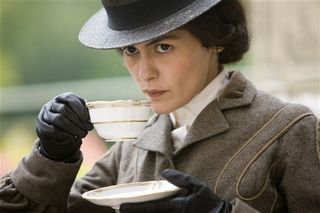
It’s 1893 when we’re first introduced to the young Coco, or, as she was then known, Gabrielle Chanel, an orphan who waits each Sunday for the return of her father. He never appears; cue daddy-issues and an embedded distrust in men. Instead, 10-year-old Gabrielle is left to look sullenly upon the faces of children who are whisked away to better lives, an expression which Audrey Tautou, playing Coco’s later incarnation, masters perfectly throughout the film.
Fifteen years on, Gabrielle and her sister, Adrienne (Marie Gillain) find themselves as cabaret performers. And it is here that Gabrielle is first transformed into ‘Coco’, a nickname given to her by the aristocrat Étienne Balsan. The best friend of Adrienne’s lover, Balsan (played effortlessly by Benoît Poelvoorde in a performance which should not be overshadowed by Tautou’s) is introduced to us with a prostitute in one arm and glass of champagne in the other. Humble beginnings, Coco says, do not bring one to the heights of society. For this reason, she lies about her past at every opportunity, making her character less easy to sympathise with and her calculating mind apparent. Men to Coco are dispensable human steps on the social ladder. She will not convert to love, she promises Balsan.
 Clive Thompson in the NYT Magazine:
Bueno de Mesquita is one of the world’s most prominent applied game theorists. A professor at New York University and a senior fellow at the Hoover Institution at Stanford, he is well known academically for his work on “political survival,” or how leaders build coalitions to stay in power. But among national-security types and corporate decision makers, he is even better known for his prognostications. For 29 years, Bueno de Mesquita has been developing and honing a computer model that predicts the outcome of any situation in which parties can be described as trying to persuade or coerce one another. Since the early 1980s, C.I.A. officials have hired him to perform more than a thousand predictions; a study by the C.I.A., now declassified, found that Bueno de Mesquita’s predictions “hit the bull’s-eye” twice as often as its own analysts did.
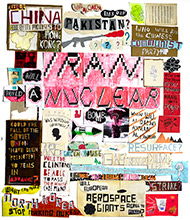
Last year, Bueno de Mesquita decided to forecast whether Iran would build a nuclear bomb. With the help of his undergraduate class at N.Y.U., he researched the primary power brokers inside and outside the country — anyone with a stake in Iran’s nuclear future. Once he had the information he needed, he fed it into his computer model and had an answer in a few minutes.
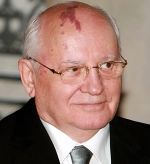
In an interview with a reporter not long ago, Mikhail Gorbachev reminisced about his years at the pinnacle of power in the Soviet Union. Once in flow, it is normally hard to stop him talking. But on this occasion he hesitated, was silent for a long time and stared at his interviewer disconcertingly with those piercing eyes. “You know, I could still be there now, in the Kremlin,” he said. “If I was motivated solely by personal power I might still be possessing it… If I had simply done nothing, changed almost nothing in the Soviet Union as it then was, just sat there and carried on like those before, who knows…” Then he laughed. If he felt bitterness, he hid it well. Part of this was the usual self-delusion of retired, defeated or ousted leaders. But Gorbachev has a more profound point, especially relevant this year—the 20th anniversary of 1989, the beginning of the end of his rule. Even with hindsight, it does not seem inevitable that the Soviet empire—that vast monolith that two generations in the west were brought up to fear—would disappear overnight. Analysts thought the USSR could limp on for decades trying and failing to reform communism: Upper Volta with nukes, but a serious power.
more from Victor Sebestyen at Prospect Magazine here.

The famous man looked at the wooden lectern. On May 7, 2005, the horror author Stephen King gave the commencement address to graduates at the University of Maine, his home state. In it, he half-joked: “If I show up at your house in ten years from now … and find nothing on your bedroom night table but the newest Dan Brown novel … I’ll chase you to the end of your driveway, screaming, ‘Where are your books? Why are you living on the intellectual equivalent of Kraft Macaroni & Cheese?’ ” An interesting analogy from a writer who endured a long critical ice age, during which his own books would sell by the million but pass unnoticed in the posh papers’ book sections. In 1982, in an afterword to the anthology Different Seasons, King referred to his own work as “the literary equivalent of a Big Mac and large fries”, which makes this a unique case of the burger calling the macaroni cheese junk.
more from Andrew Collins at the London Times here.
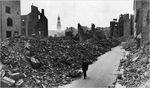
We have rarely felt sorry for what the Germans suffered at the end of World War II, in part because the Germans have done a superb job of feeling sorry for themselves. Most Germans in 1945 (and long afterward) believed that their own suffering freed them from any obligation to ponder what Germans had done unto others. Historians, therefore, have hesitated to exploit this material, for fear of seeming to endorse the repellent spectacle of German self-pity. The distinguished British historian Richard Bessel, however, understands the difference between suffering and atonement, and with “Germany 1945” he has produced a sober yet powerful account of the terrible year he calls the “hinge” of the 20th century in Europe. The decisive blow came in January, when a Red Army invasion force, nearly four million strong, poured into eastern provinces that would soon cease forever to be German. (The Anglo-American invasion from the west paled by comparison.) They killed with dreadful efficiency. German military deaths that month exceeded the total wartime losses of either the United States or Britain. Millions of civilians fled in terror from what they had long been told were savage Slavic hordes. Hitler’s government, deep in denial, did little to ease the refugees’ distress. Nor did it permit the orderly surrender of lost territories. While some soldiers and civilians enthusiastically embraced orders to fight to the death, the rest were kept in line by roving SS death squads that hanged deserters from lampposts. But the formidable Wehrmacht was hopelessly outnumbered and outgunned.
more from Brian Ladd at the NYT here.
Milk
I flew into New York
and the season
changed
a giant burr
something hot was moving
through the City
that I knew
so well. On the
plane though it was
white and stormy
faceless
I saw the sun
& remembered the warning
in the kitchen
of all places
in which I was
informed my wax
would melt
no one had gone high
around me,
where’s the fear
I asked the
Sun. The birds
are out there
in their scattered
cheep. The people
in New York
like a tiny chain
gang are connected
in their
knowing
and their saving
one another. The
morning trucks
growl. Oh
save me from
knowing myself
if inside
I only melt.
by Eileen Myles
from Jacket Magazine; #37, 2009
From The New York Times:
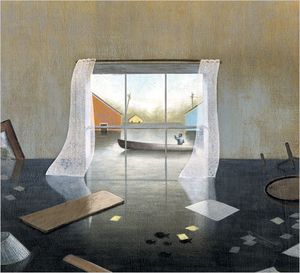 Imagine Charles Dickens, his sentimentality in check but his journalistic eyes wide open, roaming New Orleans after it was buried by Hurricane Katrina. He would find anger and pathos. A dark fable, perhaps. His villains would be evil and incompetent, even without Heckuva-Job-Brownie. In the end, though, he would not be able to constrain himself; his outrage might overwhelm the tale. In “Zeitoun,” what Dave Eggers has found in the Katrina mud is the full-fleshed story of a single family, and in telling that story he hits larger targets with more punch than those who have already attacked the thematic and historic giants of this disaster. It’s the stuff of great narrative nonfiction.
Eggers, the boy wonder of good intentions, has given us 21st-century Dickensian storytelling — which is to say, a character-driven potboiler with a point. But here’s the real trick: He does it without any writerly triple-lutzes or winks of postmodern irony. There are no rants against President Bush, no cheap shots at the authorities who let this city drown. He does it the old-fashioned way: with show-not-tell prose, in the most restrained of voices.
More here.
From Nature:
 A new approach for identifying drugs that specifically attack cancer stem cells, the cellular culprits that are thought to start and maintain tumour growth, could change the way that drug companies and scientists search for therapies in the war against cancer. “We now have a systematic method that had not been previously known that allows us to find agents that target cancer stem cells,” says Piyush Gupta of the Massachusetts Institute of Technology and the Broad Institute in Cambridge, Massachusetts, and first author of the study, published online today in Cell.
Applying the technique, Gupta and his colleagues discovered one of the first compounds that can selectively destroy cancer stem cells. The drug, an antibiotic commonly fed to pigs and chickens, reduces the proportion of breast cancer stem cells by more than 100-fold compared with a drug widely used in chemotherapy for breast cancer.
More here.
Friday, August 14, 2009

Khieu Samphan and Jacques Vergès, two old men with thin-rimmed glasses and thickened waists, were sitting on a floor mat, shoeless, having tea. It was late August 2006, in a room at the Renakse hotel, a converted colonial mansion in central Phnom Penh. Khieu, the former president of Cambodia under the Khmer Rouge and a Pol Pot loyalist to the end, was still free. But he was growing nervous as a UN-backed tribunal was ramping up its efforts to indict the few surviving Khmer Rouge leaders for war crimes and crimes against humanity. So he had called on his old friend Vergès, defender of terrorists and tyrants. Khieu wore brown polyester pants, Vergès a beige linen suit. They called each other “Maître” and “Président” and reminisced about the time when they had no titles – their student days in Paris in the 1950s. And they strategised. Vergès’ first move was to present Khieu as neither a monster nor an ideologue but a reasonable man and a patriot. Vergès had already argued, in a preface to Khieu’s 2004 memoir The History of Cambodia and the Positions I Took, that while Khieu was Cambodia’s president under the Khmer Rouge, he was only their “fellow traveller”. It was true, according to most accounts, that Khieu, a well-respected populist economist and member of Cambodia’s parliament in the early 1960s, had only joined Pol Pot’s group after he was forced to flee to the jungle to avoid being assassinated by the regime. But Vergès was going further.
more from Stéphanie Giry at The National here.
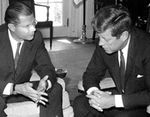
Washington in the early days of a new administration is a didactic, lesson-drawing place, but even so, it has been striking to see how quickly the commentary on the death of Robert McNamara, defense secretary in the Kennedy and Johnson administrations and architect of the Vietnam war, has turned to abstraction–as if it was not one exceptionally smart man being buried, but a certain kind of smarts itself. “What happened … to Robert McNamara teaches a lesson to all those who talk of governments of all the talents,” editorialized The Times of London. “Vietnam shattered the rationalist’s faith,” concluded David Ignatius in The Washington Post. This theme looked particularly ripe for exploration because the Obama administration seems to echo the old Kennedy sensibility–ambitious, technocratic, self-consciously modern. McNamara, wrote Bret Stephens in The Wall Street Journal , “will go down as a cautionary tale for the ages, and perhaps none more than for the Age of Obama. … These are people deeply impressed by their own smarts, the ones for whom the phrase ‘the best and the brightest’ has been scrubbed of its intended irony.”
more from Benjamin Wallace-Wells at TNR here.
Mr. Swansburg, Ms. Turner, What dreadful things does it say about me that my favorite character in Mad Men is Roger Sterling, the gluttonous, lecherous, over-entitled, walking-heart-attack philosopher-hedonist whose name, as he is wont to observe, is “on the building”? In a show packed with ids in skinny ties, Roger manages both to take the antics up a notch (I’m looking at you, Cartwright double-sided aluminum twins) and to rhapsodize about those antics—and articulate his angst—more poetically than any other character. I mean: “One minute you’re drinking at a bar and they come and tell you your kid’s been born. Next thing you know, they’re headed off to college.” To say nothing of: “He’s young, handsome, a Navy hero. Honestly, it shouldn’t be too difficult to convince America that Dick Nixon is a winner.”
more from Slate’s TV Club on Mad Men here.
