Catching the Wind in Rural Malawi

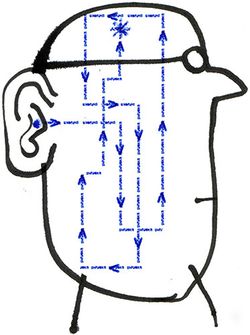
Kamkwamba_inline_diagram_640x585Maywa Montenegro in Seed:

Fourteen-year-old William Kamkwamba had never heard of windmills, or climate change, for that matter, when he stumbled across a photograph one day and it changed his life forever.

Now 22, Kamkwamba has become something of an international DIY celebrity: He’s spoken at the World Economic Forum, at the Aspen Ideas Festival, and at TED Global—twice. He’s chatted with Al Gore, Bono, and Larry Page. A documentary about his life is currently in the works. But Kamkwamba’s story isn’t really about stardom: It’s about the grit, resourcefulness, and audacity of a young engineer who built a windmill from scrap in his native Malawi and brought power to his home—and eventually lit up every house in the village. It’s told in brilliant detail in The Boy Who Harnessed the Wind, (out now from William Morris) co-authored with journalist Bryan Mealer. Seed editor Maywa Montenegro spoke with Kamkwamba while he was in New York City kicking off a US book tour.

Seed: How did you first get the idea to build a windmill?

William Kamwamba: In 2001, there was drought in Malawi so many people didn’t have enough food. Starting in November, people began starving to death. It was the same year I was supposed to start high school, but in Malawi you pay school fees. My parents couldn’t manage to pay the fees so I was forced to drop out.

In order to keep up with my friends who were going to school, I decided to start reading books at the library. When I was reading, I came across a book that had a picture of a windmill. I thought maybe if I try to build one of these machines, I will be able to pump water for irrigation and then my family would no longer have to go through this hunger problem.

From Liberalism to Social Democracy

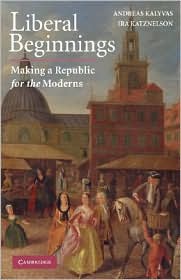
AndreasIraGeoffrey Kurtz reviews Andreas Kalyvas and Ira Katznelson's Liberal Beginnings: Making a Republic for the Moderns, in Dissent:

The central political question at stake in this book is whether the liberal tradition contains sufficient resources for its own renewal. In other words, whether the way of thinking about politics pioneered by Adam Smith, Adam Ferguson, Thomas Paine, James Madison, Germaine de Staël, and Benjamin Constant offers the ideas the democratic left needs if it is to rethink its work today. The authors think it does. But in explaining their reasons, they also give us reason to think that it might not.

Kalyvas and Katznelson present a new framework for thinking about the relationship between the liberal and republican traditions in political thought. Debates between liberals and those critics of liberalism who style themselves as “civic republicans” have often been organized around unnecessary dichotomies.

How can we choose between process and substance, the universal and the particular, the individual and the community? We can’t, at least not if we want to think through the demands of a politics that is simultaneously radical and democratic.

Kalyvas and Katznelson’s alternative is to understand the relationship between the two traditions historically. Liberalism, they write, developed from republicanism as a butterfly does from a chrysalis. A cohort of pivotal thinkers between 1750 and 1830 began as republicans and, in trying to construct “a republic for moderns,” ended up inventing modern liberalism and bringing about the end of republicanism as a “freestanding model.”

The Collider, the Particle and a Theory About Fate

Dennis Overbye in the New York Times:

ScreenHunter_07 Oct. 13 14.16 In December, if all goes well, protons will start smashing together in an underground racetrack outside Geneva in a search for forces and particles that reigned during the first trillionth of a second of the Big Bang.

Then it will be time to test one of the most bizarre and revolutionary theories in science. I’m not talking about extra dimensions of space-time, dark matter or even black holes that eat the Earth. No, I’m talking about the notion that the troubled collider is being sabotaged by its own future. A pair of otherwise distinguished physicists have suggested that the hypothesized Higgs boson, which physicists hope to produce with the collider, might be so abhorrent to nature that its creation would ripple backward through time and stop the collider before it could make one, like a time traveler who goes back in time to kill his grandfather.

More here.

How I learned to stop worrying and live with the bomb

Michael Lind in Salon:

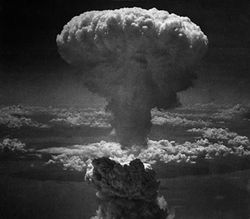
Bomb President Obama's Nobel Peace Prize has been justified by some because it draws attention to the goal he endorses of ridding the world of nuclear weapons. I share that goal, but not because nuclear weapons are uniquely horrible — if you're a victim, it makes little difference whether you're killed or maimed by nuclear weapons or conventional weapons, which sometimes can create lingering illnesses and poison the landscape, too. I support the abolition of nuclear weapons because, if it were successful, it would lock in the advantages of the small number of great powers like the U.S. that are capable of building and maintaining first-class conventional militaries.

The goal of American liberal internationalism, since the days of Woodrow Wilson and Franklin Roosevelt, has been what Wilson called “a community of power” — a great power concert whose members collaborate to keep the peace. This is different from the conservative vision of unilateral U.S. hegemony. But whether you think the law should be enforced by a posse or a single sheriff, you want the law officers to be better armed than the law-breakers.

More here.

In Mammals, a Complex Journey to the Middle Ear

Natalie Angier in The New York Times:

Ang Imagine what a dinner conversation would be like if you had decent table manners, but the ears of a lizard. Not only would you have to stop eating whenever you wanted to speak, but, because parts of your ears are now attached to your jaw, you’d have to stop eating whenever you wanted to hear anybody else, as well. With no fork action on your end, your waiter would soon conclude that you were obviously “done working on that” and would whisk your unbreached baked ziti away.

Sometimes it’s the little things in life that make all the difference — in this case, the three littlest bones of the human body. Tucked in our auditory canal, just on the inner side of the eardrum, are the musically named malleus, incus and stapes, each minibone, each ossicle, about the size of a small freshwater pearl and jointly the basis of one of evolution’s greatest inventions, the mammalian middle ear. The middle ear gives us our sound bite, our capacity to masticate without being forced to turn a momentarily deaf ear to the world, as most other vertebrates are. Who can say whether we humans would have become so voraciously verbal if not for the practice our ancestors had of jawboning around the wildebeest spit.

More here.

Subject: Our Marketing Plan

Ellis Weiner in The New Yorker:

ScreenHunter_06 Oct. 13 11.31 Hi, Ellis—

Let me introduce myself. My name is Gineen Klein, and I’ve been brought on as an intern to replace the promotion department here at Propensity Books. First, let me say that I absolutely love “Clancy the Doofus Beagle: A Love Story” and have some excellent ideas for promotion.

To start: Do you blog? If not, get in touch with Kris and Christopher from our online department, although at this point I think only Christopher is left. I’ll be out of the office from tomorrow until Monday, but when I get back I’ll ask him if he spoke to you. We use CopyBuoy via Hoster Broaster, because it streams really easily into a Plaxo/LinkedIn yak-fest meld. When you register, click “Endless,” and under “Contacts” just list everyone you’ve ever met. It would be great if you could post at least six hundred words every day until further notice.

If you already have a blog, make sure you spray-feed your URL in niblets open-face to the skein. We like Reddit bites (they’re better than Delicious), because they max out the wiki snarls of RSS feeds, which means less jamming at the Google scaffold. Then just Digg your uploads in a viral spiral to your social networks via an FB/MS interlink torrent. You may have gotten the blast e-mail from Jason Zepp, your acquiring editor, saying that people who do this sort of thing will go to Hell, but just ignore it.

More here.

The pieces are in place, but no one wants an intifada

Tony Karon in The National:

ScreenHunter_05 Oct. 13 11.24 Mr Obama has certainly not been deterred by failure thus far. His envoy, George Mitchell, is in the region pressing the two sides to begin final-status negotiations, but there is little belief on either side that a peace agreement is possible. Israel’s foreign minister, Avigdor Lieberman, declared that any attempt to reach a final settlement for years to come is misguided and doomed to fail, and the prime minister Benjamin Netanyahu’s senior aide, Uzi Arad, has said much the same.

On the Palestinian side, the president, Mahmoud Abbas, grows ever weaker. His political demise was accelerated last week by Palestinian fury over his decision to sideline the Goldstone report into alleged war crimes during Israel’s invasion of Gaza in January. Fatah has instructed Mr Abbas to stay out of any talks with Mr Netanyahu until the Israelis commit to the settlement freeze demanded by the Obama administration. And his likely successor as the head of Fatah, the imprisoned Marwan Barghouti, says anyone who believes it possible to negotiate peace with the current Israeli government is “delusional”.

Moreover, Mr Obama could soon have more to worry about than the absence of progress. Ominous echoes are everywhere of the conditions that brought about the second Palestinian intifada in 2000, which left thousands dead and destroyed the Oslo peace process.

More here.

Monday, October 12, 2009

Sunday, October 11, 2009

Clausewitz as Educator

Photo_1225_landscape_large Willis G. Regier in The Chronicle of Higher Education:

Vegetius, a Roman writer of the fourth century AD, said, “Let him who desires peace prepare for war.” Carl von Clausewitz sharpened the point: “The fact that slaughter is a horrifying spectacle must make us take war more seriously, but not provide an excuse for gradually blunting our swords in the name of humanity. Sooner or later someone will come along with a sharp sword and hack off our arms.” Darfur has made clear that that is not just a metaphor.

Clausewitz (1780-1831) studied total war. Although he knew nothing of tanks, air forces, or satellite communications, he knew from combat how wars kill, confuse, and terrify. In war studies, expertise matters enormously; he had plenty.

At the age of 12, Clausewitz joined two brothers as cadets in the Prussian army. (Eventually all three became generals.) He fought for Prussia against Napoleon at Jena, was captured, taken to Paris, exchanged, and returned to duty. When Prussia was intimidated into joining Napoleon for his disastrous 1812 campaign, Clausewitz resigned his commission and fought for the czar. In 1815, again with the Prussian army, he fought at Ligny. In 1818 he became director of the Military Academy in Berlin, where he devoted the last 15 years of his life to scholarship. His major work, On War (three volumes of Vom Kriege were published, from 1832 to 1843), was left unfinished at his death.

On War has become something of a classic, often cited, discussed in numerous recent books, seen in the company of Sun Tzu’s Art of War (thought to be circa fourth century BC), and studied in military academies. On War appeals to anyone who wants to see how a general thinks, and to all who suppose that warcraft applies to an office, company, college, or team. Clausewitz himself compared war with commerce and alliances with “a business deal.”

Sunday Poem

Nurse.........................
Veronica’s face is not like the face on the veil.
It has seen much suffering but it does not wear

last judgment or a crown of thorns. I have seen blood

on her uniform (which happens to be violet today
……………………..

but is often white), sometimes fresh splashes of it

leaked from an IV or, barely visible, dry specks.
…………………….

I have observed firsthand her unflinching kindness,

and I have thanked any and all the gods for her,
…………………….

and I have wondered at her ability to bear

so many crucifixions all at once.

Susan Kelly-DeWitt

Photoquai 2009

From Lensculture.com:

Photoquai_2009_10 Photoquai, the biennial festival of photography based in Paris, was founded in 2007. Dedicated to non-western photography, the festival aims to to raise the international profile of artists previously unexhibited or little-known in Europe. It also aims to foster cultural exchange — and the vibrant interchange of different world views.

This year, the Guest of Honor at Photoquai is Iran. The festival has been directed by Anahita Ghabaian Etehadieh, an Iranian gallerist and founder of the Silk Road Gallery in Tehran, a space specifically dedicated to photography.

Etehadieh has organised an intriguing exhibition, focusing on the themes of politics, society and poetry, and featuring the work of 50 contemporary photographers from around the world.

More here.

Evolution All Around

Nicholas Wade in The New York Times:

THE GREATEST SHOW ON EARTH The Evidence for Evolution

By Richard Dawkins

Wade-600 Dawkins invites the reader to share the frustration of an imaginary history teacher, some of whose students refuse to accept that the Roman Empire ever existed, or that Latin is the mother tongue from which the Romance languages evolved. Instead of concentrating on how Western culture emerged from the institutions of the Roman state, the teacher must spend time combating a school board that insists he give equal time to their alternative view that French has been spoken from time immemorial and that Caesar never came or saw or conquered. This is exactly analogous to the plight of the biology teacher trying to acquaint students with the richness of modern biology in states where fundamentalist opponents of evolution hold sway.

Dawkins has a nice sense of irony, deployed without mercy on the opponents of evolution. If the creationists think the earth is less than 10,000 years old, rather than 4.6 billion, he asks, shouldn’t they assume, by the same measure, that North America is less than 10 yards wide? The book is even more enjoyable when Dawkins forgets the creationists and launches into evolutionary explanations, whether of the hippopotamus’s long-lost cousin the whale, or of the long-tongued moth that Darwin predicted must exist to pollinate a Madagascan orchid with a nectary 11 inches in length. He gives striking examples of “unintelligent design,” forced on evolution because it cannot ever start from scratch but must develop new structures from older ones.

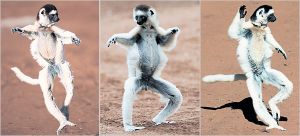
Picture: The dancing sifaka lemur of Madagascar, which Richard Dawkins calls “possibly my favorite species in all the world.”

More here.

Abstraction has its place in science as it does in art

Roald Hoffmann in American Scientist:

ScreenHunter_02 Oct. 11 10.30 Although abstract art has been with us for only about 100 years, sometimes it seems that there are more abstract-art movements than there are scientific “-ologies.” The list begins with cubism, and will not end with postmodern painting. Recognizing that there are degrees of the abstract, my perception of the essence of this artistic direction involves several factors.

First of all, abstraction is oppositional, wanting to be seen as alternative to such ideals as naturalistic representation and the figurative. I will not say “alternative to reality,” for (to paraphrase Magritte) the two-dimensional surface of the most photorealist painting still is not its subject. Not unexpectedly, much theory of the abstract disclaims a definition by opposition. Art desires a broader conception of what stirs the imagination…

To be abstract, chemistry might thus have to be oppositional. But opposed to what?

More here.

Americana That Barack Obama Has Made Un-American

John Cook at Gawker:

It's been getting kind of confusing keeping track of what's truly American anymore, so we came up with a handy list of things that are socialist and foreign because Barack Obama has soiled them, by doing them.

Winning the Nobel Peace Prize
Used to be a win for America back when Henry Kissinger won it. Now it's a sign of a “weakened, neutered U.S.,” unless John McCain had won it, which he should have, in which case it would have been awesome.

Puppies
Bo is a ringer, a fake rescue dog who was personally raised by Ted Kennedy for the Obamas and the press won't look into it because they're too busy writing about how cute he is. And he's Portuguese!

Classrooms
That's where kids get indoctrinated. Keep them away.

Community Organizing
What sort of person helps other people?

More here.

Social Science for Public Knowledge

Craig Calhoun in Transformations of the Public Sphere:

Cc Public engagement was a strong feature of the social sciences from their birth. Could one imagine Hobbes, Locke or the Scottish moralists as mere academics? Weber, Durkheim, and the great Chicago School sociologists had university jobs but both public concerns and public audiences. Social scientists today contribute to public understanding of issues from social inequality to transformations of the family. They also inform public policy on problems from educational reform to economic productivity. But since World War II, dramatic growth in universities and research institutions not only created opportunities for social scientists, it contained much of their communication inside the academy. An ideology that opposed academic professionalism to public engagement and a prestige hierarchy that favored allegedly pure science over applied added to the tendency.[1]

Today there are widespread calls for more public social science. Academics have recognized the problems that come from being too much cut off from public discussion. But two questions arise. First, what is the relationship between effective participation in public discourse and the maintenance of more or less autonomous academic fields with their own standards of judgment and intellectual agendas? Second, what is the relationship between “public intellectual” work, informing broad discussions among citizens, and “policy intellectual” work informing business or government decision makers?

More here.