Desperately Seeking Sam

Boylan_34.6_beckett Roger Boylan in Boston Review:

I could not have gone through the awful wretched mess of life without having left a stain upon the silence. –Samuel Beckett

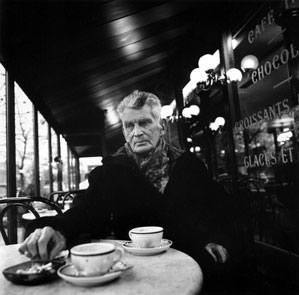
The first and last time I saw Samuel Beckett, he was walking down a Paris street, the Rue Rémy Dumoncel. At least, I think it was Beckett. The height was right; the near-skeletal thinness was right; the location was right—near the nursing home where he died not long after. I think he was wearing a hat and coat, but I can’t be sure. It was twenty years ago.

Seen always from behind whithersoever he went. Same hat and coat as of old when he walked the roads. –Beckett, Stirrings Still

But I never got close enough to be certain. I was across the street, behind a row of parked cars, admiring, if memory serves, a silver Porsche. Unusually for July in Paris, it was a gray, drizzly day, what Parisians call “la grisaille,” and it was a bit misty, as if in November. Despite all that, I could easily have crossed over and asked my suspect if he was, in fact, the One True Sam. But I didn’t. I funked it. He disappeared. Six months later he was dead. And I had wanted to meet him for years.

I first learned of his work from Mr. Achkar, my French teacher in high school in Geneva, who was most enthusiastic about Oh les Beaux Jours (Happy Days), of which he’d seen the Paris premiere in 1961.

“What a play!” he enthused.

A woman sinks slowly into the earth while reciting the inanities of her everyday life … c’est magnifique! Does anyone understand as well as Beckett does the banality of tragedy and the tragedy of banality? This woman, she could be my wife: the eternal optimist despite all the evidence. Non, mais non, c’est magnifique.

There were the other plays, notably Waiting for Godot, that incomparable hymn to the vital nothingness of life (the play in which, in the words of the Irish critic Vivian Mercier, “nothing happens, twice”); Krapp’s Last Tape, Beckett’s melancholy homage to memory and failure; Rockaby, the tender death-lullaby; and the great Fin de Partie (Endgame), Mr. Achkar’s favorite—and mine.


If you want to make God laugh, tell him about your plans

Aquinas

PLANNING IS SOMETHING that people learned from God. The lesson might be said to have begun with the prescriptions God laid out for His earthly habitation among the Israelites: the Tabernacle that housed Him in the desert, and then the Temple that was His residence in Jerusalem. The dimensions of these structures were dictated by a divine blueprint. The Temple gave birth to a city, and from it emerged a civilization. We are descendants of this tradition, irrespective of such trivialities as whether one identifies as a “believer.” Its most obvious inheritors are those who shout of “God’s plan for you” from street corners and write “purpose-driven” books, people for whom the blueprint—and our basic need to follow it—is a raft in the ocean of time. But this tradition also finds resonance in something as ordinary as the practical virtue of prudence: the present’s responsible response to the uncertainties of the future, which Thomas Aquinas considered the highest of the cardinal virtues.

more from Nathan Schneider at Triple Canopy here.

Buy yourself a sequencer and let the games begin!

100111_r19200_p233

There is a recurring aversion on the part of American labels to foreign singers, and it sometimes amounts to a mutual distrust. Kylie Minogue, the tiny Australian who has annexed most of Europe, has had only three hits here. Girls Aloud, the devilishly clever flagship act of the producer Brian Higgins and his Xenomania production team, generally doesn’t release records outside Britain. For many such acts, the American mountain can sometimes appear like too much bother, since even superstars can’t gain purchase. But given the retro-eighties feel and Euro-friendly nature of the year’s biggest female star, Lady Gaga, why not admit an actual European, who is even more fond of the eighties, into the game? Anne Lilia Berge Strand, a Berlin-based Norwegian singer-songwriter known as Annie, has no American label behind her. Her second album, “Don’t Stop,” a brash, bright, and easily absorbed pop effort, was completed in 2008 but is only now being released, jointly, by Annie’s Totally Records and an independent label in Norway called Smalltown Supersound. (After working on an earlier version, Annie was dropped by Island in Europe.)

more from Sasha Frere-Jones at The New Yorker here.

A Scientist’s Infectious Enthusiasm

From Science:

Benjamin_tenOever_200x250 In late 2007, during the early months of his faculty position at Mount Sinai School of Medicine in New York City, Benjamin tenOever faced a wrinkle in his research plans. Experienced in looking at how cells respond to viruses, he'd set his sights on microRNA and how these small molecular segments that tweak protein expression might help cells fight off infection. After months of work, the project looked like it might be a dead end: They had found that microRNAs are produced as a virus infects a cell, but those sequences didn't make a difference in how a cell responded to its invader.

With the dilemma percolating in the back of his mind, tenOever had a eureka moment while shopping with his wife along Lexington Avenue in Manhattan: “Every cell has a pool of microRNAs, even if they didn't target the viruses,” he explains. So, he wondered, what if he flipped the idea around and engineered viruses that bound to the existing cellular microRNAs? Instead of trying to harness a cell's microRNAs to fight infection, he would be creating tools to tweak the immune response of an altered vaccine. The strategy could provide a stealth way to build attenuated viruses for producing vaccines. Since then, he and his colleagues have modified the sequences of influenza viruses to bind to a natural microRNA expressed in humans and mice, in essence developing a virus that's knocked down by the body's natural microRNA. What's more, the microRNA they chose is not expressed in chickens; therefore, the modified virus reproduces well in chicken eggs, potentially solving a common flu vaccine-production problem. They reported the work in the June issue of Nature Biotechnology.

More here.

Where Did the Time Go? Do Not Ask the Brain

Benedict Carey in The New York Times:

Time That most alarming New Year’s morning question — “Uh-oh, what did I do last night?” — can seem benign compared with those that may come later, like “Uh, what exactly did I do with the last year?” Or, “Hold on — did a decade just go by?” It did. Somewhere between trigonometry and colonoscopy, someone must have hit the fast-forward button. Time may march, or ebb, or sift, or creep, but in early January it feels as if it has bolted like an angry dinner guest, leaving conversations unfinished, relationships still stuck, bad habits unbroken, goals unachieved. “I think for many people, we think about our goals, and if nothing much has happened with those then suddenly it seems like it was just yesterday that we set them,” said Gal Zauberman, an associate professor of marketing at the Wharton School of Business.

Yet the sensation of passing time can be very different, Dr. Zauberman said, “depending on what you think about, and how.” In fact, scientists are not sure how the brain tracks time. One theory holds that it has a cluster of cells specialized to count off intervals of time; another that a wide array of neural processes act as an internal clock. Either way, studies find, this biological pacemaker has a poor grasp of longer intervals. Time does seem to slow to a trickle during an empty afternoon and race when the brain is engrossed in challenging work. Stimulants, including caffeine, tend to make people feel as if time is passing faster; complex jobs, like doing taxes, can seem to drag on longer than they actually do. And emotional events — a breakup, a promotion, a transformative trip abroad — tend to be perceived as more recent than they actually are, by months or even years. In short, some psychologists say, the findings support the philosopher Martin Heidegger’s observation that time “persists merely as a consequence of the events taking place in it.”

More here.

Drone attacks in Pakistan: Challenging some fabrications

Farhat Taj in the Daily Times:

ScreenHunter_01 Jan. 05 09.53 There is a deep abyss between the perceptions of the people of Waziristan, the most drone-hit area and the wider Pakistani society on the other side of the River Indus. For the latter, the US drone attacks on Waziristan are a violation of Pakistani’s sovereignty. Politicians, religious leaders, media analysts and anchorpersons express sensational clamour over the supposed ‘civilian casualties’ in the drone attacks. I have been discussing the issue of drone attacks with hundreds of people of Waziristan. They see the US drone attacks as their liberators from the clutches of the terrorists into which, they say, their state has wilfully thrown them. The purpose of today’s column is, one, to challenge the Pakistani and US media reports about the civilian casualties in the drone attacks and, two, to express the view of the people of Waziristan, who are equally terrified by the Taliban and the intelligence agencies of Pakistan. I personally met these people in the Pakhtunkhwa province, where they live as internally displaced persons (IDPs), and in the Federally Administered Tribal Areas (FATA).

More here. [Thanks to David Schneider.]

James Cameron’s Avatar

Our own Morgan Meis in The Smart Set:

Morgan Vampire In retrospect, it was fitting that I saw James Cameron's new film Avatar at an IMAX 3-D theater in Las Vegas. Las Vegas is not a place for those with any nostalgia for simpler times. In Vegas, reality is something to be fabricated, played with, and reproduced in as many ridiculous ways as someone is willing to pay for. Robert Venturi, the architect who penned the famous postmodern manifesto Learning from Las Vegas, was never a fan of Minimalism or austerity. In response to Mies van der Rohe's architectural dictum “less is more,” Venturi quipped that “less is a bore.”

Likewise, Cameron has never been a prophet of restraint. From Terminator to Titanic, he likes things big, expensive, messy, and new. It was, thus, fully expected when Cameron told Dana Goodyear of The New Yorker that Avatar is, “the most complicated stuff anyone’s ever done.” Cameron's goal, in short, is to completely revolutionize cinema. He also thinks of cinema as largely a visceral and visual thing. Emotional complexity is not his strong suit. He wants people to see something new, like when they first discovered the moving image.

More here.

Monday, January 4, 2010

Sunday, January 3, 2009

Stephen Toulmin, 1922-2009

ToulminI appear to have missed this death a month ago. In the NYT:

Stephen Toulmin, an influential philosopher who conducted wide-ranging inquiries into ethics, science and moral reasoning and developed a new approach to analyzing arguments known as the Toulmin model of argumentation, died on Dec. 4 in Los Angeles. He was 87.

The cause was heart failure, said his son Greg.

Mr. Toulmin, a disciple of Ludwig Wittgenstein, earned his undergraduate degree in mathematics and physics, and throughout his long philosophical career showed a marked inclination to ground his ideas in real-world situations.

In the introduction to a 1986 edition of his first book, “An Examination of the Place of Reason in Ethics” (1950), he wrote that “having been trained as a natural scientist, I had always hoped to relate philosophical issues to practical experience, and could never wholly side with Hume the philosopher against Hume the backgammon player.” His bent, he wrote, was toward “practical moral reasoning.”

Although he wrote on disparate topics like the history of science, international relations, medical ethics and Wittgenstein’s Vienna, he was best known for “The Uses of Argument,” published in 1958. In it, he criticized formal logic as an overly abstract, inadequate representation of how human beings actually argue. He also challenged its claims to universality, as well as its faith in absolute truth and moral certainty.

Still terminally ill: Outdated materials and obsolete techniques characterise Pakistan’s school system

Zakia Sarwar in Himal Southasian:

MichaelBlue In accordance with a traditional understanding that continues to be widely followed in our region by many educationists, the process of learning in Southasia today is still largely by rote. As such, there is little or no understanding on the part of most students of what exactly they are studying, nor why. It is critical to realise, however, that education in the 21st century is far more demanding and competitive than it was in the past, due to the vast and growing knowledge base, developments in technology and an increasingly globalised perspective. It is imperative, then, to make students into active rather than passive learners to deal with this changing context – but this is a lesson that many in Southasia, and particularly in Pakistan, have yet to appreciate.

Around the world, the idea of ‘quality’ education has itself been forced to evolve in recent years, in three particular ways. First, in terms of the education process itself, students must be taught how to relate their learning to their day-to-day lives, with a focus on how to learn rather than depending solely on teachers and textbooks. Second, the goal of quality education has also changed, with an eye to enabling students to perform well academically and socially, and to become thinking, caring and tolerant global citizens. The third aspect is facilitating learners not only to perform well academically, but also to groom them to think for themselves. In short, we hope that they will be adaptive, mature and tolerant; and to respect ideological, cultural and religious diversity. Indeed, such skills – quite removed from the central tenets of the traditional curricula in this region’s countries – have become important for a student’s very survival in the globalised world. Quality education assumes the pivotal role of trained teachers who have a solid knowledge base, and have control over what to teach and how to teach it. The teachers themselves, therefore, need to be allowed to develop the expertise and self-confidence to show students the path to independent thinking and learning – and without feeling threatened themselves.

More here.

What a Colored Square Taught Me About Defeating Fear

From Scientific American:

Fear-conditioning-memory-extinction-therapy_1 Every time that a colored square appeared on the monitor in front of me, I braced for pain. Early into the 10-minute session as a subject of this experiment, I learned that about half of the times that I saw that square, I received a low-voltage shock, via a bar strapped to my right wrist. I also learned that every time I saw a square of a different, “good” color, I could momentarily breathe easy. But in the second day's session, as I watched the squares appear in random order, no shocks punctuated either the “bad” or “good” colors. After several minutes I started to relax.

The researcher conducting this fear conditioning experiment at New York University's Department of Psychology, David Bosch, was monitoring my fear responses. Changes in how much I was sweating, which he gauged by measuring the electrical conductance of the skin on my left middle finger, indicated my fear level. On the first day I was conditioned, like Pavlov's dog, to sweat at the sight of the “bad” color. But that response faded over the course of the second, shock-free session as my fear was “extinguished,” a process known as extinction. As Bosch explains, “extinction is learning a new contingency.”

More here.

Saturday, January 2, 2009

Confessions of a Jane Austen-Spinoff Addict

091209_XX_janeAustenASara Dabney Tisdale in doubleX:

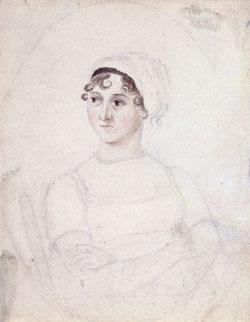
Will the real Jane Austen fans please stand up? Stand up, that is, if you love Jane Austen but are sick and tired of Jane Austen spinoffs. Stand up if you thought Pride and Prejudice and Zombies, a mash-up of Austen’s Pride and Prejudice with “all-new scenes of bone-crunching zombie action,” was a terrible idea. If you cringe in horror every time you see sexed-up paperback titles like Mr. Knightley’s Diary on Austen-themed display tables at your local bookstore. If you are fed up with Austen-mania—the fan fiction, the movies and miniseries, the romance advice books and etiquette guides and detective novels and vampire riffs and cookbooks and choose-your-own-adventures. If you, like me, are a real Jane Austen fan, and you don’t think Sense and Sensibility and Sea Monsters is funny—you think it’s a crime.

Dear reader, there is hope, and it comes in the form of Susannah Carson’s new book, A Truth Universally Acknowledged: 33 Great Writers on Why We Read Jane Austen. Carson, a doctoral candidate at Yale University, has culled a collection of essays by literary greats such as E.M. Forster, Virginia Woolf, C.S. Lewis, Kingsley Amis, Eudora Welty, and Lionel Trilling, all on the subject of why Jane Austen is not only worth reading but worth reading over and over again. The book is a refreshing triumph over the muck of Jane Austen spinoffs that blight our current culture.

Or is it? After all, every fan of Jane Austen fan thinks she is a real fan of Jane Austen – that her understanding of and empathy with Austen surpasses that of other readers, that she and she alone fully appreciates and savors Austen’s merits.

The Best Fiction of the Millennium (So Far)

In The Millions (I'm partial to number 2 on the list):

[W]e’ve conducted a poll of our regular contributors and 48 of our favorite writers, editors, and critics (listed below), asking a single question: “What are the best books of fiction of the millennium, so far?” The results were robust, diverse, and surprising.

…The List

#20: Gilead by Marilynne Robinson
#19: American Genius, A Comedy by Lynne Tillman
#18: Stranger Things Happen by Kelly Link
#17: The Fortress of Solitude by Jonathan Lethem
#16: Middlesex by Jeffrey Eugenides
#15: Varieties of Disturbance by Lydia Davis
#14: Atonement by Ian McEwan
#13: Mortals by Norman Rush
#12: Twilight of the Superheroes by Deborah Eisenberg
#11: The Brief, Wondrous Life of Oscar Wao by Junot Díaz
#10: Never Let Me Go by Kazuo Ishiguro

The Kids Are Alright

Irankids377

Evidence already suggests that the contemporary student movement in Iran is prepared to make full use of its political potential. Within the first week of its opening in late September, the Islamic Students Association of Amir Kabir University posted a statement on their website condemning post-election attacks on university residences and declaring that “the will for change is now epidemic and students… are full of passion and hope.” Then, on September 28th, Radio Zamaaneh, a Persian language radio station based in Holland, reported that more than a thousand students at the University of Tehran protested the presence of Minister of Science Kamran Daneshjoo at the university’s opening ceremonies. Several weeks later, the opposition website Mowj camp posted a video that showed a speech given by Ahmadinejad’s former minister of Culture and Islamic Guidance during which he was interrupted by students shouting pro-opposition slogans (the Minister was also pelted with a shoe). Opposition leader Mir Hossein Mousavi’s Facebook page also displayed videos of over two thousand students at Azad University as they staged a demonstration against Ahmadinejad’s coup d’etat as well as the brutal reprisal against student activists by the Basij militia in the post-election crackdown.

more from Sara Irani at Guernica here.

dear Mr. Gorbachev

Mikhail-Gorbachev

In entries like these Borokowski’s ironic humor almost seems to fail him as he confronts phenomena in and outside him that he is unable to make sense of, though the author usually regains his casual humor: The thing is, Mr. Gorbachev –this is what the lady at the garden store told me—YOU’RE NOT ALLOWED TO PLANT TREES IN THE FOREST. Other kinds of glimpses into the blogger’s interests and perceptions are also afforded, such as his vision of poetry (which he considers the heart of his own writing). In another entry he provides humorous insight into his approach and attitudes towards the genre: This evening, Mr. Gorbachev, I’d like to share with you some of my ideas about poetry, though I greatly fear you will find everything I have to say about this strange, outdated genre ridiculous. In truth poetry isn’t one thing and it isn’t another. Take the French. For Rimbaud it was an obsession and an insanity—he said poetry was destroying him and we must believe him. Baudelaire spent a lot of time with prostitutes. Verlaine spent a lot of time in prison, as did Jean Genet. Genet also masturbated a lot and his mentor Sartre posited that poetry was closely related to this most shameful act. I would rather not get into your Russians—suffice it to say that they were a kind of suicide circus, so that when they weren’t writing poetry they were thinking of ways to kill themselves, and in fact often combined these activities by writing poems about the different ways of killing themselves. . . . As far as way over there on the other side—let’s just leave it at that Jack Henry Abbot was a homicidal maniac.

more from Chris Michalski at The Quarterly Conversation here.