Brain surgery boosts spirituality

From Nature:

News.2010 Removing part of the brain can induce inner peace, according to researchers from Italy. Their study provides the strongest evidence to date that spiritual thinking arises in, or is limited by, specific brain areas. To investigate the neural basis of spirituality, Cosimo Urgesi, a cognitive neuroscientist at the University of Udine, and his colleagues turned to people with brain tumours to assess the feeling before and after surgery. Three to seven days after the removal of tumours from the posterior part of the brain, in the parietal cortex, patients reported feeling a greater sense of self-transcendence. This was not the case for patients with tumours removed from the frontal regions of the brain. “Self-transcendence used to be considered just by philosophers and crank new age people,” says co-author Salvatore Aglioti, a cognitive neuroscientist at the Sapienza University of Rome. “This is the first really close-up study on spirituality. We're dealing with a complex phenomenon that's close to the essence of being human.”

The authors pinpointed two parts of the brain that, when damaged, led to increases in spirituality: the left inferior parietal lobe and the right angular gyrus. These areas at the back of the brain are involved in how we perceive our bodies in spatial relation to the external world. The authors of the study in the journal Neuron, say that their findings support the connection between mystic experiences and feeling detached from the body. “The most surprising part was the rapidity of the change,” says Urgesi. “This discovery shows that some complex personality traits are more malleable than previously thought.”

More here.
Christopher Hitchens and Claudius Galenus on Sports

Dave Zirin in The Nation:

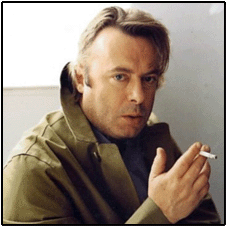
Hitchenscigarettecoat Nuance is the mortal enemy of essayist Christopher Hitchens. Whether it's his rapturous support for Bush's Iraq invasion or his best-selling dismissal (God is NOT Good) of religion, Hitchens will always eschew a surgical analysis for the rhetorical amputation. Beneath the Oxford education, he has become Thomas Friedman in an ascot, with all the subtlety of a blowtorch.

Now Hitchens has turned his attention to sports and the ensuing essay in Newsweek, called “Fool's Gold: How the Olympics and other international competitions breed conflict and bring out the worst in human nature” is everything you might fear. I'm no fan of the politics that surround the Olympic games but when Hitchens takes out his dull saw, nothing connected to sports is spared.

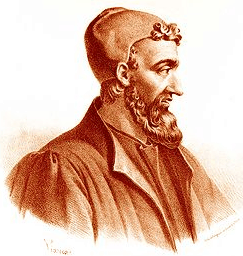
More here. In defense of Hitchens, I also present somethin written by the Roman physician Galen a couple of thousand years ago, and unearthed (for me, I mean) by Justin E. H. Smith:

ScreenHunter_05 Feb. 13 11.20 All natural blessings are either mental or physical, and there is no other category of blessing. Now it is abundantly clear to everyone that athletes have never even dreamed of mental blessings. To begin with, they are so deficient in reasoning powers that they do not even know whether they have a brain. Always gorging themselves on flesh and blood, they keep their brains soaked in so much filth that they are unable to think accurately and are as mindless as dumb animals.

Perhaps it will be claimed that athletes achieve some of the physical blessings. Will they claim the most important blessing of all: health? You will find no one in a more treacherous physical condition… Their sleep is also immoderate. When normal people have ended their work and are hungry, athletes are just getting up from their naps. In fact, their lives are like those of pigs, except that pigs do not overexert or force feed themselves…

More here.

HM Naqvi shoots cocaine, smart patois and energy into the tired 9/11 novel

Nisha Susan in Tehelka:

ScreenHunter_04 Feb. 13 10.39 One of the annoying things about contemporary South Asian writing is the lack of memorable characters. Where are the people who leap off the page and lodge themselves under your skin? Where are the characters whose names you remember? Part of the problem is the locating of narrative within a thin shell of geopolitical significance. Post 9/11, much of our literature has suffered from the ‘Angst in the Time of’ syndrome. Young Pakistani writer HM Naqvi breathes life and urgency into the tiresome subgenre with his energetic, rich turn of phrase and a memorable trio of young men in New York around 9/11.

Neither cynicism nor affectation taints his description of the loss of innocence suffered by AC, Jimbo and our hero Chuck — all Pakistanis — first generation, second generation and expatriate respectively. From the first page Naqvi plunges you into the clubs, the happy pursuit of dope, sex and glorious hangover food. Naqvi is skilled at capturing the sensory states of very young men: the ravenous hunger and enjoyment of food, the complicated lives within cliques, the still larger-thanlife presence of parents. He has a gift for painting the ‘scene’, understood in the ordinary literary sense or in the sense of revelry. With the air of a banquet he presents clubs, dinners at AC’s sister’s home as well as hospital lobbies. Largely, these spectacles grow out of his wonderful descriptions of faces and bodies.

More here.

Jews and the Burden of Money

Catherine Rampell in the New York Times Book Review:

Rampell-t_CA0-articleInline The question of why so many Jews have been so good at making money is a touchy one. For hundreds of years, it has been fraught with suspicion, denial, resentment, guilt, self-hatred and violence. No wonder Jews and gentiles alike are so uncomfortable confronting Jewish capitalistic competence. Still, in his slim essay collection “Capitalism and the Jews,” Jerry Z. Muller presents a provocative and accessible survey of how Jewish culture and historical accident ripened Jews for commercial success and why that success has earned them so much misfortune.

As Muller, a history professor at the Catholic University of America, explains it, much anti-Semitism can be attributed to a misunderstanding of basic economics. From Aristotle through the Renaissance (and then again in the 19th century, thanks to that Jew-baiting former Jew Karl Marx), thinkers believed that money should be considered sterile, a mere means of exchange incapable of producing additional value. Only labor could be truly productive, it was thought, and anyone who extracted money from money alone — that is, through interest — must surely be a parasite, or at the very least a fraud. The Bible also contended that charging interest was sinful, inspiring Dante to consign usurers to the seventh circle of hell (alongside sodomites and murderers). In other words, 500 years ago, the phrase “predatory lending” would have been considered redundant.

More here.

Friday, February 12, 2010

Love and Marriage: A Profile of Nancy and Joan

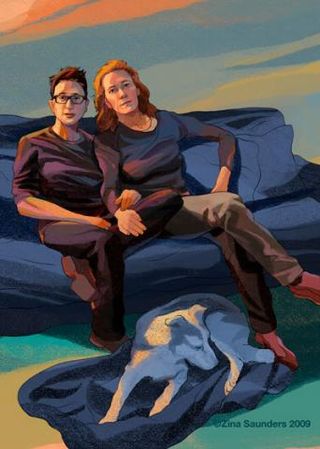
Nancy-and-Joan.previewZina Saunders interviews my friends Nancy Goldstein and Joan Hilty in RH Reality Check:

I was dismayed earlier this month when the New York State Senate voted down the gay marriage bill, and I decided to interview and paint long-standing gay couples, both men and women, and ask them about their stories and their relationships and what marriage means to them. This is the first of the series.

On a recent rainy afternoon in Brooklyn, I sat down to talk with writer and communications specialist Nancy Goldstein and syndicated cartoonist Joan Hilty, whose marriage in Provincetown in May of 2004 has been recognized in New York State since July of 2006. With their dog Juno trying to get in on the conversation, Nancy and Joan talked about love and marriage.

Joan: We met online in the early, early days of internet dating, in mid-1999. It was on a lesbian/gay dating website called Edwina.com. Its icon was a little guy dressed up as your “Aunt Edwina who only wants the best for you”. You could browse other people’s personals, and only get an idea of them through the quality of their writing because there were barely any pictures up yet or videos or songs or anything.

Nancy: The chick you chose me over did have a picture of herself up with a cowboy hat. But she overused the ellipsis.

Joan: Yeah, and no capitalizing, no nothing. But there was Nancy, who wrote beautifully and talked about all the great places she liked to eat in Prospect Heights, which was just a neighborhood away from me, and that one was interesting to me.

Hillary Chute on Graphic Narratives

HillaryIn the Browser:

I’ve just spoken to Tom Gauld about comics. But, whereas Tom Gauld is a cartoonist, you have been studying cartoons, or graphic novels, from a theoretical, academic point of view: a new discipline and you’re at the front of it. So where should we start?

Well, I wouldn’t call them graphic novels. I’d call them graphic narratives or comics, because all of the stuff I’m interested in is non-fiction, so ‘graphic novel’ is simply a misnomer for this kind of work. Also, it’s a publishing, marketing term and a lot of cartoonists don’t like it. It seems like a kind of shallow bid for respectability. So let’s say comics.

You’ve chosen Fun Home by Alison Bechdel to start with. What’s it about?

Alison has a strip that’s been running for a long time called Dykes to Watch Out For, but this is an autobiographical book. ‘Fun Home’ is short for the funeral home Alison’s dad ran when she was a child. It’s a book that blew me away and continues to blow me away every time I read it – and I must have read it five or six times by now: probably the best book I’ve read in the past ten years in any genre or form. It’s an incredibly crafted book in which the chapters are not chronological but thematic, and each chapter is keyed to a book that her father loved. So it’s not a book about what happened to her father, a closeted gay man who committed suicide a few months after Alison herself came out when she was 19. It’s about looking through a family archive to try and get a sense of her father’s particularity.

The Renunciation Artist: On Leo Tolstoy

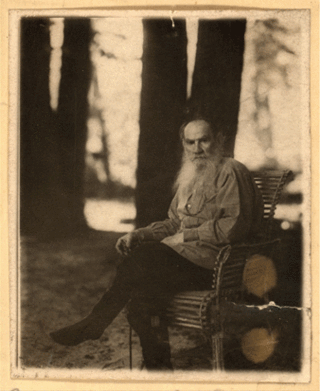
1265911167-largeWilliam Deresiewicz in The Nation:

A Russian soldier is taken prisoner by Caucasian mountaineers. They bring him to a village, where everything is strange. “And the dark one–he was brisk, lively, moving as if on springs–went straight up to Zhilin, squatted down, bared his teeth, patted him on the shoulder, started jabbering something very quickly in his own language, winked, clucked his tongue, and kept repeating: 'Kood uruss! Kood uruss!'” But slowly, the Russian starts to get through. He makes a friend of the dark one's daughter, a girl of 13, by fashioning a doll of clay. It has “a nose, arms, legs, and a Tartar shirt.” She brings him food, talks, plays with him. Later, surveying the hills in search of escape, he sees a river far below, with women on the bank, “like little dolls.”

The story, “The Prisoner of the Caucasus,” is about perspective–about physical and cultural distances and the angles of vision they enforce. Tolstoy doubles the point by trapping us, too, on foreign ground. The story's notation is rudimentary, clipped (“The nights were short. He saw light through a chink”), the diction mined with alien words (“aoul,” “saklya,” “beshmet”) we're forced to make out on the run. We stand with Zhilin; nothing is explained, because nothing is understood. But the story is also about art, its ability to bridge the crevasse of otherness. Zhilin makes dolls, and so, the simile of the women reminds us, does Tolstoy. His figures, too, have a nose, arms, legs and Tartar shirt, fashioned from the clay of words. Zhilin leaves his doll on the roof, hoping the girl will see it and understand, and so Tolstoy does with us, placing the wager of art.

“The Prisoner of the Caucasus” makes a fitting start to the present volume, though probably not for reasons its translators intended.

The Devil Wore Purdah

3808.kfwFaiza S. Khan on fashion in Pakistan in Open Magazine:

Karachi Fashion Week was held recently, showcasing the work of 32 Pakistani designers, the largest, but by no means only, event of its kind in the country. Occurring amid postponements and last minute changes of venue due to security concerns, for reasons that surely don’t require stating, it was eventually held at Karachi’s Marriott hotel, the Islamabad branch of which was brought crashing down last year, killing over 50 people. Every night for four nights, eight designers sent models down a blazing white runway in everything from shalwar kameez and gharara to skirts, jeans, shorts and, in one instance, something that looked suspiciously like my bedroom curtains, only worn with a belt, baring more or less the same amount of flesh one might expect to see at an opulent private party.

While the extent to which the exercise stimulated the economy remains to be seen, its effect on international media was instantaneous, with the event resulting in writers going head to head to claim the journalistic equivalent of the Golden Raspberry Award. It was with some bewilderment that one read in the papers the next day of the display of a bare back and some thigh hailed as “snubbing the Taliban”, regardless of the fact that it was done in a private, carefully contained environment filled with people who were not remotely like the Taliban, i.e. socialites, designers, buyers and the inevitable twerp in gigantic sunglasses in the dead of night. There was the de rigueur cliché of how daring it was to see skimpily dressed models in a society where women generally cover up, entirely omitting to mention that distinctions exist between those people who cover up and those who don’t, and fashion models fall quite clearly into the latter category. One scribe wrote of how heroic it was to show exposed navels while war is simultaneously waged in Waziristan, as if these two are somehow connected, as if, perhaps, the navels were being bared in Waziristan or that the war would be won should the military choose to spend its budget on tank-tops rather than tanks.

The civil war through slaves’ eyes: An interview with Andrew Ward

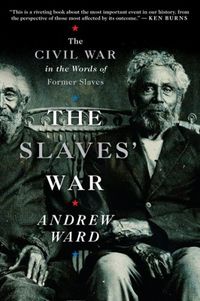
Robin Lindley in HNN:

AW: One said, “I just hated Lincoln and Harriet Beecher Stowe and all that crowd. They didn’t do anything for me, and they never will.” The concepts of Lincoln from the [slave] interviews run from next to God, Moses and Jesus, and on the other hand, there wasn’t a Negro in the country who wasn’t cursing Lincoln that first winter after Lincoln was shot [because] they felt a sense of abandonment and betrayal.

There’s been a lot of revisionist [material] on Lincoln and slavery. The Great Emancipator was an absurd myth, but at the same time, he was an extraordinary human being in his capacity for growing so much. From a backwoods Kentucky boy surrounded by slaves. His uncle had slaves. He had the most extraordinary capacity to empathize with people and to influence others. He was a great politician. He saw the moral core of [issues] balanced out with country-boy pragmatism. With the Emancipation Proclamation, we look back and ask why didn’t he just declare that slavery was over? He was trying to win this war, and if he didn’t win, he didn't get to end slavery. His idea of how to bring us onto the path of righteousness was to win the war, and he was going to do everything in his power to do it, and try to alienate as few people as possible.

More here.

Friday Poem

Housing Shortage

I tried to live small.
I took a narrow bed.
I held my elbows to my sides.
I tried to step carefully
And to think softly
And to breathe shallowly
In my portion of air
And to disturb no one.

Yet see how I spread out and I cannot help it.
I take to myself more and more, And I take nothing
That I do not need, but my needs grow like weeds,
All over and invading; I clutter this place
With all the apparatus of living.
You stumble over it daily.

And then my lungs take their fill.
And then you gasp for air.

Excuse me for living,
But, since I am living,
Given inches, I take yards,
Taking yards, dream of miles,
And a landscape, unbounded
and vast in abandon.

You too dreaming the same.

by Naomi Replansky

from No More Masks;
Anchor Books, 1973

Masters of American literature

Mark Lawson in The Guardian:

With the death of JD Salinger last week, a remarkable era in US literature came to its end. Mark Lawson reflects on the passing of an unrivalled generation

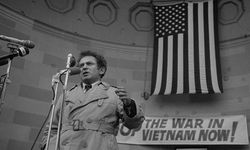
American-Writer-Norman-Ma-001 January 27 is becoming a black-letter day in American literature. On that day in 2009, John Updike died and, this year, the first ­anniversary of that loss was marked by the news that JD Salinger was dead. It's an artificial coincidence – of a sort that authors as good as Updike and Salinger would have scorned in their stories – but the deaths in close succession of members of the literary generations born in the 1910s, 20s and 30s do have a symbolic significance. If we add the deaths within four months of 2007 of Norman Mailer and Kurt Vonnegut – members with Salinger of the set of major American writers formed by service in the second world war – it's clear that an era in American literature is coming to a close.

There is an obvious temptation to believe that the authors who have recently died form – with others who fought in the war (such as Saul Bellow and Gore Vidal) or were teenagers in America during it (Philip Roth) – the greatest literary generation the country has ever seen or ever will see. This triumphalist but nostalgic position holds that these writers took advantage of their nation's geopolitical power – and a media culture and bookstore customer-base which regarded serious writers ­seriously – to create a superpower of the pen to match the financial and military clout of the US during what became known as the American century.

More here.

Martin Amis on the sexual revolution, Philip Larkin’s sex life, and why JM Coetzee is no good

Tom Chatfield interviews Martin Amis in Prospect:

ScreenHunter_03 Feb. 12 11.03 I spoke to Martin Amis at his house in January, shortly before publication of his twelfth novel, “The Pregnant Widow.” If you’re not familiar with the book, it may be useful to look at my review of it (available here) before reading the interview.

Tom Chatfield: I wanted to start off by asking you about the new book, which I’ve been very struck by. It has had an unusually long gestation, and yet it read very easily to me, in a way that I hadn’t felt for a while: it felt very much of a piece.

Martin Amis: Well, that’s an accurate apprehension on your part. I’ll tell you exactly what happened. I struggled for years with a turgid autobiographical novel, with a fictional structure. It seemed endless and inert. And it’s a funny thing about life that, when you put it in a novel, it’s dead. None of the usual forces that are in a novel—to do with unities and metaphor and imagination—were there. There was this horrible Easter, the Easter before last, in Uruguay, where it seemed huge and endless, no end in sight. I just thought to myself, “my god, this is dead.”

I had a bad couple of weeks, and there was a bit in it that I liked, which was the Italy bit. It was a big bit, but it was a tenth of what I had written. I took it out and it was about maybe 100 pages—and I thought, can I get this up to a novel size and expand it?

More here.

New Findings Suggest Spiritual Center in Brain

Joseph Brownstein at ABC News:

ScreenHunter_02 Feb. 12 10.49 Medically speaking, it was just brain surgery. But for some patients, it was a spiritual reawakening.

Researchers report in a new study today that they have found regions of the brain that seem to impact a person's level of spirituality.

The researchers worked with 88 patients with tumors in various locations in the brain and found that those with damage in the parietal region — located in the top rear region of the brain — could be seen to have a change in their attitude toward spirituality, something that tends to be relatively constant in a person.

“This finding highlights the key role of parietal cortices in spirituality and suggests that changes of neural activity in specific areas may modify even inherently stable dispositional traits,” explained Cosimo Urgesi, one of the study's lead researchers and an assistant professor in psychobiology and physiological psychology at the University of Udine in Italy.

The specific scale researchers used to determine spirituality is known as self-transcendence, a measure used to determine spirituality that appears to remain stable in a person over time.

More here.

The story of P(ee): Phosphorus is being used up and flushed away

Melinda Burns in Miller-McCune:

ScreenHunter_01 Feb. 12 09.21 Unremarked and unregulated by the United Nations and other high-level assemblies, the world’s supply of phosphate rock, the dominant source of phosphorus for fertilizer, is being rapidly — and wastefully — drawn down. By most estimates, the best deposits will be gone in 50 to 100 years.

Worse, phosphorus production could peak in just two decades, according to new research from Australia and Sweden. That’s when demand could outstrip supply, playing out a familiar scenario of scarcity, price shocks, riots, starvation and war.

In short, peak phosphorus could be the unwelcome sequel to peak oil.

More here.

Thursday, February 11, 2010

Wallace Stevens, Armchair Visionary

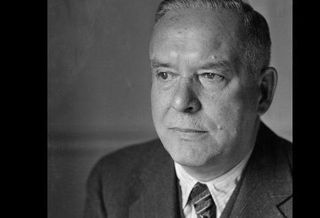
Stevens4Ryan Ruby in More Intelligent Life:

You can find them anywhere you go. Unshaven young men who slam down cheap liquor in remodelled dives. From their stools they hold forth on the doctrines of this obscure mystic or that obscurantist philosopher, and then they brawl for brawling’s sake. They swap stories about the tiny towns they reached by thumbing a ride or hopping the rails, tales that invariably end with a night in jail or the gutter and a rescue from some local angel. This is what’s known as Experience, to be distilled into stanzas that can fit within the circumference of the bottle stains on their cocktail napkins.

These are lifestyle poets, the Beats of yesteryear. Should you find yourself in the presence of one, ask him (always him) whether he likes the poetry of Wallace Stevens. Not one will say yes.

To a lifestyle poet, Stevens’s biography presents a problem. Born in 1879 in Reading, Pennsylvania, Stevens never quite became a member of the Lost Generation. He considered moving to Paris to become a writer, but caved to pressure from his lawyer father and stayed in the States, where he studied at Harvard and earned a degree from New York Law School. In 1916 he and his wife abandoned the bohemia of New York's Greenwich Village for sleepy Hartford, Connecticut, where Stevens began work for a local insurance company. By 1934 he had become vice president of the Hartford Accident and Indemnity Company, a post he would keep until his death from stomach cancer in 1955, aged 75.

Stevens published “Harmonium”, his first book and one of the most important collections of 20th-century verse, when he was 44. He went on to win two National Book Awards, a Bollingen and the Pulitzer, yet when he died, his office colleagues were surprised to learn that he had been anything but an insurance executive. “It gives a man character as a poet to have this daily contact with a job,” he once said in a newspaper interview.

“I have no life except in poetry,” Stevens once wrote to himself in the late 1930s. To put it another way, he was a square.

take the “bulevar” route

Marias

There are certain streets in Chamberí that I always associate with my childhood, streets that still exist and have preserved their old names, none of them particularly resonant now, or perhaps the names have simply grown inconsequential because forgotten: Miguel Ángel, Génova, Sagasta, Zurbano, Luchana, Zurbarán, Almagro, Fortuny, Bárbara de Braganza, Santa Engracia. And Covarrubias. The streets may still exist, but, in large measure, they have also been destroyed. That area, which is now home to so many banks, was once full of small eighteenth-century palaces and mansions with high doors and imperial marble staircases. I certainly didn’t live in one of those, but they were the backdrop to the walk I went on most frequently with my brothers, hand-in-hand with my mother and with Leo, our highly imaginative maid, who had us believe that she was the girlfriend of the soccer player Gento (a popular idol at the time) and told us apocryphal stories about Laurel and Hardy. Or else with two worthy ladies of Cuban origin and accent, my grandmother and her sister, Aunt María, who would accompany us ironically and excitably to one of the nearby movie houses.

more from Javier Marías at The Threepenny Review here.

Go See Eddie

100203_Spec_JDTN

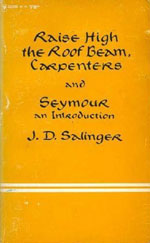
The great mystery J.D. Salinger left behind, of course, is just what he’d been writing all these years. There have been repeated sketchy reports that he was still writing in those last 45 years or so since he stopped publishing. There were, supposedly, completed manuscripts in his lonesome house of refuge on a hill in Cornish, N.H., a house I once paid a conflicted visit to. But no one seemed to have any real evidence about what it was he was working on. Will we find reams of pages covered with “All work and no play makes Jack a dull boy” a la The Shining? Or arcane tomes on one of his esoteric, mystical enthusiasms, such as homeopathy? Or—sigh—more, yet more Glass family sagas, centering on that supposed saint, the tedious Seymour, no matter how much his last, vexing visitations in “Seymour: An Introduction” and “Hapworth 16, 1924” tried the patience of his most avid followers. I know it’s wishful thinking, but I wonder whether there’s a clue in a little-known, unpublished—at least, not in book form—story that I came on the first time a day after Salinger’s death. A story called “Go See Eddie.”

more from Ron Rosenbaum at Slate here.

Science, religion and plague

TLS_Martines_682871a

In this brilliant study, a leading expert on the history of plague finds the origins of our understanding of the disease not in the science of seventeenth-century Protestant Europe but in the heartland of Catholicism, Counter-Reformation Italy. Here, in the upper part of the peninsula, the epidemic of 1575–8 gave rise to passionate debate, issuing in a stream of writings that would challenge the tenets of classical, Arabic and medieval views of plague. Learned doctors in Milan, Padua, Verona and other cities continued to cite Galen, Hippocrates, or Arab authorities. And religious processions – cocking a snook at the idea of virulent contagion – were allowed to take place. But knowledge of the ancient authorities, and the idea of striving to placate God’s wrath by means of orchestrated prayer, did not stymie close empirical observation of the symptoms and pathology of plague. Old and new ways of thinking proceeded side by side. Yet in the teeth of plague, doctors and medical workers were revolutionizing the approach to it by rejecting Galenic and other mistaken assumptions about “corrupt air”, humours and the malign configuration of the stars. They chose, instead, to concentrate on exact symptoms, contagion, the movement of people, poverty, filth of all sorts, water pollution, the sequestering of the infected and the intervention of the state.

more from Lauro Martines at the TLS here.