
Category: Recommended Reading
Alain Badiou on The Courage of the Present
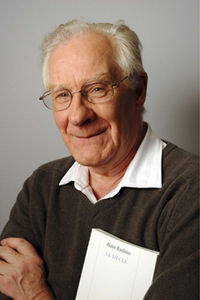
For almost thirty years, the present, in our country, has been a disoriented time. I mean a time that does not offer its youth, especially the youth of the popular classes, any principle to orient existence. What is the precise character of this disorientation? One of its foremost operations consists in always making illegible the previous sequence, that sequence which was well and truly oriented. This operation is characteristic of all reactive, counter-revolutionary periods, like the one we’ve been living through ever since the end of the seventies. We can for example note that the key feature of the Thermidorean reaction, after the plot of 9 Thermidor and the execution without trial of the Jacobin leaders, was to make illegible the previous Robespierrean sequence: its reduction to the pathology of some blood-thirsty criminals impeded any political understanding. This view of things lasted for decades, and it aimed lastingly to disorient the people, which was considered to be, as it always is, potentially revolutionary.
To make a period illegible is much more than to simply condemn it. One of the effects of illegibility is to make it impossible to find in the period in question the very principles capable of remedying its impasses. If the period is declared to be pathological, nothing can be extracted from it for the sake of orientation, and the conclusion, whose pernicious effects confront us every day, is that one must resign oneself to disorientation as a lesser evil. Let us therefore pose, with regard to a previous and visibly closed sequence of the politics of emancipation, that it must remain legible for us, independently of the final judgment about it.
In the debate concerning the rationality of the French Revolution during the Third Republic, Clemenceau produced a famous formula: ‘The French Revolution forms a bloc’. This formula is noteworthy because it declares the integral legibility of the process, whatever the tragic vicissitudes of its unfolding may have been. Today, it is clear that it is with reference to communism that the ambient discourse transforms the previous sequence into an opaque pathology. I take it upon myself therefore to say that the communist sequence, including all of its nuances, in power as well as in opposition, which lay claim to the same idea, also forms a bloc.
So what can the principle and the name of a genuine orientation be today? I propose that we call it, faithfully to the history of the politics of emancipation, the communist hypothesis.
Revolutionaries
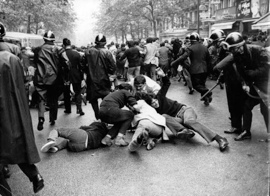
[I]n Germany, politics was about sex—and sex very largely about politics. I was amazed to discover, while visiting a German student collective (all the German students I knew seemed to live in communes, sharing large old apartments and each other’s partners), that my contemporaries in the Bundesrepublik really believed their own rhetoric. A rigorously complex-free approach to casual intercourse was, they explained, the best way to rid oneself of any illusions about American imperialism—and represented a therapeutic purging of their parents’ Nazi heritage, characterized as repressed sexuality masquerading as nationalist machismo.
The notion that a twenty-year-old in Western Europe might exorcise his parents’ guilt by stripping himself (and his partner) of clothes and inhibitions—metaphorically casting off the symbols of repressive tolerance—struck my empirical English leftism as somewhat suspicious. How fortunate that anti-Nazism required—indeed, was defined by—serial orgasm. But on reflection, who was I to complain? A Cambridge student whose political universe was bounded by deferential policemen and the clean conscience of a victorious, unoccupied country was perhaps ill-placed to assess other peoples’ purgative strategies.
I might have felt a little less superior had I known more about what was going on some 250 miles to the east. What does it say of the hermetically sealed world of cold war Western Europe that I—a well-educated student of history, of East European Jewish provenance, at ease in a number of foreign languages, and widely traveled in my half of the continent—was utterly ignorant of the cataclysmic events unraveling in contemporary Poland and Czechoslovakia? Attracted to revolution? Then why not go to Prague, unquestionably the most exciting place in Europe at that time? Or Warsaw, where my youthful contemporaries were risking expulsion, exile, and prison for their ideas and ideals?
What does it tell us of the delusions of May 1968 that I cannot recall a single allusion to the Prague Spring, much less the Polish student uprising, in all of our earnest radical debates? Had we been less parochial (at forty years’ distance, the level of intensity with which we could discuss the injustice of college gate hours is a little difficult to convey), we might have left a more enduring mark. As it was, we could expatiate deep into the night on China’s Cultural Revolution, the Mexican upheavals, or even the sit-ins at Columbia University. But except for the occasional contemptuous German who was content to see in Czechoslovakia’s Dubcek just another reformist turncoat, no one talked of Eastern Europe.
An Ominous Warning on the Effects of Ocean Acidification

The JOIDES Resolution looks like a bizarre hybrid of an oil rig and a cargo ship. It is, in fact, a research vessel that ocean scientists use to dig up sediment from the sea floor. In 2003, on a voyage to the southeastern Atlantic, scientists aboard the JOIDES Resolution brought up a particularly striking haul.
They had drilled down into sediment that had formed on the sea floor over the course of millions of years. The oldest sediment in the drill was white. It had been formed by the calcium carbonate shells of single-celled organisms — the same kind of material that makes up the White Cliffs of Dover. But when the scientists examined the sediment that had formed 55 million years ago, the color changed in a geological blink of an eye.
“In the middle of this white sediment, there’s this big plug of red clay,” says Andy Ridgwell, an earth scientist at the University of Bristol.
In other words, the vast clouds of shelled creatures in the deep oceans had virtually disappeared. Many scientists now agree that this change was caused by a drastic drop of the ocean’s pH level. The seawater became so corrosive that it ate away at the shells, along with other species with calcium carbonate in their bodies. It took hundreds of thousands of years for the oceans to recover from this crisis, and for the sea floor to turn from red back to white.
The clay that the crew of the JOIDES Resolution dredged up may be an ominous warning of what the future has in store. By spewing carbon dioxide into the air, we are now once again making the oceans more acidic.
Our World May be a Giant Hologram

DRIVING through the countryside south of Hanover, it would be easy to miss the GEO600 experiment. From the outside, it doesn't look much: in the corner of a field stands an assortment of boxy temporary buildings, from which two long trenches emerge, at a right angle to each other, covered with corrugated iron. Underneath the metal sheets, however, lies a detector that stretches for 600 metres.
For the past seven years, this German set-up has been looking for gravitational waves – ripples in space-time thrown off by super-dense astronomical objects such as neutron stars and black holes. GEO600 has not detected any gravitational waves so far, but it might inadvertently have made the most important discovery in physics for half a century.
For many months, the GEO600 team-members had been scratching their heads over inexplicable noise that is plaguing their giant detector. Then, out of the blue, a researcher approached them with an explanation. In fact, he had even predicted the noise before he knew they were detecting it. According to Craig Hogan, a physicist at the Fermilab particle physics lab in Batavia, Illinois, GEO600 has stumbled upon the fundamental limit of space-time – the point where space-time stops behaving like the smooth continuum Einstein described and instead dissolves into “grains”, just as a newspaper photograph dissolves into dots as you zoom in. “It looks like GEO600 is being buffeted by the microscopic quantum convulsions of space-time,” says Hogan.
If this doesn't blow your socks off, then Hogan, who has just been appointed director of Fermilab's Center for Particle Astrophysics, has an even bigger shock in store: “If the GEO600 result is what I suspect it is, then we are all living in a giant cosmic hologram.”
The idea that we live in a hologram probably sounds absurd, but it is a natural extension of our best understanding of black holes, and something with a pretty firm theoretical footing. It has also been surprisingly helpful for physicists wrestling with theories of how the universe works at its most fundamental level.
The poetry of Ayatollah Khomeini
Daniel Kalder in the Books Blog of The Guardian:
This was what I was really interested in – something that would reveal a side of Khomeini unknown to those of us in the west; a more tender aspect of the bearded, reactionary theocrat.
And what a poem! If the first two lines are startling:
I have become imprisoned, O beloved, by the mole on your lip!
I saw your ailing eyes and became ill through love.Then what follows a few lines down is absolutely amazing:
Open the door of the tavern and let us go there day and night,
For I am sick and tired of the mosque and seminary.The whole thing ends with a repudiation of Islam in favour of the “tavern's idol”.
Even allowing for the fact that the Ayatollah is utilising a poetic persona, the poem is remarkable: free thinking, even heretical.
More here.
Richard Nathaniel Wright 1908-1960
From Kirja.sci:
American short story writer and novelist, whose best known work, NATIVE SON, appeared in 1940. The book immediately established Wright as an important author and a spokesman on conditions facing African-Americans. It gained a large multiracial readership and was a Book-of-the-Month Club selection. Wright's works drew on the poverty and segregation of his childhood in the South and early adulthood in Chicago.
“And, curiously, he felt that he was something, somebody, precisely and simply because of that cold threat of death. The terror of the white world had left no doubt in him about his worth; in fact, that white world had guaranteed his worth in the most brutal and dramatic manner. Most surely he was was something, in the eyes of the white world, or it would not have threatened him as it had. That white world, then, threatened as much as it beckoned. Though he did not know it, he was fatally in love with that white world, in love in a way that could never be cured. That white world's attempt to curb him dangerously and irresponsibly claimed him for its own.” (from The Long Dream, 1958)
Richard Wright was born on a plantation near Natchez, Mississippi. His grandparents had been slaves and his father, Nathaniel, who was an illiterate sharecropper and mill worker, left home when Richard was six. Wright grew up in poverty, staying often at homes of relatives. His mother, Ella Wilson, was a schoolteacher; she moved with her family to Memphis, where she found employment as a cook. In 1915-16 Wright attended school for a few months, but his mother's illness forced him to leave. He attended school sporadically, lived in Arkansas with his aunt Maggie and uncle Silas, who was murdered, and in Mississippi. In his childhood Wright was often beaten. However, he continued to teach himself, secretly borrowing books from the whites-only library in Memphis. “My days and nights were one long, quiet, continuously contained dream of terror, tension, and anxiety,” he later wrote in his autobiography BLACK BOY (1945).
More here.
A bomb in her bosom: Emily Dickinson’s secret life
From The Guardian:
Emily Dickinson was a great poet whose life has remained a mystery. The time has come to dispel the myth of a quaint and helpless creature, disappointed in love, who gave up on life. I think she was unafraid of her own passions and talent; that her brother's sexual betrayal and subsequent family feud had a profound effect on the Dickinson legend that has come down to us; and perhaps most significantly, I believe that Emily had an illness – a secret that explains much. It was Emily herself who helped to devise the blueprint for her legend, starting at the age of 23 when she declined an invitation from a friend: “I'm so old-fashioned, Darling, that all your friends would stare.” In place of the tart young woman she was, she adopted this retiring posture. Born in 1830 into the leading family of Amherst, a college town in Massachusetts, she never left what she always called “my father's house”. Townsfolk spoke of her as “the Myth”.
On the face of it, the life of this New England poet seems uneventful and largely invisible, but there's a forceful, even overwhelming character belied by her still surface. She called it a “still – Volcano – Life”, and that volcano rumbles beneath the domestic surface of her poetry and a thousand letters. Stillness was not a retreat from life (as legend would have it) but her form of control. Far from the helplessness she played up at times, she was uncompromising; until the explosion in her family, she lived on her own terms.
More here.
Wednesday Poem
The Question
What about the people who came to my father's office
For hearing aids and glasses—chatting with him sometimes
A few extra minutes while I swept up in the back,
Addressed packages, cleaned the machines; if he was busy
I might sell them batteries, or tend to their questions:
The tall overloud old man with a tilted, ironic smirk
To cover the gaps in his hearing; a woman who hummed one
Prolonged note constantly, we called he “the hummer”—how
Could her white fat husband (he looked like Rev. Peale)
Bear hearing it day and night? And others: a coquettish old lady
In a bandeau, a European. She worked for refugees who ran
Gift shops or booths on the boardwalk in the summer;
She must have lived in winter on Social Security. One man
Always greeted my father in Masonic gestures and codes.
Why do I want them to be treated tenderly by the world, now
Long after they must have slipped from it one way or another,
While I was dawdling through school at that moment—or driving,
Reading, talking to Ellen. Why this new superfluous caring?
I want for them not to have died in awful pain, friendless.
Though many of the living are starving, I still pray for these,
Dead, mostly anonymous (but Mr. Monk, Mrs. Rose Vogel)
And barely remembered: that they had a little extra, something
For pleasure, a good meal, a book or a decent television set.
Of whom do I pray this rubbery, low-class charity? I saw
An expert today, a nun—wearing a regular skirt and blouse,
But the hood or headress navy and white around her plain
Probably Irish face, older than me by five or ten years.
The post office clerk told her he couldn't break a twenty
So she got change next door and came back to send her package.
As I came out she was driving off—with an air, it seemed to me,
Of annoying, demure good cheer, as if the reasonableness
of change, mail, cars, clothes was a pleasure in itself; veiled
And dumb like the girls I thought enjoyed the rules too much
In grade school. She might have been a grade school teacher;
But she reminded me of being there, aside from that—as a name
And person there, a Mary or John who learns that the janitor
Is Mr. Woodhouse; the principal is Mr. Ringleven; the secretary
In the office is Mrs. Apostolacus; the bus driver is Ray.
by Robert Pinsky
from New American Poets of the 90s;
David R. Godine Publisher, 1991
The ultimate indignity for an animal: to be killed by a plant
Carl Zimmer in National Geographic:
A hungry fly darts through the pines in North Carolina. Drawn by what seems like the scent of nectar from a flowerlike patch of scarlet on the ground, the fly lands on the fleshy pad of a ruddy leaf. It takes a sip of the sweet liquid oozing from the leaf, brushing a leg against one tiny hair on its surface, then another. Suddenly the fly's world has walls around it. The two sides of the leaf are closing against each other, spines along its edges interlocking like the teeth of a jaw trap. As the fly struggles to escape, the trap squeezes shut. Now, instead of offering sweet nectar, the leaf unleashes enzymes that eat away at the fly's innards, gradually turning them into goo. The fly has suffered the ultimate indignity for an animal: It has been killed by a plant…
There is something wonderfully unsettling about a plant that feasts on animals. Perhaps it is the way it shatters all expectation. Carl Linnaeus, the great 18th-century Swedish naturalist who devised our system for ordering life, rebelled at the idea. For Venus flytraps to actually eat insects, he declared, would go “against the order of nature as willed by God.” The plants only catch insects by accident, he reasoned, and once a hapless bug stopped struggling, the plant would surely open its leaves and let it go free.
Charles Darwin knew better…
More here.
Tim Minchin – If I Didn’t Have You
An American admiral, a Pakistani general, and the ultimate anti-terror adventure
Michael Crowley in The New Republic:
On August 26, 2008, Michael Mullen, the chairman of the Joint Chiefs of Staff, touched down for a secret meeting on an aircraft carrier stationed in the Indian Ocean. The topic: Al Qaeda and the Taliban.
The summit had been arranged the previous month. Mullen had grown anxious about the rising danger from Pakistan’s tribal areas, which Islamic militants were using as a base from which to strike American troops in Afghanistan and to plot terrorist attacks against the United States. He flew to Islamabad to see the country’s army chief of staff, Ashfaq Parvez Kayani. Kayani is Pakistan’s most important general, commanding its 550,000-man army. By some accounts, he is also the ultimate source of power in a militarized society that reveres its generals more than its politicians. Mullen had been blunt with Kayani: The United States needed Pakistan’s army to take on the militants flourishing along the border, he said. The days of Pakistan looking the other way–cutting deals and playing double games with the radicals–had to end.
It was hardly a painless request; the Pakistani military is organized for warfare against its arch-nemesis India, and many of its mid-level officers are sympathetic to the Taliban and, at best, wary of the United States.
More here.
Tuesday, February 16, 2010
Watchdogs Need Not Bark Together

[E]ach country looks at each proposal and assesses how it affects the competitiveness of its financial system; the objective too often is to find a regulatory regime that crimps competitors more than one’s own companies. As the saying goes, all politics is local, and, at least in the US and many other jurisdictions, finance is a big political player. This, combined with deep philosophical differences – as remarkable as it may now seem, there are some that still believe in unfettered markets – mean the only agreements that are easy to come by are those involving the least common denominator, or small countries not at the table; and even these victories are often hard fought, as evidenced by the struggle to deal with tax havens.
Given the difficulties in achieving global co-ordination, insisting on such co-ordination may be a recipe for paralysis – just what the bankers who don’t want regulations want. It is perhaps no surprise that they have become among the most vocal advocates of the need for global action.

Mark Blyth and Leonard Seabrooke provide some additional thoughts on the benefits of an unleveled playing field:
Readers may recall that in the 1970s and 1980s the Laffer Curve for taxes imagined a one-size-fits-all Goldilocks solution, where there was too hot, too cold and a sweet spot for taxes. Tax them too hot, they said, and the high-income earners will run. We seem to have a rerun of this argument today. Too light regulation and the national economy implodes. Too much regulation and the bankers run. Where then is the sweet spot that we today refer to as “right-sizing” finance with appropriate regulation?
In this regard Prof Stiglitz points to something fundamentally important: global solutions may not be the appropriate target for financial regulation. However, we would go further. Favouring national autonomy is superior to home regulation where big banks can throw their weight around and dictate terms to widely divergent national economies. While global regulations benefit global banks by enabling them to lower the costs of capital, it is far from clear that these regulations benefit the countries where these banks operate, given the volatility they can produce. Just as the Laffer Curve for taxes can’t explain why Danes, Germans and Americans are willing to pay different tax rates, so the idea of a Laffer Curve for Financial Regulation, with its presumed global sweet spot, is surely fallacious.

Why Do Humans Reason? Arguments for an Argumentative Theory
Hugo Mercier and Dan Sperber make the case:
Reasoning is generally seen as a mean to improve knowledge and make better decisions. Much evidence, however, shows that reasoning often leads to epistemic distortions and poor decisions. This suggests rethinking the function of reasoning. Our hypothesis is that the function of reasoning is argumentative. It is to devise and evaluate arguments intended to persuade. Reasoning so conceived is adaptive given human exceptional dependence on communication and vulnerability to misinformation. A wide range of evidence in the psychology or reasoning and decision making can be reinterpreted and better explained in the light of this hypothesis. Poor performance in standard reasoning tasks is explained by the lack of argumentative context. When the same problems are placed in a proper argumentative setting, people turn out to be skilled arguers. Skilled arguers, however, are not after the truth but after arguments supporting their views. This explains the notorious confirmation bias. This bias is apparent not only when people are actually arguing but also when they are reasoning proactively with the perspective of having to defend their opinions. Reasoning so motivated can distort evaluations and attitudes and allow the persistence of erroneous beliefs. Proactively used reasoning also favors decisions that are easy to justify but not necessarily better. In all of these instances traditionally described as failures or flaws, reasoning does exactly what can be expected of an argumentative device: look for arguments that support a given conclusion, and favor conclusions in support of which arguments can be found.
The claims the paper presents are not as disheartening as the abstract may suggest:
[T]he argumentative theory of reasoning..maintains that there is an asymmetry between the production of arguments, which involves an intrinsic bias in favour of the opinions or decisions of the arguer whatever their soundness, and the evaluation of arguments, which aims at differentiating good arguments from bad ones and thereby genuine information from misinformation. This asymmetry is often obscured in a debate situation (or in a situation where a debate is anticipated). People who have an opinion to defend don't really evaluate the arguments of their interlocutors in search for genuine information but rather consider them from the start as counter-arguments to be rebuked. Still, as shown by the evidence reviewed in section 2, people are good at assessing arguments, and are quite able to do so in an unbiased way, provided they don't have a particular axe to grind. In group reasoning experiments where participants share an interest in discovering the right answer, it has been shown that truth wins.
Is There Manic Pixie Dream Girl in Y Tu Mama Tambien

After I quit squelching my doubts about “American Beauty” and saw it for the bankrupt film it is—and was happy to see other critics and people I admire express those same doubts down the road (who doesn’t like validation?)—I got a little firmer in my opinions, a little braver about my own tastes. Which is why I humbly wish someone had reamed the crap out of “Y Tu Mama Tambien” on this list, since that’s the last movie I saw that I just absolutely hated and couldn’t believe that so many people were impressed by it. It’s probably the same issue as “American Beauty”—since it’s well shot and well acted and has all the markers of an arty film, it suckers people into ignoring that it has the same plot as “Love Story”. Except worse, in a way, because the Manic Pixie Dream Girl is not only interested in teaching young men to live life so she can expire with her purpose in life being filled, but she’s there to teach us something about men’s relationships with each other. In this case, the attempt to weasel out of a tedious, sexist cliche involves injecting some man-on-man action and having the men’s relationship with each other fall apart, but I was unimpressed, since the basic idea that cheeky women are there as muses and conduits for men, and that they have no reason to continue to exist having accomplished their assigned task, was central to the story.
Onion AV writer Nathan Rabin coined the term to describe Kristen Dunst's character in a scathing review of Elizabethtown:
The Manic Pixie Dream Girl exists solely in the fevered imaginations of sensitive writer-directors to teach broodingly soulful young men to embrace life and its infinite mysteries and adventures. The Manic Pixie Dream Girl is an all-or-nothing-proposition. Audiences either want to marry her instantly (despite The Manic Pixie Dream Girl being, you know, a fictional character) or they want to commit grievous bodily harm against them and their immediate family.
We feminists roll our eyes at the MPDG character for obvious reasons. It's an annoying form of objectification most commonly perpetrated by male writers who are smugly convinced of their own progressive sensibilities. They think they're better than the guys who leer at pinups, but the MPDG doesn't have any more depth. The MPDG is wish-fulfillment for all those nice guys out there who just want someone conventionally beautiful to see their inner beauty and appreciate their mix tapes. The writer doesn't want you to doubt that the guy totally deserves her–maybe not in the sense of being handsome, successful, or charming. But, see, those are bullshit social norms that are keeping our hero down, which is why he needs a crazy girl to truly appreciate him in ways that shallow cheerleaders cannot. Lazy writers think that if they make the girl a little daft, they can skip the part where they explain what she sees in him. She's whimsical, that's why!
Whatever else you can say about Y Tu Mama, and it's not a flawless movie by any means, Luisa is no MPDG.
Patti Smith, Where’s Your Critical Distance?

In his piece for the New York Times Book review on Just Kids, Patti Smith’s new memoir about her long-term relationship with Robert Mapplethorpe, Tom Carson writes:
Peculiarly or not, the one limitation of “Just Kids” is that Mapplethorpe himself, despite Smith’s valiant efforts, doesn’t come off as appealingly as she hopes he will. When he isn’t candidly on the make — “Hustler-hustler-hustler. I guess that’s what I’m about,” he tells her — his pretension and self-romanticizing can be tiresome.
Carson’s criticism is well-deserved. At first read, Smith’s memoir tells a pretty romantic story: Two 20-year-old dreamers arrive penniless in New York, find in each other kindred spirits, and build a life together in pursuit of art. The messy little details—like that Mapplethorpe turns out to be gay, or that he eventually dies of AIDS, or that their pennilessness forces them to steal, hustle, and compromise themselves in manifold ways—don’t really get in the way of Smith’s message: that this is a love affair for the ages. Smith is a seductive storyteller. She has at her disposal an enviable range of allusions and references. But her greatest asset as a writer is the clarity with which she sees herself and the people around her—a clarity that is compromised only by a gigantic, Robert Mapplethorpe-shaped blind spot.
Tuesday Poem
How to Photograph the Heart
You remember how the lens squeezed
unimportant details into stillness:
the essential trail of rain down glass,
the plummet of autumn dead leaves,
your grandfather's last blink when
the breath moved on.
Your startled hands compressed
the shutter when you realized: this is it,
this is the last movement he will take
away from the silent fall of morphine,
beyond the soft gasp of the nurse,
past the sick, slow thud of your heart
moving in the luminous silence.
by Christine Klocek-Lim
from How to Photograph the Heart;
The Lives You Touch Publications, 2009
Ralph Waldo Ellison
From Nathanielturner.com:
When Ralph Ellison’s impassioned, compelling novel Invisible Man was published in 1952, it won the National Book Award for fiction. Although Ellison himself was modest in his estimate of the novel’s durability, the book has shown every indication that it is on its way to becoming an American classic. In a poll of 200 writers, editors, and critics conducted by the New York Herald Tribune’s Book Week magazine in 1965, Invisible Man was voted the most distinguished novel published in the twenty years since 1945. In Invisible Man Ellison constructed, from the fabric of his own background as a Negro, a nightmarish story of the brutal experience endured by a young American black man and their effect on his once naively idealistic psyche. Despite its theme, the book transcends the bounds of a traditional Negro novel. “This is not another journey to the end of the night,” Wright Morris once wrote of Invisible Man. “With this book the author maps a course from the underground world into the light. The Invisible Man belongs on the shelf with the classical efforts man has made to chart the river Lethe from its mouth to its source.” Ellison has also published Shadow and Act (1964)
Ralph Waldo Ellison was born in Oklahoma City, Oklahoma on March 1, 1914 to Lewis Alfred and Ida (Millsap) Ellison. His father, a construction worker and tradesman, died when Ellison was three, and his mother supported herself and her son by working as a domestic. From an early age Ellison was interested in music and books, and his mother brought home for him from the households where she labored discarded phonograph records and magazines. Growing up in Oklahoma City, Ellison knew Hot Lips page, the jazz musician, and he was a friend . . . of Jimmy Rushing, the blues singer. In high school, he played trumpet in the band.
Ellison began reading Hemingway in adolescence, and later he became interested in the poetry of T.S. Eliot. “At first I was puzzled when I began to read Ernest Hemingway . . . as to just why his stories could move me but I couldn’t reduce them to a logical system. . . .” Ellison told Mike McGrady of Newsday (October 28, 1967). “Then I began to look at my own life through the lives of fictional characters. When I read Stendhal, I would search within the Negro communities in which I grew up. I began, in other words, quite early to connect the worlds projected in literature and poetry and drama and novels with the life in which I found myself.”
(Picture: Invisible Man: A Memorial to Ralph Ellison
Sculptor Elizabeth Catlett, 2003
Riverside Park @ 150th Street, Manhattan
Bronze, graniteThis sculpture honors author Ralph Ellison, who lived opposite this park. It consists of a bronze monolith through which is cut the silhouette of a striding man –a literal allusion to Ellison's epic novel, Invisible Man. A quotation from the novel and biographical details relating to Ellison are inscribed in low-lying pink granite wall framing an oval landscape designed by Ken Smith.)
More here.
As Girls Become Women, Sports Pay Dividends
From The New York Times:
Almost four decades after the federal education law called Title IX opened the door for girls to participate in high school and college athletics, a crucial question has remained unanswered: Do sports make a long-term difference in a woman’s life? A large body of research shows that sports are associated with all sorts of benefits, like lower teenage pregnancy rates, better grades and higher self-esteem. But until now, no one has determined whether those improvements are a direct result of athletic participation. It may be that the type of girl who is attracted to sports already has the social, personal and physical qualities — like ambition, strength and supportive parents — that will help her succeed in life.
Now, separate studies from two economists offer some answers, providing the strongest evidence yet that team sports can result in lifelong improvements to educational, work and health prospects. At a time when the first lady, Michelle Obama, has begun a nationwide campaign to improve schoolchildren’s health, the lessons from Title IX show that school-based fitness efforts can have lasting effects.
More here.
Fundamental Forces and Chopping Wood
Hartosh Singh Bal interviews Professor T Padmanabhan about the work for which he was awarded the 2009 Infosys Prize for the Physical Sciences, in Open Magazine:
Q You combine your interest in science with pursuits that can loosely be termed ‘spiritual’. Are these not at odds? What do you make of the assault on religion by someone like Richard Dawkins?
A Dawkins has erected a straw man and knocked it down. I have no respect for this. It is very easy to knock down a particular class of models for God and religion. Russell and others, for example, have already done this a long time ago and far more effectively.
My take is that my concept of fundamental reality does not require any support from science or vice-versa. The two things lie in different domains and represent different types of knowledge. One is by its nature introverted, an inner knowledge, and the other is extroverted. Together, they complement each other.
Q Where does this other knowledge come from?
A The idea of direct experience lies beyond Aristotelian logic. It is born out of a personal knowledge—say, through a meditative experience. It is not translatable into the normal grammar of ideas, but nothing in ordinary logic precludes its existence.
Q Once you step beyond Aristotelian logic, what keeps you interested in physics? Does it not then become just a game?
A There was an enlightened Zen master who was asked what he did before enlightenment, and he replied, “I used to fetch water and chop wood.” And asked what he does now after gaining enlightenment, he said he fetches water and chops wood. Nothing external changes. Doing physics is like chopping wood and fetching water!
More here.