Publishing: The Revolutionary Future

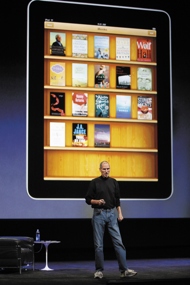
JobsipadJason Epstein in the NYRB:

Amid the literary chaos of the digital future, readers will be guided by the imprints of reputable publishers, distinguishable within a worldwide, multilingual directory, a function that Google seems poised to dominate—one hopes with the cooperation of great national and university libraries and their skilled bibliographers, under revised world copyright standards in keeping with the reach of the World Wide Web. Titles will also be posted on authors' and publishers' own Web sites and on reliable Web sites of special interest where biographies of Napoleon or manuals of dog training will be evaluated by competent critics and downloaded directly from author or publisher to end user while software distributes the purchase price appropriately, bypassing traditional formulas. With inventory expense, shipping, and returns eliminated, readers will pay less, authors will earn more, and book publishers, rid of their otiose infrastructure, will survive and may prosper.

This future is a predictable inference from digitization in its current stage of development in the United States, its details widely discussed in the blogosphere by partisans of various outcomes, including the utopian fantasy that in the digital future content will be free of charge and authors will not have to eat.

Digitization will encourage an unprecedented diversity of new specialized content in many languages. The more adaptable of today's general publishers will survive the redundancy of their traditional infrastructure but digitization has already begun to spawn specialized publishers occupying a variety of niches staffed by small groups of like-minded editors, perhaps not in the same office or even the same country, much as software firms themselves are decentralized with staff in California collaborating online with colleagues in Bangalore and Barcelona.

The difficult, solitary work of literary creation, however, demands rare individual talent and in fiction is almost never collaborative. Social networking may expose readers to this or that book but violates the solitude required to create artificial worlds with real people in them. Until it is ready to be shown to a trusted friend or editor, a writer's work in progress is intensely private. Dickens and Melville wrote in solitude on paper with pens; except for their use of typewriters and computers so have the hundreds of authors I have worked with over many years.
How Christian Were the Founders?

Russell Shorto in the New York Times Magazine:

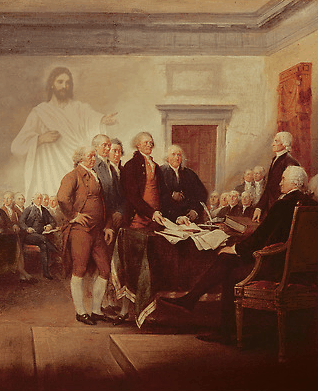
ScreenHunter_06 Feb. 24 09.15 There was a religious element to the American Revolution, which was so pronounced that you could just as well view the event in religious as in political terms. Many of the founders, especially the Southerners, were rebelling simultaneously against state-church oppression and English rule. The Connecticut Baptists saw Jefferson — an anti-Federalist who was bitterly opposed to the idea of establishment churches — as a friend. “Our constitution of government,” they wrote, “is not specific” with regard to a guarantee of religious freedoms that would protect them. Might the president offer some thoughts that, “like the radiant beams of the sun,” would shed light on the intent of the framers? In his reply, Jefferson said it was not the place of the president to involve himself in religion, and he expressed his belief that the First Amendment’s clauses — that the government must not establish a state religion (the so-called establishment clause) but also that it must ensure the free exercise of religion (what became known as the free-exercise clause) — meant, as far as he was concerned, that there was “a wall of separation between Church & State.”

This little episode, culminating in the famous “wall of separation” metaphor, highlights a number of points about teaching religion in American history. For one, it suggests — as the Christian activists maintain — how thoroughly the colonies were shot through with religion and how basic religion was to the cause of the revolutionaries.

More here.

Ten rules for writing fiction

Elmore Leonard, Diana Athill, Margaret Atwood, Roddy Doyle, Helen Dunmore, Geoff Dyer, Anne Enright, Richard Ford, Jonathan Franzen, Esther Freud, Neil Gaiman, David Hare, PD James, and AL Kennedy in The Guardian:

Creativewriting Elmore Leonard: Using adverbs is a mortal sin

1 Never open a book with weather. If it's only to create atmosphere, and not a charac�ter's reaction to the weather, you don't want to go on too long. The reader is apt to leaf ahead look�ing for people. There are exceptions. If you happen to be Barry Lopez, who has more ways than an Eskimo to describe ice and snow in his book Arctic Dreams, you can do all the weather reporting you want.

2 Avoid prologues: they can be �annoying, especially a prologue �following an introduction that comes after a foreword. But these are ordinarily found in non-fiction. A prologue in a novel is backstory, and you can drop it in anywhere you want. There is a prologue in John Steinbeck's Sweet Thursday, but it's OK because a character in the book makes the point of what my rules are all about. He says: “I like a lot of talk in a book and I don't like to have nobody tell me what the guy that's talking looks like. I want to figure out what he looks like from the way he talks.”

3 Never use a verb other than “said” to carry dialogue. The line of dialogue belongs to the character; the verb is the writer sticking his nose in. But “said” is far less intrusive than “grumbled”, “gasped”, “cautioned”, “lied”. I once noticed Mary McCarthy ending a line of dialogue with “she asseverated” and had to stop reading and go to the dictionary.

More here.

How one man’s traumatic youth revolutionised painting

Our own Sue Hubbard in New Statesman:

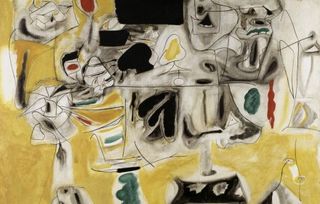
Gorky He was a bridge not only between surrealism and abstract expressionism, old Europe and a new American culture, but also between a vanished eastern world and the west. Like the Portuguese poet Fernando Pessoa, who wrote under a series of heteronyms, Arshile Gorky's tragic past led him to reinvent himself according to the poet's dictum that: “Life is whatever we conceive it to be.” Indeed, there are few painters for whom autobiography and artistic output are so intimately linked.

His adoption of the pseudonym “Gorky” was an attempt to link himself to his celebrated contemporary Maxim Gorky, and to disguise his Armenian origins. He was born Vostanik Manoog Adoyan in 1904 in a rural part of what was then the Turkish Ottoman empire. An attack on the city of Van by the Turks in 1915 had prompted virtually the whole of the population of western Armenia to walk a hundred miles to the east, in a desperate evacuation over the mountains.

Gorky's father had already left in 1908 to work in Rhode Island, leaving mother and children behind (until the money could be raised for their passage). During the winter of 1919, as the Russian civil war raged, Gorky's mother died of starvation before he and his sister, Vartoosh, finally began the long journey to join his father in New York. This tragedy was to colour Gorky's relationship to his art. Issues of loss, nostalgia and belonging haunt these edgy, intense paintings.

More here.

Tuesday, February 23, 2010

Death List, Poem

Charles Simic in the New York Review of Books Blog:

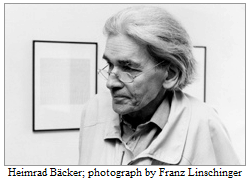
ScreenHunter_05 Feb. 23 22.18 A strange little book came in the mail the other day. It’s called transcript and is published by the admirable Dalkey Archive Press. Translated from the German by Patrick Greaney and Vincent Kling, its author, Heimrad Bäcker (1925-2003), was unknown to me. He was an Austrian book editor, photographer and concrete poet who as a teenager joined the Nazi party and became an active member in the regional leadership of the Hitler Youth. At a first glance, his book looks like a collection of verbal scraps of uncertain origin, some of which have the appearance of avant-garde poetry, but on examination it turns out to be something entirely different. Bäcker’s “poems” consist of excerpts from documents by Holocaust planners, perpetrators, and victims.

There are quotes from concentration camp files, arrest reports, instructions for operating gas chambers and hanging prisoners, comments by executioners and witnesses, notes on medical experiments and other such material found in the vast files of a regime that was not only busy exterminating millions of people, but striving to micromanage its degrading acts down to the smallest detail:

you are requested to leave the keys in the locks of all furniture, chests etc. as
well as the keys in the locks of all interior doors. if the keys are on a separate
key ring, they are to be taken off and placed in the lock of the receptacle to
which they belong. to the building and hallway keys should be attached a
ribbon and a piece of cardboard on which you are to write your names and
apartment number and identification number. these keys are to be given to
the authorized official. before leaving your residence, the list of assets that
was issued to you is to be

Bäcker doesn’t invent anything.

More here.

Chasing a bird that flies indoors at 200 mph

Craig Lambert in Harvard Magazine:

ScreenHunter_03 Feb. 23 22.14 In 1985, an astonishing time-motion study compared badminton with tennis. That year, Boris Becker defeated Kevin Curran in four sets for the Wimbledon tennis championship, and, amid far less fanfare, Han Jian of China bested Denmark’s Morten Frost in three sets of badminton at Calgary. The Wimbledon match lasted three hours and 18 minutes; the badminton contest took only one hour, 16 minutes. During the matches, the tennis ball was actually in play for a mere 18 minutes, as compared with 37 minutes for the badminton shuttlecock. Becker and Curran had 299 rallies and struck 1,004 shots; Jian and Frost had only 146 rallies but hit 1,972 shots, for an average of 13.5 per rally, about four times as many as the 3.4-shot average tennis point. And the distance covered by the players? Two miles in tennis, four miles in badminton.

This isn’t science; it’s a comparison of two matches that took place more than two decades ago, at the highest levels of competition. One reason badminton rallies last longer is that the court is smaller—a tennis doubles court covers roughly triple the area of its badminton counterpart. But these data should put to rest any notion that badminton is no more than an amusing game played at summer cookouts with a beer in one hand and a racquet in the other.

More here.

Will an algorithm pick you for your next coding job?

Charles Arthur in the Technology Blog of The Guardian:

ScreenHunter_02 Feb. 23 22.11 The problem: how do you figure out who the people to recruit for your project are, when you're not familiar with the people in the area but need to get going?

Well, one option is to analyse submissions to Github, the open source code repository used by dozens of companies and individual programmers.

Biddulph explains:

“When I'm hiring, one of the things I always want to see is evidence of personal projects. Over the last two years, GitHub has become an amazing treasure trove of code, with the best social infrastructure I've ever seen on a developer site. GitHub profiles let the user set their location, so I started with a few web searches for Berlin developers. This finds hundreds of interesting people, but how do I prioritise them?”

Good question. Of course, another question would be “how do you know if they're any good?” For that, Biddulph moves to the next step:

“Another thing that I look for when building a good team is someone's personal network. I've always believed strongly in spending lots of time at conferences meeting passionate people who are smarter than me. A good developer can make themselves even more productive by knowing who to email, IM or DM to answer a question when they're stuck.”

From there it's a pretty short hop, skip and JMP to his solution…

More here. [Thanks to Marko Ahtisaari.]

David Cope’s software creates beautiful, original music. Why are people so angry about that?

Ryan Blitstein in Miller-McCune:

ScreenHunter_03 Feb. 23 14.14 She was just a software program, a jumble of code he’d originally dubbed Experiments in Musical Intelligence (EMI, hence “Emmy”). Still — though Cope struggles not to anthropomorphize her — he speaks of Emmy wistfully, as if she were a deceased child.

Emmy was once the world’s most advanced artificially intelligent composer, and because he’d managed to breathe a sort of life into her, he became a modern-day musical Dr. Frankenstein. She produced thousands of scores in the style of classical heavyweights, scores so impressive that classical music scholars failed to identify them as computer-created. Cope attracted praise from musicians and computer scientists, but his creation raised troubling questions: If a machine could write a Mozart sonata every bit as good as the originals, then what was so special about Mozart? And was there really any soul behind the great works, or were Beethoven and his ilk just clever mathematical manipulators of notes?

Cope’s answers — not much, and yes — made some people very angry. He was so often criticized for these views that colleagues nicknamed him “The Tin Man,” after the Wizard of Oz character without a heart. For a time, such condemnation fueled his creativity, but eventually, after years of hemming and hawing, Cope dragged Emmy into the trash folder.

This month, he is scheduled to unveil the results of a successor effort that’s already generating the controversy and high expectations that Emmy once drew.

More here.

“Shirt” by Robert Pinsky

Shirt

The back, the yoke, the yardage. Lapped seams,
The nearly invisible stitches along the collar
Turned in a sweatshop by Koreans or Malaysians

Gossiping over tea and noodles on their break
Or talking money or politics while one fitted
This armpiece with its overseam to the band

Of cuff I button at my wrist. The presser, the cutter,
The wringer, the mangle. The needle, the union,
The treadle, the bobbin. The code. The infamous blaze

At the Triangle Factory in nineteen-eleven.
One hundred and forty-six died in the flames
On the ninth floor, no hydrants, no fire escapes–

The witness in a building across the street
Who watched how a young man helped a girl to step
Up to the windowsill, then held her out

Away from the masonry wall and let her drop.
And then another. As if he were helping them up
To enter a streetcar, and not eternity.

A third before he dropped her put her arms
Around his neck and kissed him. Then he held
Her into space, and dropped her. Almost at once

He stepped up to the sill himself, his jacket flared
And fluttered up from his shirt as he came down,
Air filling up the legs of his gray trousers–

Like Hart Crane's Bedlamite, “shrill shirt ballooning.”
Wonderful how the patern matches perfectly
Across the placket and over the twin bar-tacked

Corners of both pockets, like a strict rhyme
Or a major chord. Prints, plaids, checks,
Houndstooth, Tattersall, Madras. The clan tartans

Invented by mill-owners inspired by the hoax of Ossian,
To control their savage Scottish workers, tamed
By a fabricated heraldry: MacGregor,

Bailey, MacMartin. The kilt, devised for workers
to wear among the dusty clattering looms.
Weavers, carders, spinners. The loader,

The docker, the navvy. The planter, the picker, the sorter
Sweating at her machine in a litter of cotton
As slaves in calico headrags sweated in fields:

George Herbert, your descendant is a Black
Lady in South Carolina, her name is Irma
And she inspected my shirt. Its color and fit

And feel and its clean smell have satisfied
both her and me. We have culled its cost and quality
Down to the buttons of simulated bone,

The buttonholes, the sizing, the facing, the characters
Printed in black on neckband and tail. The shape,
The label, the labor, the color, the shade. The shirt.

Tuesday Poem

Inheritance

At my elbow on the table
it lies open as it has done
for a good part of these thirty
years since my father died
and it passed into my hands
this Webster's New International
Dictionary of the English
Language
of 1922
on India paper which I
was always forbidden to touch
for fear I would tear or somehow
damage its delicate pages
heavy in their binding
this color of wet sand
on which thin waves hover
when it was printed he was twenty-six
they had not been married four years
he was a country preacher
in a one-store town and I suppose
a man came to the door one day
peddling this new dictionary
on fine paper like the Bible
at an unrepeatable price
and it seemed it would represent
a distinction just to own it
confirming something about him
that he could not even name
now its cover is worn as though
it had been carried on journeys
across the mountains and deserts
of the earth but it has been here
beside me this whole time
what has frayed it like that
lossening it gnawing at it
all through these years
I know I must have used it
much more than he did but always
with care and indeed affection
turning the pages patiently
in search of meanings

by W.S. Merwin
from The Shadow of Sirius;
Copper Canyon Press, 2009

Muhammad Ali: The Rumble in the Jungle

From Wikipedia:

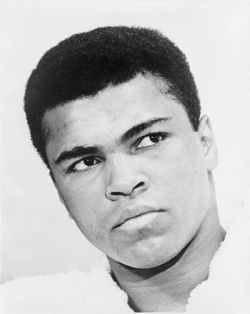
M ali In one of the biggest upsets in boxing history, Ali regained his title on October 30, 1974 by defeating champion George Foreman in their bout in Kinshasa, Zaire. Hyped as “The Rumble In The Jungle,” the fight was promoted by Don King. Almost no one, not even Ali's long-time supporter Howard Cosell, gave the former champion a chance of winning. Analysts pointed out that Joe Frazier and Ken Norton had given Ali four tough battles in the ring and won two of them, while Foreman had knocked out both of them in the second round. As a matter of fact, so total was the domination that, in their bout, Foreman had knocked down Frazier an incredible six times in only four minutes and 25 seconds.

During the bout, Ali employed an unexpected strategy. Leading up to the fight, he had declared he was going to “dance” and use his speed to keep away from Foreman and outbox him. However, in the first round, Ali headed straight for the champion and began scoring with a right hand lead, clearly surprising Foreman. Ali caught Foreman nine times in the first round with this technique but failed to knock him out. He then decided to take advantage of the young champion's weakness: staying power. Foreman had won 37 of his 40 bouts by knockout, mostly within three rounds. Eight of his previous bouts didn't go past the second round. Ali saw an opportunity to outlast Foreman, and capitalized on it.

In the second round, the challenger retreated to the ropes—inviting Foreman to hit him, while counterpunching and verbally taunting the younger man. Ali's plan was to enrage Foreman and absorb his best blows to exhaust him mentally and physically. While Foreman threw wide shots to Ali's body, Ali countered with stinging straight punches to Foreman's head. Foreman threw hundreds of punches in seven rounds, but with decreasing technique and potency. Ali's tactic of leaning on the ropes, covering up, and absorbing ineffective body shots was later termed “The Rope-A-Dope.” By the end of the seventh round, Foreman was exhausted. In the eighth round, Ali dropped Foreman with a combination at center ring and Foreman failed to make the count. Against the odds, Ali had regained the title. Many years later, Foreman would become champ again at age 45. Muhammad Ali (Foreman's best friend at the time) did not attend the title bout. When asked why, he said “I would deviate attention from George. It was his moment, not mine.”

More here.

Some of his famous quotes:

I wish people would love everybody else the way they love me. It would be a better world.
At home I am a nice guy: but I don't want the world to know. Humble people, I've found, don't get very far.

I figure I'll be champ for about ten years and then I'll let my brother take over – like the Kennedys down in Washington.

Frazier is so ugly that he should donate his face to the US Bureau of Wild Life.

Same Species, Polar Opposites

From Scientific American:

Same-species-polar-opposites_1 Two years ago, several research vessels shipped out to the North and the South poles to assemble a census of creatures living under the ice. One of the most surprising results was a discovery that 235 identical species lived on opposite sides of the world but were undocumented anywhere else. It's easy to understand how massive humpbacks can swim from Arctic to Antarctic waters, but most of the miniature worms, snails and crustaceans on the researchers' list are no bigger than grains of rice. How could tiny creatures adapted for the frigid waters travel 9,500 kilometers through warmer climes to reach the opposite pole?

Under the microscope, these invertebrates sometimes look like shredded plastic bags or shrimp with bullhorns. It's unclear how they could cross a swimming pool, let alone the globe. So, their “bipolarity” poses a 160-year mystery of the ocean—one that has only grown with time. “If bipolar species are as common as our initial list suggests, it really means we don't appreciate the mechanisms that are important for connectivity in the ocean as well as we thought,” says Russ Hopcroft, project leader of the Arctic portion of the Consortium for Ocean Leadership's Census of Marine Life.

More here.

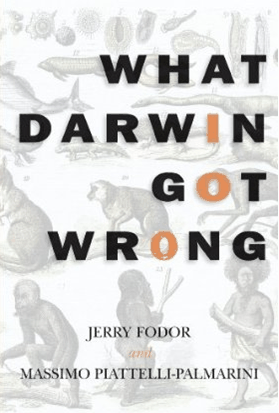
Misunderstanding Darwin: Natural selection’s secular critics get it wrong

Ned Block and Philip Kitcher write about What Darwin Got Wrong, by Jerry Fodor and Massimo Piatelli-Palmarini, in the Boston Review:

ScreenHunter_02 Feb. 23 10.09 But even as some scientists suggest that natural selection may be limited in ways Darwin could not envisage, they accept his basic insights and work to improve our biological understanding within the framework he set forth.

In their controversial new book, What Darwin Got Wrong, Jerry Fodor and Massimo Piattelli-Palmarini set out to dismantle that framework. They argue that standard evolutionary thinking—what they call Darwinism—is guilty of a basic logical error, not a mistake in biology but an “intensional fallacy.” That fallacy, they say, undermines the entire enterprise. To be clear, the authors preface their demolition with a disclaimer: in attacking Darwin, they are not supporting any religious view of “origins”; thoroughgoing materialists, they do not think that biological patterns require an intelligent designer. But their criticisms are intended to knock evolutionary theory from its scientific pedestal by demolishing the scientific credentials of natural selection.

Fodor and Piattelli-Palmarini are not biologists. Fodor is a leading philosopher of mind and cognitive scientist, best known for his ideas about the modularity of mind and language of thought; Piattelli-Palmarini is a cognitive scientist. They do not have new data, new theory, close acquaintance with the everyday practice of evolutionary investigations, or any interest in supplying alternative explanations of evolutionary phenomena. Instead, they wield philosophical tools to locate a “conceptual fault line” in contemporary Darwinism. Apparently unshaken by withering criticism of Fodor’s earlier writings about evolutionary theory, they write with complete assurance, confident that their limited understanding of biology suffices for their critical purpose. The resulting argument is doubly flawed: it is biologically irrelevant and philosophically confused. We start with the biology.

More here.

Postmodern Man

Our own Morgan Meis in The Smart Set:

ScreenHunter_01 Feb. 23 09.53 It's been more than 30 years since Jean-François Lyotard closed the historical door on Modernism. It was 1979, to be exact, when Lyotard published The Postmodern Condition: A Report on Knowledge. Rumors of the death of Modernism had been swirling for years. But death comes in stages, especially when the mortally wounded is a “movement” or an “age.” Lyotard's book managed to tie all those rumors together and then package the result as “Postmodernism,” the new next thing.

Lyotard focused on the idea of narratives. Past periods, Modernism in particular, had been fond of what he called “meta-narratives,” all-inclusive narrative frameworks that explained everything, more or less. Think, for instance, of Marxism and the way that class struggle drives every other part of the story. Look at the objects around you, the way you're dressed, current politics, movements in the arts. Strip away the details, any good Marxist will tell you, and lurking beneath you will find the class struggle. That bottle of water you're drinking is, in its essence, a natural resource owned by someone who then employs laborers hiring themselves out to work at a price determined by the market. This central relationship between wage-earners and owners of the means of production determines political structures, ideas on morality, even the dynamics of the family. For the Marxist, class struggle is the meta-narrative overarching all the other stories that fit inside.

Lyotard called the new age Postmodern because he thought that such meta-narratives no longer captured the complexity of late-20th-century existence. The fragmentation of identity brought about by modernization and globalization was too profound. At best, any narrative was going to tell only a small part of the story. Meta-narratives had blown apart into an endless chaos of micro-narratives.

More here.

Monday, February 22, 2010

Sunday, February 21, 2010

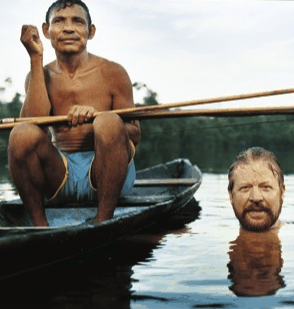
Pirahã undermines Noam Chomsky’s idea of a universal grammar

John Colapinto in The New Yorker:

ScreenHunter_04 Feb. 21 19.43 Everett, who this past fall became the chairman of the Department of Languages, Literature, and Cultures at Illinois State University, has been publishing academic books and papers on the Pirahã (pronounced pee-da-HAN) for more than twenty-five years. But his work remained relatively obscure until early in 2005, when he posted on his Web site an article titled “Cultural Constraints on Grammar and Cognition in Pirahã,” which was published that fall in the journal Cultural Anthropology. The article described the extreme simplicity of the tribe’s living conditions and culture. The Pirahã, Everett wrote, have no numbers, no fixed color terms, no perfect tense, no deep memory, no tradition of art or drawing, and no words for “all,” “each,” “every,” “most,” or “few”—terms of quantification believed by some linguists to be among the common building blocks of human cognition. Everett’s most explosive claim, however, was that Pirahã displays no evidence of recursion, a linguistic operation that consists of inserting one phrase inside another of the same type, as when a speaker combines discrete thoughts (“the man is walking down the street,” “the man is wearing a top hat”) into a single sentence (“The man who is wearing a top hat is walking down the street”). Noam Chomsky, the influential linguistic theorist, has recently revised his theory of universal grammar, arguing that recursion is the cornerstone of all languages, and is possible because of a uniquely human cognitive ability.

Steven Pinker, the Harvard cognitive scientist, calls Everett’s paper “a bomb thrown into the party.” For months, it was the subject of passionate debate on social-science blogs and Listservs. Everett, once a devotee of Chomskyan linguistics, insists not only that Pirahã is a “severe counterexample” to the theory of universal grammar but also that it is not an isolated case.

More here. [Thanks to Lee Kottner.]