Wednesday Poem

From: Home Fires

2. A Stove Lid for W.H. Auden

The mass and majesty of this world, all
…….That carries weight and always weighs the same . . .
……………………………………..”“The Shield of Achilles”

The mass and majesty of the world I bring you
In the small compass of a cast-iron stove lid.
I was the youngster in a Fair Isle jersey
Who loved a lifter made of stainless steel,
The way its stub claw found it's clink-fast hold,
The fit and weight and danger as it bore
The red hot solidus to one side of the stove
For the fire-fanged maw of the fire-box to be stoked,
Then the gnashing bucket stowed.
………………………………..So one more time
I tote it, hell-mouth stopper, flat earth disc,
And replace it safely. Wherefore rake and rattle,
Watch sparks die in the ashpan, poke again,
Think of dark matter in the starlit coalhouse.

by Seamus Heaney

from District and Circle
Farrar, Straus, and Giroux, 2006

Web-Smart Sitcom 3.0 Makers Update Ancient Comedy Formula

From Wired:

Backwash-660-tweaked Shorter and darker than the half-hour comedies that ruled TV for five decades, the new wave of net-based series draw from documentary-style breakthroughs The Office and Arrested Development, which gave the wheezing format a second wind early this decade. While a handful of TV comedies still feel fresh — witness nerd goddess Tina Fey’s half-hour gem 30 Rock, starring recent Wired cover boy Alec Baldwin — a promising crop of microbudgeted webcoms, like Crackle.com’s upcoming Reno, Nevada-based series Backwash (pictured), suggest that broadband, not broadcast, will deliver the big laughs in decades to come.

In advance of next month’s Streamy Awards honoring web-based entertainment, Wired.com deconstructs three examples of Sitcom 3.0 humor — no laugh track required. After you’ve taken a look at the clips, let us know what you think and weigh in with your own favorite web comedies.

More here.

Tuesday, March 16, 2010

the ethics of shock and incomprehension

Nonfiction021510_575

From two hundred yards, a handheld digital camera tracks a Humvee down a desolate road. Voices, in Arabic: “Keep the camera on it!” “Allahu akbar.” Most of the audience at last year’s MoMA screening of Mauro Andrizzi’s documentary Iraqi Short Films was probably thinking what I was. It was hardly surprising that many of them got up to leave before the conclusion of the film. I am going to watch these American soldiers die. The Humvee and the soldiers trundle along, perfectly in the center of the crosshairs of the camera. Then, unceremoniously, the Humvee explodes into a ball of flame. There is an audible gasp from the person sitting behind me. A few seconds later—and here is where many in the audience got up to leave—a second vehicle inches its way, in excruciating real time, to the crash site before also bursting into flame. Those who stayed until the end of the film witnessed a collage of sorts, a barrage of short clips of increasingly and astonishingly bloody footage. Soldiers and insurgents filming themselves firing machine guns at each other, tanks crushing cars and reducing buildings to rubble, graphic close-ups of dead and dying civilians, snipers on both sides recording their hits (“I got him, I got him” translates remarkably well from Arabic, as does “Shoot the motherfucker!”), KBR trucks ambushed, helicopters shot down, bombs dropping from the sky freeze-framed the moment before impact (“See you in fucking hell, dude,” one U.S. soldier offers in voiceover), masked insurgents and American soldiers alike mugging before the camera, British soldiers making amateur dance videos, alleged spies executed on the street by handgun, dead children, and many, many car bombs, IEDs, and people bursting into flame.

more from Nicholas Sautin at Guernica here.

is poetry translation possible? – Kirsch and Kaminsky

Translation

The realities of the world change. Languages such as Chinese, Spanish, French, and English are no longer confined to their original geographic locations (and some, like Yiddish, exist outside geography), and we certainly—thank God!—no longer live in the world Wyatt knew. That more poets are available to us is a great thing, and there is no reason to assume that people who are serious about contemporary poetry are going to be satisfied with a few anthologies and will abstain from a “good deal of study.” You cite Wyatt and Akhmatova as you say that too much is available: Armenian! Marathi! But as her contemporaries’ memoirs clearly tell us, Akhmatova did read quite a lot of poetry translated from Armenian. If she did, then why in the world shouldn’t we? No need to hide behind the large sign “Poetry is lost in translation” and pretend that works of art written elsewhere do not exist or should not be available to us. They exist. The genius of our literature, as you rightly quote Pound, feeds on our interaction with these works, and so there is a clear need for them to be brought over into English, if the genius of our literature is to be sustained.

more at Poetry here.

I feel … fermented

Takeshi-kitano-knitting-m-003

There’s plenty of evidence that artists can make decent movies – Steve McQueen, Sam Taylor Wood, Julian Schnabel to name a few – but it rarely works the other way around. Looking at Dennis Hopper’s goatee-stroking conceptual works, or Sylvester Stallone’s hamfisted attempts at abstract expressionism, you suspect they were misled into overestimating their talents by a coterie of star-struck sycophants. So when it was announced last year that Takeshi Kitano, Japan’s foremost film-maker, was holding an art exhibition in Paris, the alarm bells rang. Over the last 15 years, Kitano has turned out a series of spare, violent, existential thrillers, but increasingly his prime concern seems to be his own navel: last month saw the UK release of his 2005 film Takeshis’, a wilfully confusing essay exploring the many facets of Kitano’s personality. He followed that with the self-referential Glory to the Film-Maker, this time exploring the burden of being an important movie director. Variety magazine’s damning verdict? “Hailed as Kitano’s 8&½, pic weighs in closer to 1&¼”. And then there are the paintings. Anyone who has seen 1997’s Hana-Bi, Kitano’s best film, will be familiar with them: the movie is full of the director’s own artworks. At best, they are colourful, crafted examples of what you might call “the naive style”; at worst, they are the sort of amateurish doodles you might find at a flea market.

more from Steve Rose at The Guardian here.

Tuesday Poem

Proof

Her skin, saffron toasted in the sun,
eyes darting like a gazelle.

—That god who made her, how could he
have left her alone? Was he blind?

—This wonder is not the result of blindness:
she is a woman, and a sinuos vine.

The Buddha's doctrine thus is proven:
nothing in this world was created.
…………………………………….(Dharmakirti, 7th Century)


Prueba

La piel es azafrán al sol tostado,
son de gacela los sedientos ojos.

—Ese dios que la hizo, ¿cómo pudo
dejar que lo dejase? ¿Estaba ciego?

—No es hechura de ciego este prodigio:
es mujer y es sinuosa enredadera.

La doctrina del Buda así se prueba:
nada en este universo fue creado.
…………………………………….(Dharmakirti, siglo VII)

by Octavio paz

from The Collected Poems 1957-1987
publisher Carcenet Press Limited
translation Eliot Weinberger

Philosophers Rip Darwin

From The Chronicle of Higher Education:

Darwin Last year was the 200th anniversary of the birth of Charles Darwin and the 150th anniversary of the publication of his book, On the Origin of Species by Means of Natural Selection, or the Preservation of Favoured Races in the Struggle for Life. The anniversary was marked by conferences the world over. I will not tell you how many I attended; ecologically sensitive readers of The Chronicle might start whining about carbon footprints and that sort of thing. Let me just say that I found myself going no fewer than three times through the Quad City International Airport, in Moline, Ill. Moline!

I mention this as background to the publication of a new book by Jerry A. Fodor, a professor of philosophy at Rutgers University, and Massimo Piattelli-Palmarini, a professor of cognitive science at the University of Arizona. The title of the book, What Darwin Got Wrong (Farrar, Straus and Giroux), tells you their opinion of the old English naturalist and of his theory of evolution through natural selection. If Fodor and Piattelli-Palmarini were an isolated case, one could dismiss their book with a grimace (if you were a biologist), or welcome them with a cheer (if you were a creationist). But in the philosophical community, there is an increasingly vocal cadre of eminent philosophers harboring doubts about Darwin. To understand their critique, we must first put the clock back a year, to the beginning of the celebrations.

More here.

The Vast World of the Tiny, Arranged From A to Z

From The New York Times:

Book “The minuscule, a narrow gate, opens up an entire world.” This is both Hugh Raffles’s epigraph and the last line of his miraculous book “Insectopedia,” as inventive and wide ranging and full of astonishing surprises as the vast insect world itself. In 26 chapters varying from 2 to 42 pages, from “Air” to “Zen” and “The Art of ZZZs,” with “Chernobyl,” “Fever/Dream,” “Kafka,” “Sex,” “The Sound of Global Warming” and “Ex Libris, Exempla” in between, he takes us on a delirious journey, zooming in and out from the microscopic to the global, from the titillating to the profound, from Niger to China, from one square mile above Louisiana to the recesses of his own mind.

First, that square mile over Louisiana in “Air.” In 1926, P. A. Glick, a scientist from the federal Division of Cotton Insect Investigations, and colleagues from the Department of Agriculture, among others, counted about 25 million to 36 million insects, including a ballooning spider they found flying at 15,000 feet, “probably the highest elevation at which any specimen has ever been taken.” (A Boeing transatlantic passenger jet flies at an average of 35,000 to 40,000 feet.) We know how the Boeing gets up there, but the spider’s launch is an aeronautical feat unequaled by aerospace engineers. Here’s how Mr. Raffles describes what Mr. Glick observed: the spiders “not only climb up to an exposed site (a twig or a flower, for instance), stand on tiptoe, raise their abdomen, test the atmosphere, throw out silk filaments, and launch themselves into the blue, all free legs spread eagled, but they also use their bodies and their silk to control their descent and the location of their landing.” His own sense of wonder is infectious: “Thirty-six million little animals flying unseen above one square mile of countryside? The heavens opened.”

More here.

Psychopaths Keep Their Eyes on the Prize

Michael Torrice in Science:

ScreenHunter_05 Mar. 16 09.26 Whether it involves gambling away one's life savings or committing one murder after another, a psychopath inevitably leaves the rest of us wondering: What was going on in his head? Now researchers report that part of the answer may be hypersensitivity to rewards, which may create a pathological drive for money, sex, and status.

All psychopaths share two characteristic traits: an inability to empathize with others' emotions, such as the fear in a person's face, and impulsive, anti-social behavior, such as reckless risk taking or excessive aggression. Neuroscientists have pinpointed neural mechanisms that may cause psychopaths' lack of empathy. But very little research has looked at what leads to impulsivity-which in some ways might be more important, because it can help predict a psychopath's tendency towards violent crime.

Neuroscientist Joshua Buckholtz of Vanderbilt University in Nashville and his colleagues decided to focus on a system of interconnected brain regions called the mesolimbic system, which motivate us to hunt for rewards by releasing the neurotransmitter dopamine. Drugs like heroine-to which psychopaths are also more susceptible—can push circuits in this system into overdrive, leaving addicts compulsively seeking another hit. The researchers hypothesized that psychopaths might also overreact to other rewards.

To test their hypothesis, the scientists studied how normal personality is affected by variations in the nucleus accumbens, a part of the mesolimbic system involved in motivation.

More here.

Glory, piety and politics in Pakistan

Nadeem F. Paracha in Dawn:

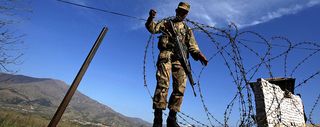
ScreenHunter_04 Mar. 16 09.22 The seeds of neo-religious traditionalism disguised as ‘modern Islam’ were thus sown, and a contemporary identification tool for a number of not-so-clear-minded middle-class youth was discovered. Hijab and beard became ‘cool’; so did the idea of trendy and hip looking folks sounding like 21st century versions of Abul Ala Mauddudi, or worse, yuppie adaptations of Mulla Omar! The tragic 9/11 episode, Bush’s diabolic invasion of Iraq, another military dictatorship in Pakistan, and the rise of the Taliban in the country, all this (and more), eventually began to politicise the otherwise apolitical wave of neo-traditionalist piety, attire and thought that had started sweeping across large sections of Pakistani middle-class.

TV personalities like Zaid Hamid and Aamir Liaquat, and politicians like Imran Khan and Munawar Hussan, are pegs of this new trend, mixing neo-traditionalist trappings of exhibitionistic piety, dress and claims with political discourses that may sound populist and radical, but in fact they are nothing more than the kind of reactionary and myopic mindset that sections of Pakistan’s military establishment started being plagued with during the Afghan jihad under Zia and after. Today society stands clearly polarised.

More here.

The pope’s entire career has the stench of evil about it

Christopher Hitchens in Slate:

100315_FW_PopeTN There are two separate but related matters here: First, the individual responsibility of the pope in one instance of this moral nightmare and, second, his more general and institutional responsibility for the wider lawbreaking and for the shame and disgrace that goes with it. The first story is easily told, and it is not denied by anybody. In 1979, an 11-year-old German boy identified as Wilfried F. was taken on a vacation trip to the mountains by a priest. After that, he was administered alcohol, locked in his bedroom, stripped naked, and forced to suck the penis of his confessor. (Why do we limit ourselves to calling this sort of thing “abuse”?) The offending cleric was transferred from Essen to Munich for “therapy” by a decision of then-Archbishop Joseph Ratzinger, and assurances were given that he would no longer have children in his care. But it took no time for Ratzinger's deputy, Vicar General Gerhard Gruber, to return him to “pastoral” work, where he soon enough resumed his career of sexual assault.

It is, of course, claimed, and it will no doubt later be partially un-claimed, that Ratzinger himself knew nothing of this second outrage. I quote, here, from the Rev. Thomas Doyle, a former employee of the Vatican Embassy in Washington and an early critic of the Catholic Church's sloth in responding to child-rape allegations. “Nonsense,” he says. “Pope Benedict is a micromanager. He's the old style. Anything like that would necessarily have been brought to his attention. Tell the vicar general to find a better line. What he's trying to do, obviously, is protect the pope.”

This is common or garden stuff, very familiar to American and Australian and Irish Catholics whose children's rape and torture, and the cover-up of same by the tactic of moving rapists and torturers from parish to parish, has been painstakingly and comprehensively exposed. It's on a level with the recent belated admission by the pope's brother, Monsignor Georg Ratzinger, that while he knew nothing about sexual assault at the choir school he ran between 1964 and 1994, now that he remembers it, he is sorry for his practice of slapping the boys around.

Very much more serious is the role of Joseph Ratzinger, before the church decided to make him supreme leader, in obstructing justice on a global scale.

More here.

Monday, March 15, 2010

Obama Abroad

by Michael Blim

In Rome, the 64 bus takes all — pilgrims, pickpockets, and just folks — from the Stazione Termini to the Vatican. Though still an armpit-in-face experience, Roman hygiene, commercial deodorants or both have improved, so that one can focus one’s senses on the scene rather than devote some to avoiding smells. While traveling from the Piazza della Repubblica, where the old second hand book stands now must treat with new five star hotels winnowed out of its old colonnades, past the Quirinale and the Banca d’Italia, the last institutional redoubts not under Berlusconi’s control, the Via del Corso, Largo Argentina, and finally over the Bridge into Vatican City, I listened in on an animated conversation among three Roman women of a certain age returning home from a late afternoon walk in Centro. Though their dress was modest, almost matronly, there were enough rings and things to indicate that they were respectable and expected to be taken so. One sported more than a bit of coral and butch, red-dyed hair, suggesting to me that they were ladies of the neighborhoods rather than of the center. Proper, ordinary Roman women, in other words.

Obama-smile-415x253 Obama and American health care was on their minds. What kind of a country was it, they wondered, where half of the people don’t want health care reform? Obama was doing the right and obvious thing, and was being defeated by the lobbies. One opined that Obama was a failure, but her two companions argued that after only one year, it was too soon to tell. The lady in coral was indignant: she would never step foot in America, because what if she got sick? The uninsured don’t get treatment, and the poor are left in “mezzo la strada,’ in the middle of the street, with all of the indignity and danger being left in the street implies.

Three days later, amongst several of Italy’s elite, the refrain was the same. Americans left the uninsured sick in “mezzo la strada,” noted a parliamentarian seated to my right as we discussed the decline of the Italian leadership class amidst the splendor of the main sala of Siena’s Banca Monte dei Paschi, said to be the world’s oldest bank. Obama, once America’s knight in shining armor seemed to be becoming to them America’s Don Quixote, tilting at the windmills of power in a barbarian land. Despite the travesties of current Italian politics – Berlusconi is currently being tried for bribing a judge and consorting with the Mafia in proceedings he refuses to attend while Italy’s equivalent of AT & T was caught wittingly recycling billions of drug dollars made by Calabria’s mob – my hosts found themselves morally refreshed by America’s abysmal example. It took their minds off their troubles.

As I traveled over the Alps and onto Sweden, I expected more of the same, perhaps with more than a little sanctimony mixed in, and deservedly so. What state on the planet could be said to be a true welfare state if not Sweden?

Read more »

Sunday, March 14, 2010

India Will Never Be the Same Again

5152.gamechangerHartosh Singh Bal and Dhirendra K. Jha on the new gender quota for India's parliament, in Open the Magazine:

[W]hatever the short-term impacts on politics and governance, there was something new and refreshing about Sonia Gandhi’s candour on the day the Bill was passed. She told NDTV 24/7, “Well, it is a huge risk, but we have taken risks before. Whenever there is something revolutionary and new, there is opposition. There are difficulties in all parties, perhaps in my party too. But as I said the larger picture of women’s empowerment is more important.” What she has brought to the issue of empowerment is a vision that has been lacking in our politics of pragmatism, a vision that goes beyond the calculus of losses and gains.

A week before the Bill was tabled, she had told the Congress Parliamentary Party, “It is a matter of great pride that even though it has taken so long, it is our government that has cleared the legislation in the Cabinet… This year on 8 March is the centenary of International Women’s Day. What a gift to the women of India, if on this important day this historic legislation is introduced and passed!”

It took a day longer, but the deed was done. For those who had argued the Bill could well wait till the end of the session, it must now be clear that the symbolism of the occasion was central to its passage. In fact, symbolism has been the key to its very conception. The idea of the Bill was born in 1994 as various women’s organisations, including National Federation of Indian Women (NFIW) and All India Democratic Women’s Association (AIDWA), started gearing up for Fourth World Conference on Women due then at Beijing in 1995. This was later reflected in the election manifestos of various parties, including the Left parties, before the Lok Sabha election of 1996. The Deve Gowda Government took the first step, and after the idea of reserving seats was tabled in the Lok Sabha that very year, the Bill was referred to a joint parliamentary committee headed by the Communist Party of India (CPI) leader Geeta Mukherjee. It was this committee that recommended the 33 per cent reservation for women.

Born of symbolism, the impact though will be very real. The time for looking at whether the Bill should have been framed differently is now past. And it remains the case that our contradictory approach to reservations, justice and equity will bring new pitfalls as we continue to evolve our polity. But for the time being, what counts is the impact of the Bill.

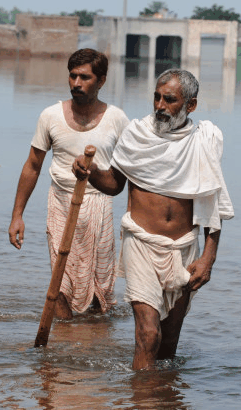
One easy way to measure its impact is to look at Panchayati Raj Institutions (PRI) where the 33 per cent rule has been in force. All the criticisms levelled at the initiative remain valid, the ironic term ‘Sarpanch Pati’ is no aberration—a nationwide survey have shown more women than men have relatives who had contested elections earlier. But it has also shown that 37.3 per cent of all women candidates stand for elections because of this reservation. And that is probably the strongest argument for the Bill. Not that major legislative or normative changes in our politics are likely because of the Bill, but that it will create the perception of participation.

And this perception is what shapes the reality of a more equitable society.

World exclusive! Finnegans Wake nonsense!

From The Guardian:

Statue-of-James-Joyce-by--001 People often wonder, rather unfairly, what exactly academics do with their time; what purpose they serve for culture and society. And now we know: they spend three decades making minor adjustments to Finnegans Wake. Well worth the time and effort, I'm sure you'll agree. No, I'm joking – sort of. Certainly, it's good that there are still people like Danis Rose and John O'Hanlon in our world, who devote themselves to something as knotty, exhausting and defiantly uncommercial as their new edition of that labyrinthine book. It's good that some people still do things for the love of art. On the other hand, in this case, the fact is that all their labours won't make a lick of difference because James Joyce's famously unreadable novel will unquestionably remain, well, unread. Finnegans Wake has attained mythic status, not because of inherent greatness or influence but because most people are unsure if it actually exists, since they've never met, or even heard about, anyone who's finished it. Rose and O'Hanlon say the new version is a “smoother” read – but this is clearly a fib, because Finnegans Wake is not, and never will be, comprehensible to anybody outside of, maybe, God. Maybe.

As I understand it, the book consists of one single word of approximately 550,000 letters. It's the work of linguistic gobbledegook that all other works of linguistic gobbledegook reverentially call “The Supreme Being”. Within days of publication, an entire Finnegans Wake-based industry had sprung up in academia, with eggheads under such pressures of production that they had to sub-contract much of the meta-textual and semiotic analysis work to factories in the Far East. For the rest of the literate world, however, it has remained an impenetrable morass of fevered gibberish, stylistic showing-off and made-up words that you can't even check in the dictionary.

More here.