by Jeff Wilson
I. GONDWANALAND, MIGRATION, AND DINOSAURS
Greater India has long inspired geographers with its singularly wondrous shape: an inverted triangle bounded on two sides by waters of the Indian Ocean and on its third side by the Himalayan Mountain Range. Nourished by the Indus and Ganges Rivers, Greater India covers nearly 4.5 million km². Those more familiar with its geography will know that within Greater India is a smaller triangle known as the Deccan Plateau. Bounded by Western Ghats, Eastern Ghats, and the Satpura and Vindhya Ranges, the Deccan is a catchment area (14,21,000 km2) for several large rivers and sanctuary to many of India’s endemic species. This geography becomes more interesting when we take into account its deeper history and evolution.
Throughout most of the 545 million years during which there has been visible life on Earth (the Phanerozoic Eon), Greater India was not part of Asia, and it was not a peninsula. The majestic Himalayas, the mighty Indus and Ganges Rivers, and the expansive Deccan Plateau did not yet exist. These geographical features, which are integral to modern characterizations of Greater India, did not emerge until well after the extinction of dinosaurs at the end of the Mesozoic Era, 65 million years ago. The Greater India that was known to early dinosaurs and their antecedents was interlocked with Antarctica, Africa, Madagascar, Australia, and South America. These conjoined southern landmasses were called “Gondwana” or “Gondwanaland”, owing to their shared flora and fauna (du Toit 1937; Sorkhabi 1996). The break-up of Gondwana later in the Mesozoic Era remains a fascinating event in Earth history because it led to the creation of islands, each initially seeded with a common flora and fauna, that became progressively isolated from one another. Greater India in particular is interesting because it rifted from Gondwana and drifted across the equator some 6,000 km to Asia. The evolutionary changes and extinction events manifest during that journey remain the subject of investigation by many paleontologists.
Dinosaurs are one of the best groups for studying the potential effects of paleogeographic changes on evolution because dinosaurs were large animals that were capable of traversing continent scale-distances. For example, early in the Mesozoic Era, when the Earth's continental landmasses were connected, dinosaur faunas worldwide are generally similar. Carnivorous dinosaurs from North America, for example, bear striking resemblance to those from southern Africa, and herbivorous dinosaurs from China resemble those from South America. Later in the Mesozoic Era, however, this is not the case. Dinosaur faunas worldwide became more distinctive from one another due to evolutionary changes and extinction associated with increased isolation.
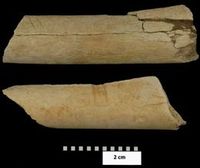
The first reported dinosaur from Greater India was discovered in 1828 by Captain W. H. Sleeman, famous for eradicating the ‘thaggi’ from central India, who encountered bones in Cretaceous sediments on Bara Simla hill near Jabalpur (Sleeman 1844). At that time, the name “Dinosauria” had not yet been coined, and Sleeman's discovery was not formally described and interpreted for some years. After passing through several hands, those first bones finally reached the Geological Survey of India. In 1877, Richard Lydekker named India's first dinosaur Titanosaurus indicus, or “India's titan lizard”. Although the remains were fragmentary (tail bones and a thigh bone), they indicated a large, herbivorous dinosaur that resembled the sauropod Cetiosaurus (“whale lizard”), known from Jurassic rocks of England. Lydekker named other species of Titanosaurus in a second paper in 1879, but few dinosaur discoveries followed.
Read more »