Study uncovers every possible Rubik’s Cube solution

From PhysOrg:

Rubikscube The research, published online, ends a 30-year search for the most efficient way to correctly align the 26 colored cubes that make up Erno Rubrik's 1974 invention. “It took fifteen years after the introduction of the Cube to find the first position that provably requires 20 moves to solve,” the team said. “It is appropriate that fifteen years after that, we prove that twenty moves suffice for all position.” Using computers lent to them by Google — the company won't disclose how many or how powerful they are — the team crunched through billions of Cube positions, solving each one over a period of “just a few weeks.”

The study builds on the work of a veritable pantheon of Rubik's researchers, starting with Morwen Thistlethwaite who in 1981 showed 52 moves were sufficient to reach the solution from any given Cube position. By May 1992, Michael Reid showed 39 moves was always sufficient, only to be undercut a mere day later by Dik Winter, who showed 37 moves would work. Rubik's enthusiasm extends not only to God's number, but the speed with which the tricky puzzle can be solved. The current world record holder is Dutch Erik Akkersdijk who successfully solved the puzzle in just 7.08 seconds.

More here.

Friday Poem

The Book of Dreams

If you dream of scissors,
two women, one light, one dark,
are whispering your name.

If you sit on the front stairs
at the bottom of the sea,
you are going to spend your life
waiting for someone.

If you are on your knees in a closet,
digging through a pile of shoes
you are going to learn something
you do not want to know.

“Madre, dime, what if I dream of the moon?”

“The moon is a woman, Hijo,
she comes, she goes,
she changes her mind.
She has power over women.
This will give her power over you.”

The book of One Thousand and One Dreams Explained
is the only book in our house, and every word is true.
It's big, so big you have to climb a chair
and use both hands to lift the cover—
both hands turn the pages
that stretch out like wings.

by Richard Garcia
from
Touching the Fire
Anchor Books, 1998

Indian Forces Face Broader Revolt in Kashmir

Lydia Polgreen in the New York Times:

ScreenHunter_02 Aug. 13 14.36 The protests, which have erupted for a third straight summer, have led India to one of its most serious internal crises in recent memory. Not just because of their ferocity and persistence, but because they signal the failure of decades of efforts to win the assent of Kashmiris using just about any tool available: money, elections and overwhelming force.

“We need a complete revisit of what our policies in Kashmir have been,” said Amitabh Mattoo, a professor of strategic affairs at Jawaharlal Nehru University in New Delhi and a Kashmiri Hindu. “It is not about money — you have spent huge amounts of money. It is not about fair elections. It is about reaching out to a generation of Kashmiris who think India is a huge monster represented by bunkers and security forces.”

Indeed, Kashmir’s demand for self-determination is sharper today than it has been at perhaps any other time in the region’s troubled history.

More here.

The Passions of Arthur Koestler

Images

During the Cold War, when communism physically enslaved half the world, it also morally enslaved the hearts and minds of Western intellectuals such as Jean-Paul Sartre, who once said “an anti-Communist is a dog,” intending no compliment to dogs. Growing up in Europe at the time, subject to the same fads and fashions as my peers, I felt besieged by the likes of Sartre and his minions, most of whom had never set foot in a communist country (as I had, several times). In May 1968 I found myself in Paris, at the height of the Marxist-inspired student uprising against De Gaulle. It was a baptism of fire that yielded many a Marxist convert, romantics all. It was almost impossible, afterward, to find a coherent opposition to communism that wasn’t tinged with the monarchist or neo-fascist right. I opposed communism, of course, and thought of myself as a democrat, but who was I? A mere teenager, adrift. I longed to hear a mighty voice raised in defense of what I believed. On a friend’s advice, I turned to Arthur Koestler’s Darkness at Noon, one of the great anti-totalitarian documents of all time. That, I felt, was all the vindication I needed. It still is.

more from Roger Boylan at Boston Review here.

after the crackdown

100816_r19914_p233

Early this summer, while walking in the Alborz Mountains outside Tehran, I came across three members of Iran’s reformist Green Movement. It was a parching-hot afternoon, and they had taken shelter from the heat in a cherry orchard next to a stream, where fruit hung glistening from the branches. The Alborz Mountains have long provided refuge, clean air, and exercise for the residents of north Tehran. The northern districts are more prosperous than the rest of the city, and their residents are generally more educated and aware of foreign ideas and trends. North Tehran was not the only locus of the Green Movement, but support there was particularly intense last summer after the conservative hard-liner Mahmoud Ahmadinejad claimed victory in the disputed Presidential elections. One of the most popular hiking trails begins just outside the walls of Evin Prison, where in recent decades thousands of dissidents have been tortured, killed, and buried in secrecy. A few hundred feet away, just across a wooden bridge over a narrow river canyon, the last paved streets of the city end. Along the river’s banks are open-air teahouses, where nostalgic music is played and people drink fresh cherry juice and smoke narghile waterpipes. Such places offer a respite from the restrictions of life in the Islamic Republic, away from the roving units of religious police and the paramilitary Basij, the plainclothes zealots who attacked Green Movement supporters in last year’s protests.

more from Jon Lee Anderson at The New Yorker here.

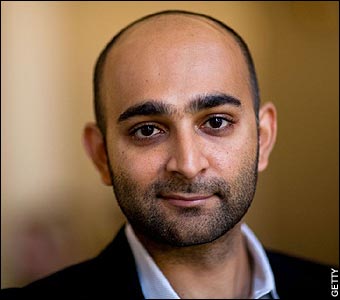
It is feverish and flooded but Pakistan can yet thrive

Mohsin Hamid in the Financial Times:

Portal-graphics-20_1158635a Pakistan’s airwaves and front pages, blogs and cafés are full of the debates of a rambunctious multi-party democracy, one of precious few in the region between India and Europe.

Yet the battle against despair is a constant one. I feel it after each deadly terrorist attack, of which this year there have been half a dozen in Lahore alone, killing some 200 people. I try to shut off my novelist’s imagination when I go to my barber, otherwise I might think that the glass of his window could make effective shrapnel and any of the motorcycles parked outside could be rigged with explosives. I also try not to think too much about the snipers on the rooftops of primary schools and the steel barricades at their gates, telling myself my daughter still has some years left before she has to enrol.

It is difficult, however, to ignore the fact that the electricity to my house is cut off for a third of the day, Pakistan having failed to plan for rapidly growing demand. It is also difficult to ignore a general sense of malaise, of steadily dropping official standards, brought home recently by a tragic aircraft crash and multiple aviation near-accidents in a single week.

And now there are the floods. The worst natural disaster in living memory, they have brought devastation to 14m Pakistanis, a number almost as large as the populations of New York and London combined. Pakistan normally ranks fourth in the world’s production of cotton and milk, and 10th in wheat – but this terrible year it will not.

Slowly and painfully, however, Pakistan should recover. And beyond that, its future need not be bleak.

More here.

Thursday, August 12, 2010

Couture Is Dead

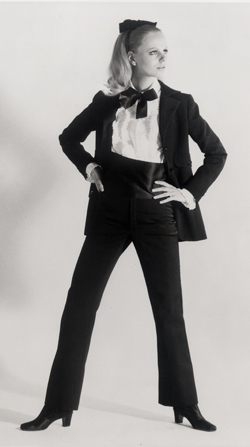
ID_NC_MEIS_YSL_AP_001Morgan Meis on Yves Saint Laurent, in The Smart Set:

Yves Saint Laurent killed himself in January of 2002. He died six years later. When you are as great as he was, you've earned the two deaths. The second death was bodily, cancer finally caught up with him. The first death was in the form of official retirement, the closing down of the Yves Saint Laurent name as it had existed for forty years. During that time, Laurent dominated fashion like no one else. It has been said that he created the modern woman.

There is a retrospective at the Petit Palais in Paris running through the end August where you can walk through those forty years, from his debut “Trapèze” collection with Dior in 1958 to the final collection of evening dresses in 2002. One wall of the exhibit is completely covered with mannequins wearing every version of “le smoking,” the men's tuxedo jacket that Laurent stole for the female wardrobe and re-imagined over the years. That smoking jacket changed women's fashion forever. It is black, sultry and dangerous. A man's smoking jacket made to look sleek and feminine, it says that women's high fashion can have everything it wants, that all the old divisions are nothing.

When Laurent killed off his name and ended his legacy in 2002, he was completing a process that he'd been engaged in all along. Even from that first Trapèze collection in 1958—which was inspired by the costumes trapeze performers used to wear—Laurent was breaking down the boundaries that defined haute couture (high dressmaking). He was actively completing a story of fashion begun in the previous century. And in completing it, he was slowly, over an entire life, laying it in its grave.

Montaigne, Philosopher of Life, Part 6: The Moment is Everything

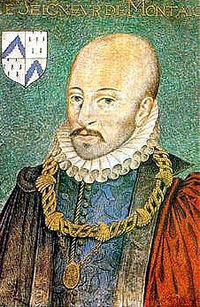
200px-Michel-eyquem-de-montaigne_1 The 6th of Sarah Bakewell's 7 part series on Montaigne, in The Guardian:

In 1580, just after publishing the first edition of his Essays, Montaigne had an audience with Henri III in Paris. Henri said he liked the book very much, to which Montaigne reportedly replied, “Sir, then your majesty must like me”. For, as he always maintained, he and his essays were one. “I have no more made my book than my book has made me”, he wrote, “it is a book consubstantial with its author”.

And this was just the beginning. By the time of its publication, he and his text had been growing together for eight years; now he would add material for 12 more, probably until the year of his death, 1592. More editions came out, and he left annotated copies for a vast posthumous one. He seems to have amazed even himself: “Who does not see that I have taken a road along which I shall go, without stopping and without effort, as long as there is ink and paper in the world?”

All this writing and tinkering rarely took the form of changing anything, or crossing out old versions. When Montaigne thought of some new angle on a question, he usually inserted it without further adjustment, even if this produced contradictions. He preferred not to repent of choices he had made either in literature or in life. His past selves each had their own voice, even if the new Montaigne no longer understood them. Thus, within a paragraph or two of the Essays, we may meet Montaigne as a young man, then as an old man with one foot in the grave, and then again as a middle-aged mayor bowed down by responsibilities. We may listen to him complaining of impotence; a moment later we see him young and lusty and bent on seduction. “I do not portray being”, he wrote; “I portray passing. Not the passing from one age to another … but from day to day, from minute to minute.” His let his thoughts lie where they fell.

Why did he do it? What, really, was he trying to achieve by “essaying” his life for so long? His love of communication had something to do with it. But writing also helped him to live a better life: to become more truly, and more thoughtfully, himself.

In a Train of the Métro

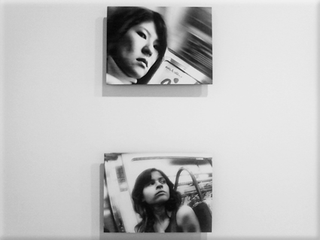
Quelle_heure_est_elleJohn Fitzgerald over at Chris Marker:

Walking over to Peter Blum Gallery in Chelsea to see the new Chris Marker exhibition, I happened to pass by a section of the newly completed High Line, a pedestrian greenspace retrofitted onto an old elevated train track on the West Side. I stopped to look at a curious feature of the renovation: a glass panel cut into the side of the wall overlooking Tenth Avenue. Behind the glass was tiered seating where people sat and watched the traffic beneath them and the pedestrians walking by. The whole image reminded me of a movie theater—tiered seating all facing a rectangular screen—except instead of a screen, there was glass, and instead of a film, there was The Street. Turning onto 29th Street to go to the gallery, I couldn’t think of a better prelude to Marker’s exhibition about watching people on the trains in Paris.

“Chris Marker: ‘Quelle heure est-elle?’” is a meditation on spectacle. Comprised of pieces selected from the early and latter periods of his career as an artist, filmmaker, and photographer, all are united by Marker’s fierce attention to the world around him, be they images of war or faces in the Métro, pictures in magazines or movie posters of imaginary films. The images that make up the exhibition’s title consist of a series of thirty-six black and white photographs of people riding the Métro in Paris between 2004 – 2008. In order to capture his subjects “truer to their inner selves,” he explains, he used a digital wristwatch camera—thereby coming a long way from the 16mm silent film camera that he boldly employed in the crowded trains of Tokyo for Sans Soleil in 1983. “Here I caught them innocent like animals, in the beauty of the jungle,” he notes.1 And while the people he captures—predominantly women—are certainly less aware of his gaze than in much of his previous work, some of the images, while very beautiful, still seem to fall short of being entirely natural. Perhaps the innocence that Marker has sought in images throughout his career is not necessarily more attainable merely with a new technology. As he acknowledges, in this age of the cellphone camera, we are more cognizant of being watched than ever before, and the subway, with its absence of anything interesting in the windows except mirror-like reflections, only heightens this sense. But Marker, for me, is a writer more than he is anything else, and while these photographs are ponderous to look at, I miss the breathless, evocative commentary that accompanies such images in his films. Commentary, in this instance, may be unnecessary though. Why articulate in prose something already so perfectly expressed by Ezra Pound in his poem, “In a Station of the Metro”: “The apparition of these faces in the crowd / Petals on a wet black bough”? This was to be Marker’s epigraph in his previous exhibition, “Staring Back,” in 2007. He dropped it at the time, but was struck by how a reviewer, seeing the photographs, began his review by quoting this poem. “So it was true, after all,” Marker writes, “there existed such a thing as poetry, whose ways are by nature different from the ways of the world, that makes one see what was kept hidden, and hear what was kept silent.”

[H/t: J. M. Tyree]

Eighteen

Natan Dvir in Guernica:

Dvir_israel Although I grew up and spent most of my photographic career in Israel, I felt I did not truly know or understand its Arab society—over a fifth of the population consisting of hundreds of thousands of families who stayed within Israel’s borders after it was established in 1948. This large minority, which is currently experiencing a challenging identity crisis, has been somewhat forgotten amidst the Israeli-Palestinian conflict. In a highly political environment I became interested in the stories of these people living as a minority in a country defined by its majority’s religion. I aim to confront and dispute the widespread misconceptions and stereotypes of the people within my own country who I was brought up to consider more as foes rather than as allies. I decided to focus on Arab men and women at the age of eighteen, a crucial turning point in their lives, when they complete school, become legal adults, and earn the right to vote. Yet unlike their Jewish peers, most do not join the military. By photographing and portraying my so-called “enemy,” I hope to highlight the impact that cultural and internal conflict have had on these young people, personally and collectively.

I chose to photograph my subjects in their close surroundings wishing to present the pictures with a sense of place and attempting to reveal the social context within which they live. The essence of the intimate environmental portraits does not lie in their aesthetics, but rather in their complex dynamics—unwelcoming expressions and body language testifying to the tense nature of our engagement. The portraits are combined with personal testimonies and candid images describing the transformation of my interaction with my subjects and illuminating their lives. Eighteen is an artistic point of contact serving as an invitation to get closer. A project aimed at reconciliation through understanding and respect. An inside view by one who is typically regarded as an outsider. If I, a Jewish Israeli man, have been accepted and was allowed into my subjects’ personal lives, so can others.

More here.

Butchering dinner 3.4 million years ago

From Nature:

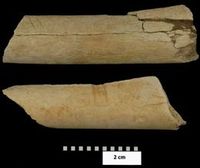
Tools Early hominins were using stone tools to butcher meat as long ago as 3.4 million years, about 800,000 years earlier than previous evidence dates to, scientists report in this week's issue of Nature.1 The finding comes from an examination of animal bones found last year in the Lower Awash Valley of Ethiopia. This site is not far from the spot where the same research team, led by palaeoanthropologist Zeresenay Alemseged of the California Academy of Science, San Francisco, had previously discovered a 3.3-million-year-old juvenile Australopithecus afarensis fossil dubbed 'Lucy's Baby'. That find is one of the most complete skeletons of an ancient human ancestor to be discovered so far2. The animal bones — one from an impala-sized creature, the other from one closer in size to a buffalo — bear cut marks that indicate butchering, says their finder, Shannon McPherron, an archaeologist at the Max Planck Institute for Evolutionary Anthropology in Leipzig, Germany, and a member of Alemseged's team.

This, he says, means that early hominins — presumably Australopithecus afarensis — were not only using tools, but also venturing out of the safety of the forests and onto the plains in search of meat. However, they probably weren't hunting, McPherron says; it is more likely that they were scavenging predator kills. Still, the search for large-animal meat is an important step in human development. “We've put this important, fundamental behaviour back into Lucy's time,” says McPherron, who is lead author of the new study. The same is true for tool usage. Previously, the earliest known date for tool usage was about 2.5 million years ago — right about the time that humanity's own genus, Homo, was first emerging. Now, it seems that tool usage pre-dates our genus. “We're pushing much deeper into our evolutionary past,” McPherron says.

More here.

The Fragile White Blossoms Emit a Hypnotic Cascade of Tropical Perfume Whose Sweet Heady Odor Leaves Its Victim Intoxicated

Johnny Misheff in the New York Times:

11originals-raza-tmagSFShe may not be a household name, but the filmmaker Alia Raza is a name to watch and to drop. Raza, 32, is the creative force behind obscure film and video projects with fittingly abstruse titles like “The Fragile White Blossoms Emit a Hypnotic Cascade of Tropical Perfume Whose Sweet Heady Odor Leaves Its Victim Intoxicated.” Her dazzling cast of subjects is equally enigmatic: the teen blogger Tavi Gevinson, whom Raza recently filmed constructing a dress out of black silk and bubble gum; the artist Terence Koh, whom she had perform surgery on a white cake; and the celebutante-around-town Julia Restoin Roitfeld, who appears in Raza’s coming video project for Six Scents, a feminist take on the mythological Medusa figure. “Their notoriety is an element in the work,” Raza says of the socially prominent actors she picks. “Someone said what I do is like ‘Francesco Vezzoli going downtown,’ which is funny because I live on the Upper East Side.”

More here. [And, yes, that's my niece.]

Thursday Poem

Heart Valve

They told me there’d be pain

so when I felt it,
sitting at my beat-up farm desk

that looks out glass doors

onto the browning garden—plain sparrows
bathing in the cube-shaped fountain

so violently they drain it,

the white-throats with their
wobbly two-note song

on the long way south still,

and our dogs
out like lights and almost

falling off their chairs

freed of the real-time for awhile
as time began for me

to swell, slow down, carry me out

of all this almost
to a where

about as strong a lure as love.

by Elizabeth Arnold

the jutter

ID_PI_GOLBE_BEACH_AP_001

You’d expect the Juttersmuseum on the little Dutch island of Texel to have an air of melancholy or something like that. Its raison d’être is loss. But the Juttersmuseum is the site of what-once-was-lost-now-is-found, no regrets, no apologies. It is a place of redemption, reclamation, more like a church than an orphanage. There’s a type of beachcombing that is the hobby of the virtuous, who try to comb all evidence of humans from the beach. They are enemies of pollution, stewards of nature. The beachcleaner wants the beach to be clean, for the greater good of people and nature alike, and cleaning the beach is an act of generosity on the part of the cleaner. Still, there is a hint of contempt in the beachcleaner. The beachcleaner finds manmade debris exasperating, infuriating, knows secretly that because beachcleaning is a Sissyphisian task, it is the work of martyrs, and beaches are the cause of perpetual heartache. The beachcleaner wishes, ultimately, to cleanse the beach free of us for us.

more from Stefany Anne Golberg at The Smart Set here.

no one knows

100809_DIS_russianFireEX

People are quiet in Moscow these days. First, because the one thing on everyone’s mind—this summer’s unremitting heat wave—has generally been deemed an impolite topic of conversation. If one does broach the topic, one must first make excuses: “I am sorry, but this is going to be about the weather.” Second, because it is plain boring: Even the newspapers and radio stations have stopped reporting the all-time heat records, to which the city’s thermometers attest daily. In a city where 90-degree days used to be rare—not even annual—occurrences, 100 degrees has become the new normal. Third, it is plainly difficult to talk: The air is thick with smoke from wildfires and peat fires burning in and just outside the city, and breathing this air tends to make one’s throat dry and scratchy. There is no relief in sight. Few Muscovites’ apartments are equipped with air conditioning, and the stores ran out of electrical fans in the middle of last month. Most pedestrians still in the streets have donned surgical masks, even though doctors warn that they do nothing to keep out the tiny particles that fill the air; nor, for that matter, do air conditioners. For weeks, the weather forecasters have promised that the heat will let up in about 10 days’ time—but as the days march on, the amount of time separating us from that illusory cold front refuses to shrink.

more from Masha Gessen at Slate here.

on background

De witte_1.jpg.crop_display

Europe’s cathedrals, churches, monasteries, and baptisteries cover the countryside like Veronica’s veil. They comprise the continent’s landmarks and focal attractions and, for centuries, have been integral to its culture. It is curious, then, that, in the history of art, architecture has been a relatively infrequent subject—in Western painting before 1900, only scattered examples come to mind, such as the Dutch seventeenth-century church interiors by Emanuel de Witte (pictured here) or the panoramas of Venice by Canaletto. The words art historians most frequently summon to describe the role of architecture in painting echo most people’s daily experience with architecture: Again and again, one reads dismissals of architecture as merely a “framing device.” If architecture seems a minor player in the Western tradition, it appears even less significant in Byzantine art, an amorphously defined aggregation of objects dating from the third century to as late as the early nineteenth. The pieces are united by religious subject (Christianity), geographic origin (parts of eastern Europe, western Asia, and the Middle East), and a flat, non-realistic, and boldly delineated style. And painting after painting (after painting) suggests that, to Byzantine artists, architecture meant little.

more from Sarah Williams Goldhagen at TNR here.

Wednesday, August 11, 2010

Kurt Vonnegut at the Blackboard

The late Kurt Vonnegut in Lapham's Quarterly:

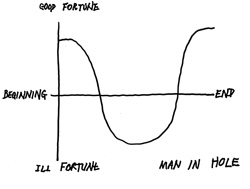
Vonnegut1-thumb-250x189-1098 I want to share with you something I’ve learned. I’ll draw it on the blackboard behind me so you can follow more easily [draws a vertical line on the blackboard]. This is the G-I axis: good fortune-ill fortune. Death and terrible poverty, sickness down here—great prosperity, wonderful health up there. Your average state of affairs here in the middle [points to bottom, top, and middle of line respectively].

This is the B-E axis. B for beginning, E for entropy. Okay. Not every story has that very simple, very pretty shape that even a computer can understand [draws horizontal line extending from middle of G-I axis].

Now, I don’t mean to intimidate you, but after being a chemist as an undergraduate at Cornell, after the war I went to the University of Chicago and studied anthropology, and eventually I took a masters degree in that field. Saul Bellow was in that same department, and neither one of us ever made a field trip. Although we certainly imagined some. I started going to the library in search of reports about ethnographers, preachers, and explorers—those imperialists—to find out what sorts of stories they’d collected from primitive people. It was a big mistake for me to take a degree in anthropology anyway, because I can’t stand primitive people—they’re so stupid. But anyway, I read these stories, one after another, collected from primitive people all over the world, and they were dead level, like the B-E axis here. So all right. Primitive people deserve to lose with their lousy stories. They really are backward. Look at the wonderful rise and fall of our stories.

More here.

Death to Belgium!

I mean, what has it done for the Flemish or the Walloons lately?

Our own Morgan Meis in The Smart Set:

Untitled A war has been brewing in Europe and no one seems to care. Admittedly, the hostilities have been mild so far: hurt feelings, insults, diplomatic wrangling. Yves Leterme (a Flemish politician) questioned whether people in the French-speaking part of Belgium have the “intellectual capacity” to learn Dutch. Belgium, Leterme suspects, holds together as a nation only because of three things: “king, national football team and certain beers.” Not even all the beers.

Belgium is not the most obvious candidate for a unified state. It is, and arguably always has been, deeply and fundamentally divided between the French-speaking southern half of the country (Wallonia) and the Dutch-speaking northern half of the country (Flanders). The separation runs back to the Frankish invasions of the area back around the fifth century, which is a pretty longstanding divide even by European standards. Speaking of that era, Belgian historian Emile Cammearts wrote:

The Franks settled in the north, the Romanized Celts or “Walas” occupied the south. The first are the ancestors of the Flemings of today, the second of the Walloons, and the limit of languages between the two sections of the population has remained the same. It runs today where it ran 14 centuries ago, from the south of Ypres to Brussels and Maestricht, dividing Belgium almost evenly into two populations belonging to two separate races and speaking two different languages.

I can personally attest to the lack of Belgian national sympathies among many Belgians. The Belgian National Holiday on July 21 just passed by with little fanfare in Antwerp, where I have been living. It seemed largely an excuse to take a day off. This is in contrast to the holiday of Flemish pride on July 11, which was greeted with rock-and-roll performances in the city’s main square and general merriment in the streets. The holiday celebrates a 1302 battle, the Battle of the Golden Spurs, in which a bunch of proto-Belgian Flemish militiamen lured a group of French knights into a swamp and cut them to pieces. They kept the golden spurs of the French as trophies. The French knights were there in the first place because the citizens of Bruges had summarily executed everyone in the city who spoke French.

More here.

How oxytocin is shaking up the field of economics

Michael Haederle in Miller-McCune:

090120oxytocin The neuroeconomist Paul Zak is driving west along Interstate 10 on a gorgeous Southern California morning. As we pass emerald hillsides, glowing from recent rains, and the snow-blanketed ridges of the San Gabriel Mountains, Zak talks about how standard economics neglects the biological mechanisms of trust that underlie myriad human interactions. “Why people cooperate — why people are altruistic — is a huge question,” he says. “When you think about how much of the world works on a handshake or on holding a door open for somebody in an airport, all that kind of falls through the cracks in economics.”

Zak and his collaborators at Claremont Graduate University have found that oxytocin, a hormone produced in the brain that promotes human bonding, plays a powerful role in shaping how generous people are. He calls it “the moral molecule.” “It’s a whole different model,” Zak says. “It tells us why global commerce works — because there is a motivation to reciprocate.”

People release oxytocin (pronounced ok-si-toh-sun) in settings that promote feelings of trust and safety, Zak has found, and their behavior becomes more trusting and generous in return. He envisions workplaces structured to reinforce this cycle.

More here.