Leila in the Wilderness

Nadeem Aslam in The Guardian:

Minarets-in-Hyderabad-006

To coincide with Granta's publication of its issue devoted to the best new writing from Pakistan, an extract from one of its standout stories.

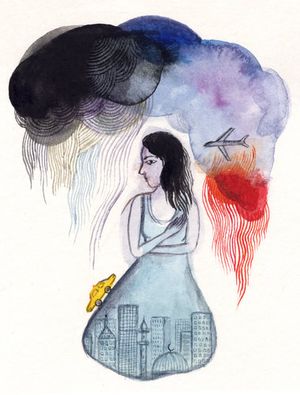
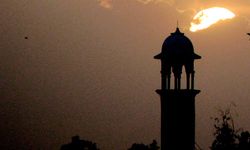
In the beginning, the great river was believed to flow out of a lion's mouth, its size reflected in its ancient name – Sindhu, an ocean. The river was older than the Himalayas; the Greeks had called it Sinthus, the Romans Sindus, the Chinese Sintow, but it was Pliny who had given it the name Indus. One night under the vast silence of a perfect half-moon and six stars, a mosque appeared on a wooded island in the river, and Leila was woken by the call to prayer issuing from its minaret just before sunrise. It was the day she was to be blessed with a son. As she knew there was no mosque within hearing distance, her initial impression was that the air itself was singing. Leila manoeuvred herself out of bed and went towards the door, making sure not to disturb her mother-in-law who had taken to sleeping in the same room as her in these last days before the birth. The servant girl appointed outside the door had fallen asleep, and as Leila moved past, a bad dream caused the girl to release a cry of fear.

Leila was fourteen years old, thin-framed with grey, glass-like eyes and a nervous flame always burning just beneath her pale skin. She pursued the song of faith drifting in the fifty-roomed mansion that had been in her husband's family for several generations. The river with its boats and blind freshwater dolphins and drowned lovers was half a mile away, and there was nothing but rocky desert and thick date orchards between the riverbank and the mansion. Long after the voice withdrew, she continued her search for its origins, now and then placing an ear against a wall. Earlier in the night she'd heard momentary fragments of other songs from the men's side of the mansion, where her husband was celebrating the imminent arrival of his first son in the company of musicians and prostitutes. No doubt they were all asleep by now.
More here.
harmonic dissonance

Auer_468w

Refecting on the changed nature of Europe 20 years after the collapse of communism, a perceptive British sociologist proclaimed boldly that “we are all post-communist now”.[49] This is to be understood not as a description of political reality in contemporary Europe, but rather as a challenge that European nations and their elites in both East and West must take seriously, if the European project is to succeed. In a similar vein, when Jerzy Buzek, on his election as President of the European Parliament, proclaimed in his acceptance speech that “there is now no ‘you’ (in the West) and ‘us’ (in the East): we live in a shared Europe”, it was a statement of intent, rather than a statement of fact.[50] Debates about key historic events and their meaning serve as a reminder that there are still significant divisions between the two parts of Europe that used to be divided by the Iron Curtain, just as there are divisions between the nations of Europe regardless of their geographic location. Yet, to accept that a Europe of 27 nation-states must live with discord is true to the legacy of EU founding fathers such as Jean Monnet and Konrad Adenauer, as much as it is to the legacy of the architects of the Velvet Revolutions of 1989 such as Adam Michnik and Vaclav Havel. With their mixture of idealism and pragmatism, these Europeans understood that the true meaning of politics consists in accepting dissonance while not giving up aspirations for more harmony.

more from Stefan Auer at Eurozine here.

the Saha­rawis

20100908_2010+36sahara_w

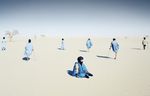
In the far western expanse of the Sahara is the world’s longest continuous wall. It starts in Morocco and slithers down through the desert for 2,400 kilometres to the Atlantic Ocean. More than 130,000 soldiers line its perimeter. Made of sand and stone, it stands one and a half metres wide and between two and three metres tall, and has command posts every two miles. Motion sensors, barbed wire and several million landmines provide an extra layer of defence. For most of its course, it cuts across a sparsely populated region that Morocco regards as its southern provinces. On maps the area appears as Western Sahara. The UN calls it a “non-self-governing territory”. It is Africa’s last colony, where a near-forgotten liberation war lies dormant. The wall is sometimes referred to as Hassan’s Wall, after King Hassan II of Morocco, who annexed most of what was then called Spanish Sahara when Spain pulled out in 1976. About half of the indigenous population, the Saha­rawis, who had been promised a vote on self-determination by Spain, fled across the desert to refugee camps in an inhospitable corner of Algeria in order to escape Moroccan rule.

more from Xan Rice at The New Statesman here.

Hybrids May Thrive Where Parents Fear to Tread

From The New York Times:

CREA-2-popup In 2006, a hunter in the Canadian Arctic shot a bear that had white fur like a polar bear’s but had brown patches, long claws and a hump like a grizzly bear’s. DNA analysis confirmed the animal was a hybrid of the two species.

While one might think that these oddities are examples of some kind of moral breakdown in the animal kingdom, it turns out that hybridization among distinct species is not so rare. Some biologists estimate that as many as 10 percent of animal species and up to 25 percent of plant species may occasionally breed with another species. The more important issue is not whether such liaisons occasionally produce offspring, but the vitality of the hybrid and whether two species might combine to give rise to a third, distinct species. While several examples of human-bred animal hybrids are well known and can thrive in captivity including zorses (zebra-horse), beefalo (bison-beef cattle) and, of course, mules (donkey-horse), naturally occurring animal hybrids have many factors working against their longer-term success.

More here.

mao’s greatest horror

Mirsky_09_10

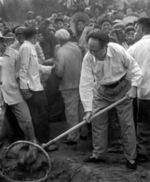
In 1936 Mao Tse-Tung, then a cave-dwelling revolutionary, told Edgar Snow his life story. Snow recorded Mao’s self-serving autobiography in Red Star Over China, which for decades made the American’s name as the leading reporter in China. Back in China twenty-four years later, Snow was pestered by news agencies enquiring about mass starvation. The Snow of the 1930s had gone into the field to see for himself a prolonged drought in the north-west, where people were rumoured to be selling their children. But this time he relied on his access to top officials such as Premier Zhou Enlai, and foreigners who flacked for China such as the New Zealander Rewi Alley. In the book he wrote about that trip, The Other Side of the River, Snow stated, ‘I saw no starving people in China … Considerable malnutrition undoubtedly existed. Mass starvation? No.’ And most positively: ‘Whatever he was eating, the average Chinese maintained himself in good health, as far as anyone could see.’

more from Jonathan Mirsky at Literary Review here.

Monday, September 13, 2010

Sunday, September 12, 2010

My Nine Years as a Middle-Eastern American

POROCHISTA KHAKPOUR in The New York Times:

Khakpourimg-popup Little did we know that it would take almost a full decade for the proverbial 9/11 fallout to fall out, for anti-Muslim xenophobia to emerge, fully formed and fever-pitched, ostensibly over plans to build an interfaith cultural center near ground zero. Even in New York, stronghold of progressive ethics and cultural diversity, my former home of 12 years, August 2010 became the evil twin of that still-innocent August 2001. In addition to the mosque, of course, there was the Florida pastor who wanted to burn Korans on the Sept. 11 anniversary, and who has yes-no-maybe-so reconsidered, after a hearty load of negative press and a dab of executive-branch headshaking. And, hey, what do you get when you put a drunk white college student, who had actually been to Afghanistan, into the cab of a Bangladeshi Muslim? The wrong answer and a stabbing, allegedly.

It’s one test I would have passed. For the record: I am not Muslim. My immediate family ultimately kept us as agnostic as possible; religion went only as far as my mother praying to the American concept of a guardian angel and my dad “studying” Zoroastrianism. But most of the extended Khakpours are Muslim and, culturally, it’s a part of me insofar as I am a Middle Easterner. I am also a New Yorker, a deal that was sealed forever nine years ago. I had just moved from Brooklyn to downtown Manhattan to shack up with a boyfriend. The studio was 25 floors up, with a nearly all-glass wall that framed a perfect view of the World Trade Center. Now, when I look back on ages 23 to 32, every aspect of my life is shadowed by what I saw through the glass that blue-and-gold Tuesday morning: two towers, each gashed and stunningly hazed in the glitter of exploding windows, falling, one after the other, over and over again. But what was once simple apprehension and mortification and trepidation has become increasingly entangled with feelings of exhaustion and marginalization and even indignation.

More here.

Sunday Poem

Errors

How wide the gulf between o and i:
He loves with his wife and daughter
in New Haven
, his bio read.
An accident of the hands, funny
in the way wrecks often are.

But don't discount the hands,
the way they know the girl will return
one day from college with her arms spilling
like her mother's once did. How he'll see
her almond sweater and the snow

as it stops in the window, and he'll wish
he'd had sons. He'll be vigilant
from here on, aware of the sanctity of letters.
He'll realize as never before that his wife's
and daughter's names both begin with C—

that they are both about sight,
about water. The difference between live
and love will expand to dive and dove,
and he won't know present
from past, past from flying.

For now, he sometimes opens
his wife's shirt in the kitchen,
and wants but does not want
to find someone looking—his daughter,
the mowing neighbor, anyone—

as if to confirm, so that he may say
in the end: Once, there were two bodies
in the same place, and one of them was mine.

by Bethany Tyler Lee
from The Cortland Review,
Issue 48, August 2010

Immortal

From Lensculture:

Speers_immortals_2 The idea of stopping time and preserving fleeting moments is, in many ways, at the heart of photography and central to human desire. Psychologically and emotionally, humans have always dreaded growing old, losing youthful vigor, and falling prey to the weaknesses of old age, faulty memories, morbidity, decay and death. These fears and anxieties are deeply rooted in our psyches, and have been played out in ancient myths, classical painting, modern poetry, theater and cinema, as well as in practically every other art form in the history of humanity, including digital gaming. We don’t want to grow old and weak, nor do we want our children and loved ones to grow old. We would like to stay forever young. We want to be beautiful, desirable, powerful and perfect like gods and goddesses. Or at least we think we do.

Vee Speers’ latest body of photo-based art, aptly titled Immortal, plays to these age-old sensibilities and timeless longings while riffing on the very contemporary convergence of similar ideas, ideals, and forms that have invaded our consciousness in our media-driven, technology-rich consumer cultures.

More here.

How animals made us human

From The Boston Globe:

Animal Who among us is invulnerable to the puppy in the pet store window? Not everyone is a dog person, of course; some people are cat people or horse people or parakeet people or albino ferret people. But human beings are a distinctly pet-loving bunch. In no other species do adults regularly and knowingly rear the young of other species and support them into old age; in our species it is commonplace. In almost every human culture, people own pets. In the United States, there are more households with pets than with children. On the face of it, this doesn’t make sense: Pets take up resources that we would otherwise spend on ourselves or our own progeny. Some pets, it’s true, do work for their owners, or are eventually eaten by them, but many simply live with us, eating the food we give them, interrupting our sleep, dictating our schedules, occasionally soiling the carpet, and giving nothing in return but companionship and often desultory affection.

What explains this yen to have animals in our lives?

An anthropologist named Pat Shipman believes she’s found the answer: Animals make us human. She means this not in a metaphorical way — that animals teach us about loyalty or nurturing or the fragility of life or anything like that — but that the unique ability to observe and control the behavior of other animals is what allowed one particular set of Pleistocene era primates to evolve into modern man. The hunting of animals and the processing of their corpses drove the creation of tools, and the need to record and relate information about animals was so important that it gave rise to the creation of language and art. Our bond with nonhuman animals has shaped us at the level of our genes, giving us the ability to drink milk into adulthood and even, Shipman argues, promoting the set of finely honed relational antennae that allowed us to create the complex societies most of us live in today. Our love of pets is an artifact of that evolutionary interdependence.

More here.

Saturday, September 11, 2010

Big Sometimes Friendly Giant

Dahl100913_1_250Sam Anderson reviews Donald Sturrock’s new biography of Roald Dahl Storyteller, in NY Magazine:

Many of Roald Dahl’s book covers today come stamped with an official-looking logo proclaiming him “The World’s No. 1 Storyteller.” The declaration is, like Dahl’s fiction itself, simultaneously thrilling and absurd and puzzling and oddly disturbing. How, one has to wonder, was the ranking determined? Was there some kind of single-elimination global storytelling showdown, in which the creator of Willy Wonka, presumably as an eighth-seeded underdog, managed to out-yarn a bracket of, say, Jack London, Salman Rushdie, Isak Dinesen, Victor Hugo, Lewis Carroll, Mark Twain, and—in what must have been a squeaker of a final—the mighty Dickens? And even if we do accept that result, isn’t the title somehow slightly patronizing? After all, we don’t celebrate Faulkner or Conrad or Shakespeare primarily as “storytellers.” It would be like calling a master chef “The World’s No. 1 Pan-Fryer”—a great compliment, but also one that immediately raises questions about his ability to bake, braise, roast, grill, stew, poach, and flambé.

Dahl was, indeed, a great storyteller: Anyone who doubts that can pull aside a random child on the street and start reading her James and the Giant Peach or Fantastic Mr. Fox. If an adult comes up to object, you can start reading him one of the short stories: maybe “Taste” (in which a dinner-party bet among wine connoisseurs spirals out of control) or “The Sound Machine” (in which a man can hear plants screaming). If a policeman intervenes, read him “Lamb to the Slaughter,” in which a woman kills her husband with a frozen lamb chop, then cooks and feeds it to the detectives who come to investigate. You could probably go on like that forever.

Dahl’s own favorite of his yarns was The BFG, a children’s book in which the eponymous hero, the Big Friendly Giant, walks around city streets at night blowing dreams through a long tube into kids’ bedroom windows. The giant keeps thousands of dreams stored in neatly labeled glass jars in his cave—with the good ones (what he calls “phizzwizards”) carefully segregated from the bad (“trogglehumpers”). “I IS ONLY AN EIGHT YEAR OLD LITTLE BOY,” runs one of the good dreams, “BUT I IS GROWING A SPLENDID BUSHY BEARD AND ALL THE OTHER BOYS IS JALOUS.” (The BFG is a self-taught writer: He learned to read from a borrowed copy of Nicholas Nickleby, whose author he identifies as “Dahl’s Chickens.”) One of the giant’s best dreams reads like a mission statement for Dahl’s career:

I HAS RITTEN A BOOK AND IT IS SO EXCITING NOBODY CAN PUT IT DOWN. AS SOON AS YOU HAS RED THE FIRST LINE YOU IS SO HOOKED ON IT YOU CANNOT STOP UNTIL THE LAST PAGE. IN ALL THE CITIES PEEPLE IS WALKING IN THE STREETS BUMPING INTO EACH OTHER BECAUSE THEIR FACES IS BURIED IN MY BOOK AND DENTISTS IS READING IT AND TRYING TO FILL TEETHS AT THE SAME TIME BUT NOBODY MINDS BECAUSE THEY IS ALL READING IT TOO IN THE DENTIST’S CHAIR.

Democracy After Citizens United

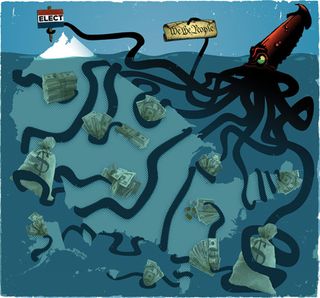
Ndf_35.5_octobucks Lawrence Lessig in the Boston Review:

Institutional corruption does not refer to the knowing violation of any law or ethical rule. This is not the problem of Rod Blagojevich, or, more generally, of bad souls acting badly. It instead describes an influence, financial or otherwise, within an economy of influence, that weakens the effectiveness of an institution, especially by weakening public trust in that institution. (An “economy of influence” rather than the simpler “system of influence” to emphasize the reciprocal character of such influence, often requiring little or no direct coordination.)

Congress is a paradigm case. Members of Congress run privately financed campaigns. The contributions that fund those campaigns are not illegal, or even unethical. To the contrary, they are protected speech under the First Amendment.

Yet arguably—or maybe obviously—those contributions are (1) an influence (2) within an economy of influence that has (3) (quite likely) weakened the ability of Congress to do its work, by (4) (certainly) weakening public trust in Congress. The vast majority of Americans believe money buys results in Congress; less than a quarter of Americans believe the institution worthy of their trust. When “free-market” Republicans vote to support milk subsidies or sugar tariffs, or when “pro-consumer” Democrats vote to exempt used-car dealers from consumer financial-protection legislation, it is easy to understand the mistrust and hard to believe that the influence of money hasn’t weakened the ability of members to serve the principles, or even the interests, they were elected to represent.

This is “corruption” not because it describes the acts of evil or corrupted individuals. Members of Congress are insanely hard-working, decent souls, the overwhelming majority of whom entered public service to do good, as they see it. And indeed, the traditional corruption of politics—bribery—is likely at its lowest point in American history. From the perspective of criminal law, this is among the cleanest Congresses ever.

Instead, this is “corruption” because it weakens the integrity of the institution, of Congress itself.

Responses from Will Wilkinson, Marvin Ammori, and David Donnelly, with others to come, can be found here.

Berlusconi’s Machiavellian Moment

AP100830132500_jpg_470x420_q85 Ingrid D. Rowland in the NYRB blog:

Several remarkable things have happened here in Italy in the past week.

One: Prime Minister Silvio Berlusconi, that self-styled man for all seasons—tycoon, soccer team owner, politician, crooner, swain—the perennial fixer who not too long ago said, in Milanese dialect, ghe pensi mi, “I’ll take care of it”—“il premier,” il Cavaliere (that is, Sir Silvio), has apparently been driven by the present political situation to say, “I don’t know what to do.” And he doesn’t, though a few days of reading Machiavelli and Thucydides might provide him with a clue or two. (Beginning with Chapter 23 of The Prince: “How Flatterers are to be Shunned.”)

Two: The independent television channel La7 (Channel Seven) is stealing viewers from all the other channels—all but one of which are controlled directly or indirectly by Berlusconi—by providing real news, and forcing the speakers on its talk shows to observe the basics of civil behavior. (The norm on the other channels is for everyone to shout at once, except Umberto Bossi, head of the Northern League, whose speech is impaired by a stroke—but his middle finger is fat and fit). Its evening newscast is conducted by Enrico Mentana, who has worked in the past for both the RAI state TV and Berlusconi’s Channel 5.

Three: Gianfranco Fini, the President of the lower house of Parliament, used a speech on September 4 to break publicly with Berlusconi in a way that brooks no return.

Busted: Stories of the Financial Crisis

Joshua Clover in The Nation:

For all the fame surrounding Milton Friedman, Ayn Rand and Alan Greenspan, their contributions to a political economy of modern capitalism are minor in relation to those of Friedrich von Hayek, a founder of the Mont Pelerin Society and prophet of the “price signal.” A striking and original intellect, Hayek argued that something's market price is not simply what it would cost you but a kind of information used to allocate goods and services most efficiently within the social matrix. Because centrally planned economies lack a mechanism to price commodities correctly, they are unable to put things where they need to go. Individuals wouldn't get what they desired; the larger economy would be unable to balance production and consumption, supply and demand. Shortages would appear cheek by jowl with surpluses. This would have disastrous and eventually fatal consequences, not only for the market but for the lives of its subjects.

The free market, contrarily, able to revalue every object with supple velocity according not to some ideological program but the aggregate will of the people—not just the invisible hand but the invisible spirit, as it were—was more suited not simply to survival but to individual freedom. Hayek's case, best known from The Road to Serfdom (1944), remains the most rigorously persuasive brief for twentieth-century capitalism in its long, acrimonious and cordite-scented war against every other form of life. At the time, the 1989 collapse of the Soviet bloc, and the discrediting of its economic hypotheses, seemed to confer on Hayek's insight the aura of truth.

And yet, having triumphed more or less absolutely, the American model of capitalism has proved itself to be catastrophically lacking in the very balance that Hayek suggested was its singular virtue.

‘Must we dream our dreams?’

From The Guardian:

Elizabeth-Bishop-006 Elizabeth Bishop's status as one of the greatest American poets of the 20th century is based on the smallest of oeuvres. Some 70 poems were published in her lifetime in four very slim volumes. She died in 1979, aware that her reputation was steadily increasing, eclipsing that of her close friend and fellow poet Robert Lowell. Since her death and the publication of two superb volumes of her correspondence, One Art and Words in Air (letters between her and Lowell) it has grown ever more secure. In the select pantheon of 20th-century poets writing in English, she is placed with TS Eliot, WB Yeats, Wallace Stevens and WH Auden. Her poems often took her years to write and complete, and their formal perfection and the simple, limpid accuracy of their language have always drawn the admiration of other poets. John Ashbery called her “the writer's writer's writer.”

More here.

Code World

From The New York Times:

Book There are many stories Tom McCarthy chooses not to tell in “C,” his tour de force new novel encompassing the short life of one Serge Carrefax, born at the turn of the 20th century on a rural English estate. Serge’s father, a manic tinkerer with early wireless technology, runs a school for the deaf but seems oblivious to his own deaf wife, Serge’s mother, who’s so blinkered on opium (supplied by a mute gardener who grows the poppies himself) that she nearly lets Serge drown in a creek at age 2. Serge’s beloved older sister, Sophie, becomes sexually involved with a friend of their father’s and winds up committing suicide at 17 — possibly after having an abortion. Serge’s relationship to Sophie is preternaturally close, with incestuous overtones, and her death severs his only real human connection. But these dramas are merely suggested, their shadowy outlines ignored, sublimated or flat-out denied by those involved; Sophie’s self-poisoning is deemed an accident.

McCarthy, author of the ingenious 2006 novel “Remainder,” withstands the temptations of emotional plotting and holds out instead for something bigger, deeper, more universal and elemental. “C” is a rigorous inquiry into the meaning of meaning: our need to find it in the world around us and communicate it to one another; our methods for doing so; the hubs and networks and skeins of interaction that result. Gone is the minimalist restraint he employed in “Remainder”; here, he fuses a Pynchonesque revelry in signs and codes with the lush psychedelics of William Burroughs to create an intellectually provocative novel that unfurls like a brooding, phosphorescent dream.

More here.