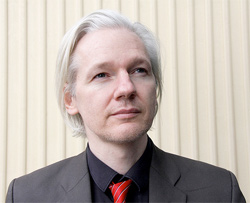
In the late 1980’s, glasnost – transparency – was one of the nails in the coffin of the Soviet Union. While WikiLeaks has certainly not had a similar effect, it epitomizes the extent of the individual’s empowerment in a networked world. All that was necessary to challenge the world’s mightiest power, after all, was a disgruntled US Army intelligence analyst, some hacking knowledge, a few computers, and a handful of determined activists enrolled under the contested banner of transparency.
At the time she was named Director of Policy Planning at the US State Department, Anne-Marie Slaughter, a respected scholar of international affairs, boldly heralded the advent of a networked world. “War, diplomacy, business, media, society…are networked,” she wrote in Foreign Affairs in January 2009, and “in this world, the measure of power is connectedness.” Having the greatest potential for connectivity, America has the edge in a “networked century.”
This drive prompted US Secretary of State Hillary Clinton in January 2010 to proclaim the “freedom to connect” as the cyber-equivalent of the more familiar freedoms of assembly or expression. Of course, Clinton added, these technologies are not an unmitigated blessing, and can be misused for darker purposes. But her list of the potential abuses of the connected world contained nothing similar to the WikiLeaks storm.
That storm will leave behind no trace of understanding if it is assessed in isolation, rather than as part of a broader pattern. WikiLeaks’ latest release demonstrates that the transformation of power by the “digital revolution” could be as far-reaching as that brought about by the fifteenth-century printing revolution. In this game, where new players invite themselves, the edge goes to agility and innovation.
Second, Evgeny Morozov in The Christian Science Monitor: