an escape artist of the imagination

Ghoststill

As ahead of her time as she was in some ways, she was very much a Victorian in others—Craddock regarded homosexuality as a perversion and deplored masturbation of any kind, which by her definition included manual and/or lingual stimulation of the genitals. “There is but one lawful finger of love,” she wrote, “the erectile organ of the male.” She discouraged clitoral contact as well, instructing couples that that organ should be “saluted, at most, in passing, and afterwards ignored as far as possible.” Not surprisingly, many of her male clients hit on her. “There are times,” she wearily confided in her case notes, “when I think maleness in men is something diabolical and loathsome.” In other ways, she sounded altogether modern:

Just as long as wives remain, by reason of their wifehood, economically dependent upon their husbands, just as long as they are willing to fill, at one and the same time, the various positions of cook, chambermaid, seamstress, laundress, housekeeper, child’s nurse, governess and concubine, with no salary for their exhausting labors and remuneration beyond their board and clothing—and often not that: Just so long will marriage mean for the average wife sexual slavery and thankless household drudgery.

Craddock’s mother attempted to have her forcibly committed to an asylum on several occasions; worse still, her lecture on the benefits of belly dancing, which had been introduced to America at the Chicago World’s Fair, brought her to the attention of Anthony Comstock of the New York Society for the Suppression of Vice. Constantly harassed by the authorities, Craddock moved frequently, making a precarious living as a secretary while pursuing her research and counseling on the side. She lived in San Francisco, Denver, and Chicago (where she started her Church of Yoga—and where her books were seized and burned after Clarence Darrow negotiated a plea bargain that kept her out of jail). She moved to Washington, DC, where she was arrested and expelled from the city.

more from Arthur Goldwag at Killing The Buddha here.
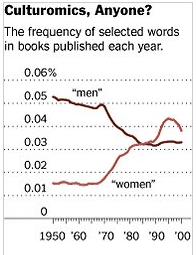
In 500 Billion Words, New Window on Culture

Patricia Cohen in the New York Times:

ScreenHunter_01 Dec. 17 15.47 With little fanfare, Google has made a mammoth database culled from nearly 5.2 million digitized books available to the public for free downloads and online searches, opening a new landscape of possibilities for research and education in the humanities.

The digital storehouse, which comprises words and short phrases as well as a year-by-year count of how often they appear, represents the first time a data set of this magnitude and searching tools are at the disposal of Ph.D.’s, middle school students and anyone else who likes to spend time in front of a small screen. It consists of the 500 billion words contained in books published between 1500 and 2008 in English, French, Spanish, German, Chinese and Russian.

The intended audience is scholarly, but a simple online tool allows anyone with a computer to plug in a string of up to five words and see a graph that charts the phrase’s use over time — a diversion that can quickly become as addictive as the habit-forming game Angry Birds.

With a click you can see that “women,” in comparison with “men,” is rarely mentioned until the early 1970s, when feminism gained a foothold. The lines eventually cross paths about 1986.

More here.

Tea and Antipathy

From The New Yorker:

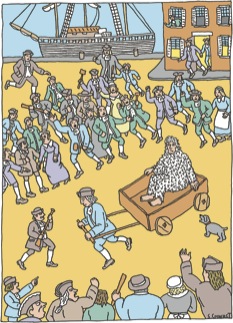
Pix What did the American Revolution look like? Nathaniel Hawthorne imagined it as an angry face, painted so as to appear divided in two. “One side of the face blazed of an intense red, while the other was black as midnight,” he wrote. This uncanny visage appears in Hawthorne’s tale “My Kinsman, Major Molineux,” of 1831; its owner rides on horseback through moonlit Boston streets, carrying a drawn sword and leading a mob of people who laugh and shout as they wheel along a rich elderly man whom they have tarred and feathered.

Hawthorne’s “double-faced fellow” was modelled on a historical figure who went by the pseudonym Joyce Jr. and, in the seventeen-seventies, claimed to lead Boston’s Committee for Tarring and Feathering. In 1777, Abigail Adams recorded the charges against five merchants who were his victims: “It seems they have refused to take paper money, and offered their goods lower for silver than for paper.” During wartime, anxieties about hoarding and profiteering no doubt shortened tempers, and, in the Boston Gazette, Joyce Jr. threatened “Judgment without Mercy” to anyone else guilty of “such nefarious Practices.” Joyce Jr. had little of the dignity that we associate with the Founding Fathers; his tone was bitter, and, more important, his grievance was mercenary rather than ideological.

More here.

Murder Music

From Guernica:

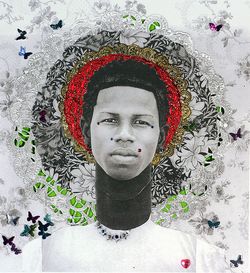
Ebony_500 “Homophobia is the wrong term for what’s going on in Jamaica because there’s no fear of gays here. The fear is all the other way,” N told me inside an HIV prevention center, one of the few places in Kingston where we could talk without fear of retribution from someone overhearing our conversation. Leaving an upscale Kingston restaurant a few months before, fourteen men had ambushed N and a male colleague in the restaurant’s parking lot. Shouting anti-gay epithets and in clear view of witnesses, the assailants ripped a hole in N’s eye, punched and body-slammed both men, and left them to bleed out on the pavement. “I’m afraid to drive in my own vehicle with another man in the front seat,” said N. “I can pull up to a red light and something can happen. I’m afraid to have any man in my apartment. I’m afraid someone will call me out as gay for using too many hand gestures. Yes, that happens here. Anything can be used to call a man gay, on the street or in the neighborhood.”

This fear of being identified as gay may have even contributed to Jamaica’s rising incidence of colon cancer. Jamaican men often refuse digital rectal examinations out of fear the procedure will result in an allegation of homosexuality, health officials have complained to local media. Until a few years ago, private apartment parties in Kingston were common places for gay Jamaicans to meet, but after mobs attacked several gay parties they are now considered too dangerous. Today, occasional street dance parties with a high security presence and, for those who can afford to travel, chance encounters at gay events abroad comprise the few venues where gay Jamaicans can openly socialize.

More here.

Thursday, December 16, 2010

Lifetime Medical Costs of Obesity: Prevention No Cure for Increasing Health Expenditure

Pieter H. M. van Baal, Johan J. Polder, G. Ardine de Wit, Rudolf T. Hoogenveen, Talitha L. Feenstra, Hendriek C. Boshuizen, Peter M. Engelfriet, and Werner B. F. Brouwer in PLoS Medicine:

Background

Obesity is a major cause of morbidity and mortality and is associated with high medical expenditures. It has been suggested that obesity prevention could result in cost savings. The objective of this study was to estimate the annual and lifetime medical costs attributable to obesity, to compare those to similar costs attributable to smoking, and to discuss the implications for prevention.

Methods and Findings

Cigarette-Smoking With a simulation model, lifetime health-care costs were estimated for a cohort of obese people aged 20 y at baseline. To assess the impact of obesity, comparisons were made with similar cohorts of smokers and “healthy-living” persons (defined as nonsmokers with a body mass index between 18.5 and 25). Except for relative risk values, all input parameters of the simulation model were based on data from The Netherlands. In sensitivity analyses the effects of epidemiologic parameters and cost definitions were assessed. Until age 56 y, annual health expenditure was highest for obese people. At older ages, smokers incurred higher costs. Because of differences in life expectancy, however, lifetime health expenditure was highest among healthy-living people and lowest for smokers. Obese individuals held an intermediate position. Alternative values of epidemiologic parameters and cost definitions did not alter these conclusions.

Conclusions

Although effective obesity prevention leads to a decrease in costs of obesity-related diseases, this decrease is offset by cost increases due to diseases unrelated to obesity in life-years gained. Obesity prevention may be an important and cost-effective way of improving public health, but it is not a cure for increasing health expenditures.

More here.

Supermax Torture in America

Lance Tapley in the Boston Review:

Tapley_35_6_james James, who is in his twenties, has been beaten all his life, first by family members: “I was punched, kicked, slapped, bitten, thrown against the wall.” He began seeing mental-health workers at four and taking psychiatric medication at seven. He said he was bipolar and had many other disorders. When a doctor took him off his meds at age eighteen, he got into “selling drugs, robbing people, fighting, burglaries.” He received a twelve-year sentence for robbery. Of the four years James had been in prison when I met him, he had spent all but five months in solitary confinement. The isolation is “mental torture, even for people who are able to control themselves,” he said. It included periods alone in a cell “with no blankets, no clothes, butt-naked, mace covering me.” Everything James told me was confirmed by other inmates and prison employees.

James’s story illustrates an irony in the negative reaction of many Americans to the mistreatment of “war on terrorism” prisoners at Guantánamo. To little public outcry, tens of thousands of American citizens are being held in equivalent or worse conditions in this country’s super-harsh, super-maximum security, solitary-confinement prisons, or in comparable units of traditional prisons. The Obama administration— somewhat unsteadily—plans to shut down the Guantánamo detention center and ship its inmates to one or more supermaxes in the United States, as though this would mark a substantive change. In the supermaxes inmates suffer weeks, months, years, or even decades of mind-destroying isolation, usually without meaningful recourse to challenge the conditions of their captivity. Prisoners may be regularly beaten in cell extractions, and they receive meager health services. The isolation frequently leads to insane behavior including self-injury and suicide attempts.

More here.

Poems of the Night by Jorge Luis Borges

Patrick Kurp in The Quarterly Conversation:

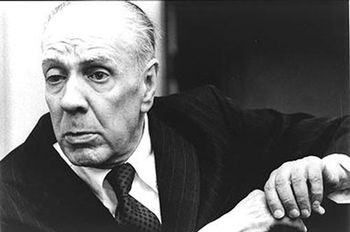
Jorge-luis-borges Borges—as with Aristotle, one name will do—migrated to North American shores early in the 1960s and was identified by critics as a doubly exotic species—a “Latin American” and a spinner of such metaphysical tales as “Funes the Memorious,” “The Library of Babel” and “Tlön, Uqbar, Orbis Tertius.” The field-guide classification has largely stuck. With Beckett and Nabokov, he has been taxonomized as a senior precursor to the trendy “meta-fiction” practiced half a century ago by such juniors as John Barth and Donald Barthelme. Without benefit of his Argentine context, critics have misunderstood this deeply tradition-minded and allusive writer, and failed to notice we had a major poet on our hands, an elegant Spanish-language alternative to the odious Pablo Neruda.

Born in 1899, Borges began writing poems as a boy and published his first volume of verse, Fervor de Buenos Aires, in 1923, a decade before he started writing his best-known ficciones. Throughout his life (he died in 1986) Borges deemed himself principally a poet, secondarily a writer of fiction. In his prologue to a revised edition of Fervor (1969), Borges said he had “moderated its baroque excesses” and “eliminated sentimentality and haziness.” He declined to renounce his younger self, however, and said: “At the time, I was seeking out late afternoons, drab outskirts, and unhappiness; now I seek mornings, the center of town, peace.”

More here.

WikiLeaks: Where’s the Oil?

Charlotte Dennett in the Huffington Post:

Charlottedennett My father, the late Daniel C. Dennett, worked under diplomatic cover as U.S. cultural attaché in Lebanon for the Office of Strategic Services and later the Central Intelligence Group. He had been recruited because of his Harvard education in European History and Islam and his invaluable post-graduate education during the 1930s teaching English to Arabs at the American University of Beirut. In 1943, just prior to his departure for Beirut, he issued a warning to an audience of academics: “God help us if we ever send troops to the Middle East.” And yet, once immersed in his espionage work, he found himself having to play the Great Game for Oil. That same year, 1943, he wrote an “Analysis of Work” (which I later released to The Village Voice) where he wrote — thanks to the inattention of some CIA-redactor who missed this line — that the oil of Saudi Arabia was so important that it “must be controlled at all costs.” And when he said “all costs” he wasn't kidding. He had been trained to anticipate a post-war “free for all” among America's former WW II allies in their quest for Arab oil. His involvement in trying to secure the greatest oil reserves in the Middle East for the U.S. — the oil of Saudi Arabia — would cost him his life, as well as the lives of tens of millions of Arabs and Jews. But that is another story.

I never knew my father. He died under mysterious circumstances following a top secret mission to Saudi Arabia in 1947, when I was six weeks old. But I've done a lot of digging, and I invite you to go to the Voice article where you will find a World War II era government map that I obtained from the national archives in Maryland that says this: “World War II is largely a war by and for oil.”

More here.

Thursday Poem

The Dream

The tortoise had been, back then, the emblem of what
we’d always been told: Take your home with you,

she said, wherever you go. And that’s what we did—
what we had to do—back then when everything

disassembled, our belongings scattered in the yard.
We gathered, you remember. But that was elsewhere

and long ago. Now you’re packing and moving on
to the Midwest, a thousand miles from the ocean

and these days I walk into the New York morning
and carry a past I know by heart exactly but cannot find

the words to tell. In the dream, I walk the sands
of San Francisco and little Alcatrazes, slow-clawed

and cracked-shelled, wash onto the shoreline at night.

by Sarah V. Schweig
from The Boston Review
September/October 2010

The King’s Speech

From The Telegraph:

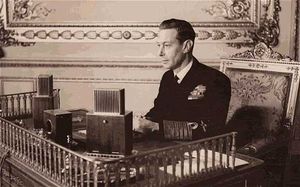
King-after-broadca_1785869c Albert Frederick Arthur George, King of the United Kingdom and the British Dominions and the last Emperor of India, woke suddenly. It was just after 3am. His bedroom in Buckingham Palace was normally a haven of piece and quiet, but this morning his slumbers had been interrupted by the crackle of loudspeakers being tested on Constitution Hill. “It was so loud one of them might have been in our room,” he wrote in his diary. And then, just when he was finally dropping back off to sleep, the marching bands started.

It was May 12, 1937, and the 41-year-old King George VI, father of the present Queen, was preparing for one of the most nerve-racking days of his life. He had acceded to the throne five months earlier after his elder brother, King Edward VIII, abdicated to marry Wallis Simpson, a twice-divorced American, plunging the monarchy into one of the worst crises in its history. Today, the reluctant monarch was to be crowned in Westminster Abbey. The coronation, a piece of national pageantry unmatched anywhere in the world, would have been daunting enough for anyone, but King George – known to the royal family as Bertie – had good reason to be anxious: he suffered from a chronic stammer that turned the simplest of conversations into a challenge and a public speech into a terrifying ordeal. Words beginning with the letter 'k' – as in king – proved a particular problem: confronted with one, he would struggle to make any sound at all, leaving an awkward silence.

More here.

Myths of the American Revolution

From The Smithsonian:

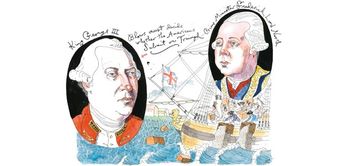
War We think we know the Revolutionary War. After all, the American Revolution and the war that accompanied it not only determined the nation we would become but also continue to define who we are. The Declaration of Independence, the Midnight Ride, Valley Forge—the whole glorious chronicle of the colonists’ rebellion against tyranny is in the American DNA. Often it is the Revolution that is a child’s first encounter with history. Yet much of what we know is not entirely true. Perhaps more than any defining moment in American history, the War of Independence is swathed in beliefs not borne out by the facts. Here, in order to form a more perfect understanding, the most significant myths of the Revolutionary War are reassessed.

I. Great Britain Did Not Know What It Was Getting Into

In the course of England’s long and unsuccessful attempt to crush the American Revolution, the myth arose that its government, under Prime Minister Frederick, Lord North, had acted in haste. Accusations circulating at the time—later to become conventional wisdom—held that the nation’s political leaders had failed to comprehend the gravity of the challenge. Actually, the British cabinet, made up of nearly a score of ministers, first considered resorting to military might as early as January 1774, when word of the Boston Tea Party reached London. (Recall that on December 16, 1773, protesters had boarded British vessels in Boston Harbor and destroyed cargoes of tea, rather than pay a tax imposed by Parliament.) Contrary to popular belief both then and now, Lord North’s government did not respond impulsively to the news. Throughout early 1774, the prime minister and his cabinet engaged in lengthy debate on whether coercive actions would lead to war. A second question was considered as well: Could Britain win such a war?

More here.

The Science Wars Redux

Fifteen years after the Sokal Hoax, attacks on “objective knowledge” that were once the province of the left have been taken up by the right.

Michael Bérubé in Democracy:

What, you ask, was the Sokal Hoax? While I was chatting with my colleagues at the Postmodern Science Forum, New York University physicist Alan Sokal, having read Higher Superstition, decided to try an experiment. He painstakingly composed an essay full of (a) flattering references to science-studies scholars such as Ross and Stanley Aronowitz, (b) howler-quality demonstrations of scientific illiteracy, (c) flattering citations of other science-studies scholars who themselves had demonstrated howler-quality scientific illiteracy, (d) questionable-to-insane propositions about the nature of the physical world, (e) snippets of fashionable theoretical jargon from various humanities disciplines, and (f) a bunch of stuff from Bohr and Heisenberg, drawing object lessons from the uncertainty at the heart of quantum mechanics. He then placed a big red bow on the package, titling the essay “Transgressing the Boundaries: Toward a Transformative Hermeneutics of Quantum Gravity.” The result was a very weird essay, a heady mix–and a shot heard ’round the world. For Sokal decided to submit it to the journal Social Text, where it wound up in a special issue edited by Ross and Aronowitz on . . . the “Science Wars.” Yes, that’s right: Social Text accepted an essay chock-full of nonsense and proceeded to publish it in a special issue that was designed to answer the critics of science studies–especially, but not exclusively, Gross and Levitt. It was more than a great hoax on Sokal’s part; it was also, on the part of Social Text, one of the great own-foot-shootings in the history of self-inflicted injury.

More here.

Metaphysics, history and a hermaphrodite

Shabnam Mahmood interviews H. M. Naqvi for the BBC:

How does it feel to be shortlisted for the DSC Prize?

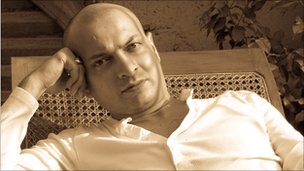
_50420811_processed-0028 It feels wonderful – I have been writing since the age of five and will continue to do so until I die. Although it's lovely to be acknowledged, I write because it allays my anxiety. I write 300 words of prose a day so I can contend with myself. I guess my reasons for writing are very personal.

Homeboy is your debut novel – tell us a bit about the story?

It's based around three Pakistanis from different regions of the country. It's set post 9/11 because I wanted to write about the changes in the US after the attack on the twin towers. The events take you from Karachi to New York. It's a coming of age story of a young male trying to blend into a new and different world – a world removed from his life in Karachi. So it deals with grave issues yet there are comedic elements to it. The idea was to fuse different genres and styles so there's Punjabi, there's Yiddish, Spanish and even Urdu in the texture of the language.

Is your own personality reflected in this novel?

I think all novels, especially debut novels, are autobiographical. I was in America in the wake of the tragedy. It was an unsettled time. And as a writer, one writes to make sense of one's self and the world. But Homeboy is not a memoir. It is fiction, a permutation of reality. If I am compelled to assign a percentage to the autobiographical component of Homeboy, it would be 14%.

I like to think the three main characters are facets of my persona. At the same time, they are amalgams of people I know, people I care about. I could conceivably introduce you to AC [character in Homeboy], who in the flesh is also larger than life.

More here.

Wednesday, December 15, 2010

The Holocaust We Don’t See: Lanzmann’s Shoah Revisited

Shoah_jpg_470x367_q85More on Shoah 25 years later by Timothy Snyder in the New York Review blog:

Lanzmann’s aim was to bring the viewer into contact with the seemingly impossible, the unqualified nothingness of mass death, which he called, in a term that is inextricable from Sartre, “le néant.” During the last quarter century, libraries and archives have paid homage to his film by collecting or recording tens of thousands of video testimonies of Holocaust survivors. These are a precious record of individual lives and a valuable bulwark against forgetting, but they present difficulties as material for historians. Very few of them have been transcribed, and watching them all is simply impossible.

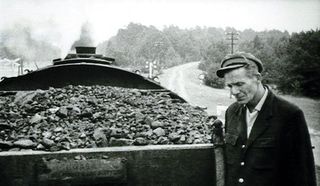
The leap to the visual has temporal costs for students of the Holocaust, of which the nine hours of Shoah are only a small taste; the written word has its advantages as a medium, and history (and so perhaps memory) depends upon it. Lanzmann’s marvelous work of research and selection leaves us with scenes around which the memory of the Holocaust has been framed: the former SS-man Franz Suchomel recalling Treblinka to the hidden camera, the calm mien of Treblinka survivor Richard Glazar as he describes the death facility, the Polish railway engineer Henryk Gawkowski’s gesture of a finger across the throat. The hundreds of thousands of hours of Holocaust video testimonies that we now have, precious though each of them is, are not arranged with such artistry and will never be edited with such skill. It is to be hoped that a benefactor will appear who will fund a team of historians, translators, and lawyers to select, transcribe and annotate some of this priceless material. This would add much to the value of the indexes and finding aides already compiled with much labor.

In Shoah, Lanzmann pays tribute to history in his conversations with Raul Hilberg, the man who wrote the first serious scholarly study of the Holocaust. We are reminded, watching Hilberg speak, of his heroic empiricism, his ability to confirm mass killing on the basis (for example) of records of one-way conveyance by rail. Yet between the scholarship of an extremely cautious institutional historian such as Hilberg and Lanzmann’s visual reconstruction of the Holocaust lies a world of valuable written material about the lives and deaths of Jews—much of it, twenty-five years later, still little used.

The Politics Behind Julian Assange’s Arrest

232px-Naomi_Wolf_at_the_Brooklyn_Book_Festival Amanda Marcotte has noted that we should be able to entertain multiple ideas at once. a) Julian Assange does great work fighting government secrecy; b) He is facing some serious allegations of sexual misconduct for which he deserves a fair trial; c) There are reasons to worry that justice has been politicized; d) It's even possible, though as yet unproven, that Assange's enemies somehow contrived to get him charged; e) Even if the charges are politically motivated, it doesn't necessarily mean they are unfounded. Naomi Wolf suggests reasons to believe that the charges are politically motivated (photo from Wikipedia):

As I have been making the case on media outlets in the past few days that the British and Swedish sex crime charges related actions against Julian Assange are so extraordinarily and unprecedentedly severe — compared to how prosecutors always treat far more cut-and-dry allegations than those in question in this case worldwide, including in the Scandinavian countries, and that thus the pretext of using these charges against Assange is a pimping of feminism by the State and an insult to rape victims — I have found myself up against a bizarre fantasy in the minds of my (mostly male) debating opponents.

The fantasy is that somehow this treatment — a global manhunt, solitary confinement in the Victorian cell that drove Oscar Wilde to suicidal despair within a matter of days, and now a bracelet tracking his movements — is not atypical, because somehow Sweden must be a progressively hot-blooded but still progressively post-feminist paradise for sexual norms in which any woman in any context can bring the full force of the law against any man who oversteps any sexual boundary.

Well, I was in Norway in March of this year at a global gathering for women leaders on International Women's Day, and heard extensively from specialists in sex crime and victims' rights in Sweden. So I knew this position taken by the male-dominated US, British and Swedish media was, basically, horsesh-t. But none of the media outlets hyperventilating now about how this global-manhunt/Bourne-identity-chase-scene-level treatment of a sex crime allegation originating in Sweden must be 'normative' has bothered to do any actual reporting of how rape — let alone the far more ambiguous charges of Assange's accusers, which are not charges of rape but of a category called 'sex by surprise,' which has no analog elsewhere — is actually prosecuted in Sweden.

Guess what: Sweden has HIGHER rates of rape than other comparable countries — including higher than the US and Britain, higher than Denmark and Finland — and the same Swedish authorities going after Assange do a worse job prosecuting reported rapes than do police and the judiciary in any comparable country. And these are flat-out, unambiguous reported rape cases, not the 'sex by surprise' Assange charges involving situations that began consensually.

Indeed, the Swedish authorities — who are now being depicted as global feminist sex-crime-avenger superheroes in blue capes — were shamed by a 2008 Amnesty International report, “Case Closed”, as being far more dismissive of rape, and far more insulting to rape victims who can be portrayed as 'asking for it' by drinking or any kind of sexual ambiguity — than any other country in their comparison group.

Bella Akhmadulina, Bold Voice in Russian Poetry, Dies at 73

30akhmadulina1-articleInline I missed this a couple of weeks ago. William Grimes in the NYT:

Bella Akhmadulina, a poet whose startling images and intensely personal style, couched in classical verse forms, established her as one of the Soviet Union’s leading literary talents, died on Monday at her home in Peredelkino, outside Moscow. She was 73.

Her death was reported by the Russian news agency Itar-Tass, which quoted her husband, Boris Messerer, as saying that she had had a heart attack.

Ms. Akhmadulina came to prominence during the post-Stalin thaw, when a loosening of censorship led to a flowering of the arts. Along with the poets Yevgeny Yevtushenko (her first husband) and Andrei Voznesensky, she became one of the bold new voices in contemporary Russian literature, attracting ecstatic audiences of thousands to readings at concert halls and stadiums.

Her poetry was resolutely apolitical, making her a target of official criticism. Her early poems, usually in rhymed quatrains, offered random observations on everyday life — buying soda from a vending machine, coming down with the flu — in dense, allusive language enriched by coined words and archaisms. A sprightly sense of humor and an audacious way with images marked her from the outset as a distinctive talent.

“More and more severely the shivering/Lashed me, drove sharp, small nails into my skin,” she wrote in one of her most famous poems, “A Chill” (sometimes translated as “Fever”). “It was like a hard rain pelting/An aspen and scourging all its leaves.”

Later, she turned to longer forms in works like “My Genealogy” and “Tale About the Rain,” both published in the collection “Music Lessons” (1969), or short poems laced into a sequence, notably in the collections “The Secret” (1983) and “The Garden” (1987).

Her themes, as she matured, became more philosophical, even religious, or they dwelled on the nature of poetic language. “O magic theater of a poem,/spoil yourself, wrap up in sleepy velvet./I don’t matter,” she wrote in one characteristic verse.

Although apolitical as a poet, she openly supported persecuted writers like Boris Pasternak and Aleksandr Solzhenitsyn and political dissidents like Andrei D. Sakharov. In 1979, she fell out of favor by contributing a short story to Vasily Aksyonov’s unofficial collection Metropol, a transgression that froze her already chilly relations with the government.

Despite her shaky official reputation, she was always recognized as one of the Soviet Union’s literary treasures and a classic poet in the long line extending from Lermontov and Pushkin.